


More DNA in the Blood May Strengthen Cancer Signals: An Indian Study Challenges an Assumption in Early Detection
Today in Science | TIS 004 | 26 November 2026
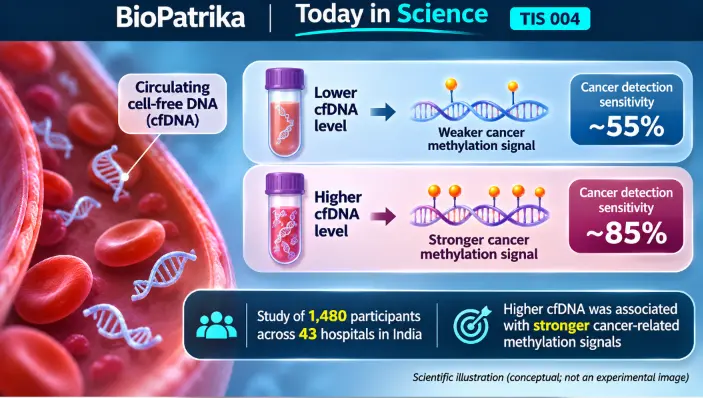
A blood test designed to detect cancer faces a fundamental challenge: finding a small amount of tumour-derived DNA among the much larger pool of DNA fragments released by healthy cells. An increase in this background DNA would ordinarily be expected to dilute the cancer signal, making detection more difficult. However, a new Indian multicentre study published in Proceedings of the National Academy of Sciences (PNAS) has reported an unexpected association. Higher concentrations of circulating cell-free DNA (cfDNA) in the blood were associated with stronger cancer-related DNA methylation signals and improved cancer detection sensitivity, including in patients with early-stage disease.
The study, titled Rising cell-free DNA level tracks cancer-associated methylation signal and improves multicancer detection, was published online on 3 November 2026 and appeared in the 10 November issue of PNAS. Researchers analysed blood samples from 1,480 previously untreated participants recruited through 43 hospitals across India. The cohort included 950 patients with 14 types of solid cancer, 80 individuals with symptomatic benign lesions and 450 healthy controls. The findings offer a new perspective on the relationship between tumour biology, immune-cell activity and the molecular signals that can be detected through a blood sample.
Understanding the DNA signals circulating in blood
Cells continuously release small fragments of DNA into the bloodstream as part of normal cellular turnover. These fragments, collectively known as cell-free DNA, originate from different tissues and cell types. In healthy individuals, a substantial proportion comes from immune cells and other blood-forming cells. In people with cancer, tumour cells also release DNA fragments into circulation. These tumour-derived fragments are known as circulating tumour DNA (ctDNA).
Although ctDNA represents only a fraction of the total cfDNA in many patients, it can carry molecular alterations that distinguish cancer cells from normal cells. These include genetic mutations, changes in DNA methylation and characteristic patterns of DNA fragmentation.
DNA methylation is an epigenetic modification in which methyl groups are added to DNA, commonly at cytosine bases within CpG sites. It does not change the underlying DNA sequence but can influence gene activity and cellular identity. During cancer development, normal patterns of DNA methylation become disrupted. Some genomic regions acquire excessive methylation, while others lose it. These changes contribute to abnormal gene regulation and can generate molecular signatures that distinguish tumour-derived DNA from DNA released by healthy tissues.
Liquid-biopsy technologies attempt to identify these tumour-associated signatures in blood without requiring an invasive tissue biopsy. Among the approaches being investigated, methylation-based assays are particularly promising because they can detect patterns across multiple genomic regions rather than relying on a single mutation. This may be useful for identifying cancers that do not carry a common, easily detectable genetic alteration.
However, the interpretation of cfDNA concentration has remained challenging. Cancer patients frequently have higher total cfDNA levels than healthy individuals, and much of this increase appears to originate from non-tumour cells, particularly leukocytes. If the amount of DNA released by these cells increases independently of tumour-derived DNA, the cancer-specific signal should become diluted.
The PNAS study investigated whether this assumption accurately reflects what happens in patients.
An unexpected relationship between cfDNA concentration and cancer detection
The researchers used targeted enzymatic methylation sequencing to examine blood-derived cfDNA across approximately 550,000 genomic regions. They also identified 10,225 genomic regions that showed increased methylation in tumour tissues compared with normal or adjacent healthy tissues, using reference data from The Cancer Genome Atlas.
The analysis revealed that higher total cfDNA concentration was associated with an increased proportion of DNA fragments carrying cancer-associated hypermethylation signatures. Importantly, this relationship remained significant after accounting for cancer type, disease stage, age, sex, body mass index, tobacco and alcohol use, and several technical variables associated with sample processing and sequencing.
One striking observation was that total cfDNA concentration explained 19.1% of the variation in cancer-associated hypermethylation scores, compared with 15.2% explained by disease stage alone. This suggests that the quantity of DNA circulating in the bloodstream may provide information about the biological processes associated with cancer beyond conventional measures of tumour burden.
The researchers then examined whether this relationship translated into differences in cancer detection sensitivity. A classifier was trained using methylation features and evaluated in an independent validation cohort. The analysis was performed at a prespecified specificity threshold of 99% in the training data.
Among patients with stage I cancer, detection sensitivity increased from 55% in the lowest cfDNA concentration group to 85% in the highest. For stage II disease, sensitivity increased from 59% to 86%. These findings suggest that patients with similar disease stages can have substantially different levels of detectable cancer-associated molecular signals in their blood.
The study also found a similar, although weaker, relationship in individuals with symptomatic benign lesions. This observation is particularly interesting because it suggests that the association between cfDNA concentration and methylation patterns may reflect a broader biological response to abnormal tissue growth or inflammation, rather than being exclusive to malignant disease.
The precise biological mechanism remains unresolved. The authors propose that immune-cell activity and tumour-associated processes may be linked, potentially allowing the release of non-tumour-derived DNA and the appearance of cancer-associated methylation signals to rise together. However, the study demonstrates an association, not a direct causal mechanism. It does not establish that immune-cell activity itself produces the tumour-associated methylation changes.
What does this mean for the future of cancer detection?
The findings have implications for the development and evaluation of multi-cancer early detection (MCED) tests. Such tests aim to identify molecular signals associated with multiple cancers through a single blood sample, potentially providing an additional route to detecting cancers for which population screening options are limited.
A major challenge in evaluating these technologies is the variation in sensitivity between studies, particularly for early-stage cancers. The researchers suggest that differences in cfDNA concentration across study populations could contribute to this variation. Incorporating cfDNA concentration as a stratification variable may therefore improve the interpretation and comparison of cancer-detection performance across different cohorts.
However, important limitations must be considered before translating these findings into screening claims. Most cancer cases in the study were identified through routine clinical care rather than population screening, meaning that many participants had symptomatic disease. The authors acknowledge that early-stage symptomatic tumours may have different biological characteristics from small, asymptomatic tumours detected through screening. Consequently, the observed sensitivity differences may not apply directly to healthy populations undergoing routine cancer screening.
The study also did not establish the biological mechanism responsible for the relationship, and cfDNA measurement methods will need greater standardisation. Prospective validation in asymptomatic screening populations will be essential to determine whether these findings improve real-world early detection.
There is also an important disclosure regarding the research: most authors were employees of Strand Life Sciences, a Bengaluru-based company involved in the development of cancer-detection technologies, and the paper reports relevant financial and patent interests. This does not invalidate the findings, but independent validation will be particularly important as the field moves towards clinical implementation.
The study represents a valuable contribution from Indian researchers to the rapidly developing field of liquid biopsy. Its most important message may not be that more DNA automatically means better cancer detection, but that the composition and biological context of circulating DNA matter as much as its quantity.
Understanding how tumour biology, immune responses and epigenetic changes interact in the bloodstream could help researchers develop more reliable approaches to detecting cancer earlier. The next challenge is to establish whether these insights can translate into accurate, clinically useful screening tools that improve outcomes for people without symptoms.