


Metabolomics Study Reveals Plant Defense Mechanisms in Withania somnifera Against Insect Attack
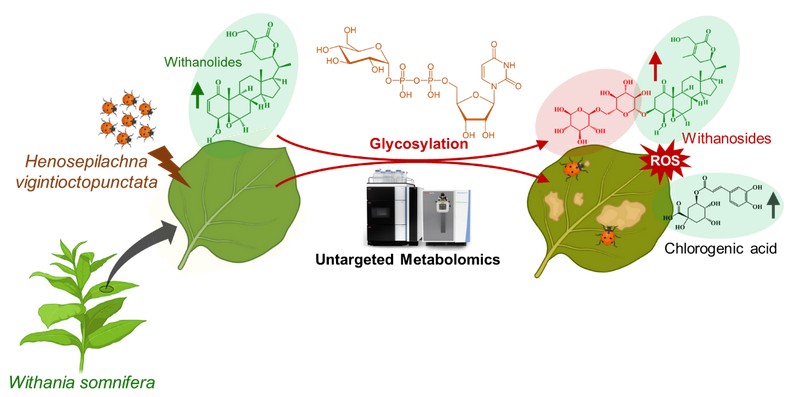
Research Summary: This study demonstrates herbivory-induced metabolic reprogramming in Withania somnifera, characterized by increased withanosides and phenylpropanoid accumulation, and highlights their roles in plant defense and potential insecticidal activity.
Researcher Spotlight

Anoop Kumar Verma is a Ph.D. researcher working in the field of Plant Metabolomics. His research explores metabolic reprogramming in the model plant Arabidopsis thaliana and the medicinal plant Withania somnifera under various biotic and abiotic stresses using multi-platform analytical techniques.
Researchgate: https://www.researchgate.net/profile/Anoop-Kumar-Verma-2
https://scholar.google.com/citations?user=UR4ozBoAAAAJ&hl=en
Linkedin: www.linkedin.com/in/anoop-kumar-verma
Twitter: https://x.com/anoopverma2698
Instagram: Instagram.com/anoop_2698
Lab: Dr. Ratnasekhar CH, CSIR-Central Institute of Medicinal and Aromatic Plants, Lucknow
Lab website: https://www.ratnasekhar-metabolomics-lab.com/
What was the core problem you aimed to solve with this research?
The core problem addressed in this research was the limited understanding of how medicinal plants like Withania somnifera respond to insect herbivory at the metabolic level. While withanolides are well known for their pharmacological importance, their functional role in plant defense, particularly under biotic stress, remains insufficiently explored. This study aimed to elucidate the metabolic reprogramming triggered by insect attack and to identify key defense-related metabolites, especially withanosides and phenylpropanoids, along with their potential role in plant-insect interactions and insecticidal activity.
“This work provides important insights into plant defense metabolism, highlighting how specialized metabolites mediate plant-insect interactions with broader implications for sustainable agriculture.” – Dr. Ratnasekhar CH
How did you go about solving this problem?
To address this problem, we employed a comprehensive metabolomics-based approach by subjecting Withania somnifera plants to controlled insect herbivory using Henosepilachna vigintioctopunctata (ladybird beetle) infestation. We performed extensive physiological, morphological, and biochemical analyses to characterize changes in Withania leaves under herbivory stress.
Further, metabolic profiling was carried out using UPLC-MS/MS and GC-MS platforms to capture both secondary and primary metabolites. The generated data were analyzed using multivariate statistical and chemometric tools, which revealed significant metabolic changes, particularly the induction of withanolide glycosylation and phenylpropanoid pathways. In addition, gene expression analysis supported pathway-level interpretations, with wsGTL1, wsGTL6, and PAL genes showing upregulated expression, consistent with the metabolomics findings.
We also examined beetle tissues using SIM-MS to assess the presence of plant-derived metabolites, suggesting their possible insect-active potential. Furthermore, we evaluated the biological activity of Withania somnifera leaf extracts containing these metabolites, which demonstrated toxic effects of withanolides, including reduced survival and feeding, gut leakage, and decreased acetylcholinesterase activity in the beetles.
Overall, this integrated approach enabled us to comprehensively link metabolic reprogramming with functional defense responses in Withania somnifera under insect herbivory.
How would you explain your research outcomes (Key findings) to the non-scientific community?
Plants are known for producing unique natural compounds that give them specific biological activities and contribute to their importance in human health and medicine. These compounds also help plants establish and survive under diverse environmental conditions. The medicinal plant Withania somnifera (Ashwagandha) is well known for its unique bioactive compounds, particularly withanolides.
In our study, we explored how this medicinal plant Withania somnifera (Ashwagandha) defends itself when attacked by insects. When insects feed on the plant, it alters its internal chemistry and produces higher levels of certain natural compounds, particularly withanosides and phenylpropanoids, which aid in its defense. We also found that some of these compounds can directly affect the insects by reducing their feeding and survival. This suggests that the same molecules known for their health benefits in humans may also play an important role in protecting the plant in its natural environment.
Overall, our research highlights that plants have their own defense systems and produce bioactive compounds not only for medicinal value but also for survival under environmental challenges.
What are the potential implications of your findings for the field and society?
The findings of this study have important implications for both the scientific community and society. From a research perspective, this work advances our understanding of plant defense mechanisms by highlighting the role of specialized metabolites, particularly withanosides, in response to insect herbivory. It also demonstrates the power of integrated metabolomics approaches in uncovering complex biological processes.
From a broader perspective, these insights may contribute to the development of sustainable crop protection strategies by utilizing naturally occurring plant compounds as alternatives to synthetic pesticides. Additionally, understanding how medicinal plants regulate the production of bioactive metabolites under stress could aid in improving their quality and therapeutic value.
Overall, this research bridges plant biology, ecology, and pharmacology, offering potential applications in agriculture, natural product research, and human health.
What was the exciting moment during your research?
There were many exciting moments during this research. For example, we explored the feeding specificity of the insect through selection assays by offering it different medicinal, aromatic, and model plants. However, one particular moment stood out during the course of this work.
Our initial hypothesis was that, although plants mount a defense response involving metabolic reprogramming, the beetle is able to efficiently metabolize these compounds. To investigate this, we performed SIM-based analysis of beetle tissues. At that time, the Orbitrap LC-MS system was newly established in our laboratory, and I was optimizing different methods to detect plant metabolites in their metabolized forms within the insect.
After nearly two weeks of method development and troubleshooting, I was able to detect plant-derived metabolites in their native (unmodified) form in beetle tissues, which was contrary to our original hypothesis. This unexpected result was particularly exciting, as it shifted our perspective and led us to further explore the insect side of the interaction in greater detail.
Paper reference: Verma, A.K., Rakwal, P., Rathor, P., Singh, S., Shivanna, B., Kedar, S.C., Gupta, A.K., Birse, N. and CH, R. (2026), Comprehensive metabolomics reveals defense-driven metabolic reprogramming via withanoside biosynthesis under insect herbivory in Withania somnifera. Plant J, 125: e70771. https://doi.org/10.1111/tpj.70771
New Book Launched – Molecules, Mentors & Mindsets: Building Indian Biopharma
Buy your copy today: https://biopatrika.com/science-society/book-molecules-mentors-mindsets-building-indian-biopharma-biocon/
Book Launch: Molecules, Mentors & Mindsets: Building Indian Biopharma | Biocon Focus
Online Interactive Course on Immunology | Starts form June 2026 | Register Today
Online Interactive Course on Immunology | Starts form June 2026 | Register Today