


DNA Aptamers Restore Antibiotic Effectiveness: New Strategy to Combat Antimicrobial Resistance
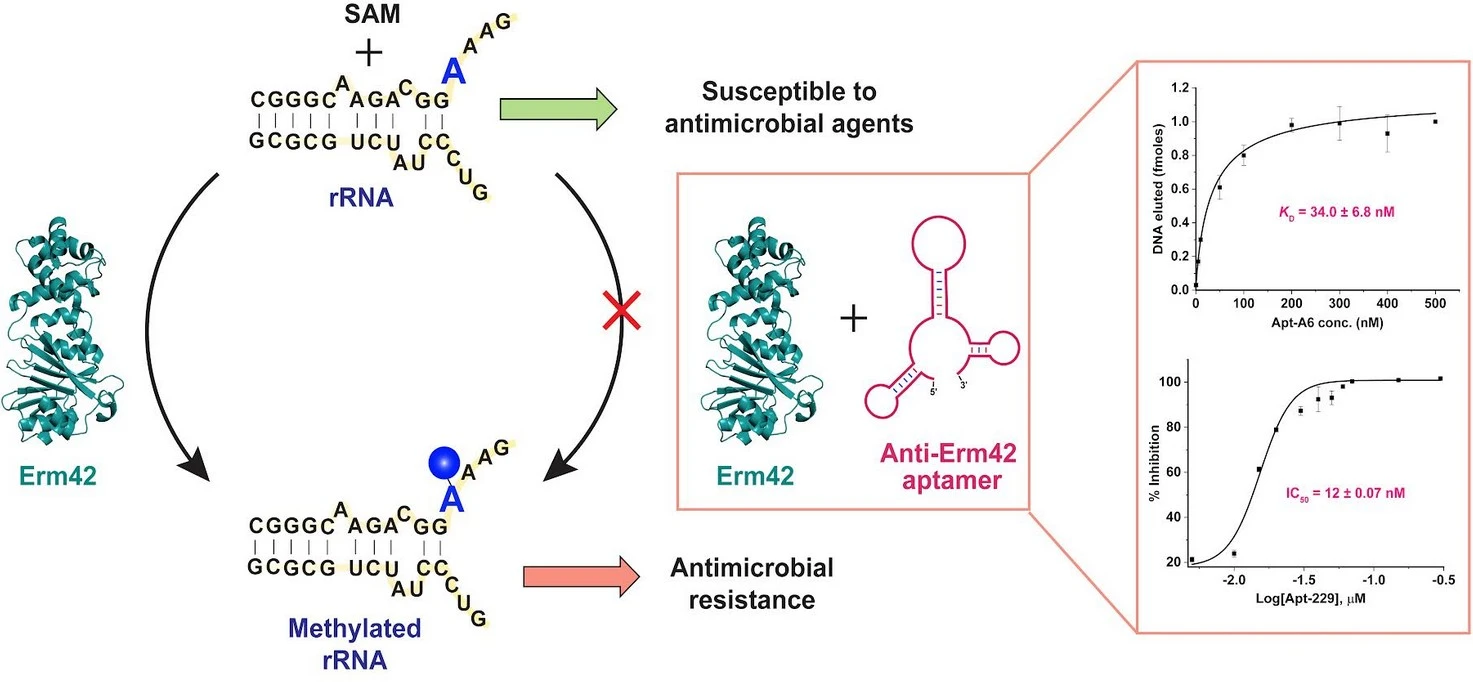
Research Summary: We discovered DNA aptamers against Erm42, a clinically relevant methyltransferase involved in AMR, using SELEX. These aptamers inhibit Erm42 function and restore erythromycin sensitivity.
Researcher Spotlight

Leena Laxmikant Badgujar is a PhD graduate from the Department of Chemistry, IIT Bombay, under the guidance of Prof. Pradeepkumar P. I. Her doctoral work was focused on the discovery of DNA aptamers and small-molecule inhibitors against proteins involved in antimicrobial resistance.
Linkedin https://www.linkedin.com/in/dr-leena-badgujar-558b98126/
Twitter https://x.com/leenabadgujar
Instagram https://www.instagram.com/leenabadgujar_/
Lab PI name: Prof. Pradeepkumar P. I.
University: Indian Institute of Technology Bombay (IIT Bombay)
Lab social media: https://x.com/NACB_IITB
What was the core problem you aimed to solve with this research?
Antibiotics revolutionized modern medicine, yet their effectiveness is increasingly undermined by antimicrobial resistance (AMR). Among the several mechanisms of AMR, the most prevalent resistance mechanism is methylation of adenine specifically at A2058 in 23S rRNA within bacterial ribosome by a class of enzymes called erythromycin-resistant methyltransferases (Erms). This modification blocks the binding of macrolide, lincosamide, and streptogramin B (MLSB) class of antibiotics, rendering these clinically important drugs ineffective. Despite their importance, selective inhibitors against Erms remain scarce. Most existing inhibitors target the highly conserved SAM-binding site shared across methyltransferases, leading to poor specificity. We aimed to develop a highly selective strategy to inhibit Erms without affecting other cellular methyltransferases, addressing a critical need in combating AMR.
How did you go about solving this problem?
Aptamers being specific to its target and could be less susceptible to develop resistance against, we therefore developed a novel aptamer-based strategy for attenuation of Erm-specific mechanism. We carried out an iterative process known as SELEX to discover aptamers against Erm42 from a library of 1014 single-stranded DNA sequences. We found that sequencing of eleventh round’s product resulted in six-eight enriched sequences. These enriched sequences on characterisation showed strong binding affinity as well as methylation inhibition activity against Erm42. To further enhance specificity, we truncated the parent 73mer aptamer, Apt-E1 to a 52mer Apt-E1T based on the DNase I footprinting experiment. The truncated, Apt-E1T, demonstrated high affinity and remarkable specificity toward Erm42, over other DNA/RNA methyltransferases and non-related proteins. This highlighted the power of aptamers as precision inhibitors.
How would you explain your research outcomes (Key findings) to the non-scientific community?
Antibiotics work by binding to a specific region in the bacterial ribosome called the peptide exit tunnel. By blocking this site, antibiotics prevent the nascent peptides to grow, ultimately inhibiting bacterial protein synthesis and killing the bacteria. However, bacteria have evolved clever ways to escape this effect. One such strategy involves methylation of antibiotic binding by Erm enzymes. This small modification prevents the antibiotics from attaching properly, making it ineffective. In our study, we discovered short single-stranded DNA sequences called DNA aptamers that specifically block Erm enzymes. By shutting down this resistance mechanism using DNA aptamers, the antibiotic can bind again at its binding site and do its job. In simple terms, instead of making new antibiotics, our approach restores the effectiveness of existing ones.
What are the potential implications of your findings for the field and society?
Our work highlights DNA aptamers as a promising tool to combat AMR through both therapeutic and diagnostic applications. These aptamers could be developed into combination therapies to restore antibiotic efficacy. Additionally, aptamer-based detection systems could help identify Erm-positive resistant strains in clinical settings, enabling more precise and timely treatment strategies. This approach offers a pathway to revive antibiotics that have lost their effectiveness.
What was the exciting moment during your research?
As the SELEX itself is unpredictable, the very first, most exciting moment was observing the sequence enrichment after analyzing the sequencing results of the eleventh-round product. However, the most rewarding point came when we confirmed that the selected aptamers not only bound Erm42 but also inhibited its methyltransferase activity. Demonstrating the functional validation, particularly with such high specificity toward Erms, was incredibly satisfying and strongly validated our original hypothesis.
Paper reference/citation: Badgujar, L. L., Sahu, D., Anand, R., & Pradeepkumar, P. I. DNA Aptamers Mediated Inhibition of Pathogenic Erm42 Enzyme Involved in Antimicrobial Resistance. ACS Infectious Diseases, 2026, 12(1), 212-223. https://pubs.acs.org/doi/10.1021/acsinfecdis.5c00756
New Book Launched – Molecules, Mentors & Mindsets: Building Indian Biopharma
Buy your copy today: https://biopatrika.com/science-society/book-molecules-mentors-mindsets-building-indian-biopharma-biocon/
Book Launch: Molecules, Mentors & Mindsets: Building Indian Biopharma | Biocon Focus
Online Interactive Course on Immunology | Starts form June 2026 | Register Today
Online Interactive Course on Immunology | Starts form June 2026 | Register Today