

Centre for Cellular and Molecular Platforms and Agilent Technologies Expand Biologics Partnership at BioNEX Confluence 2026
Bengaluru, May 12, 2026. Collaboration, resilience, and scientific innovation were at the forefront of BioNEX Confluence – Phase 2, an event jointly hosted by Centre for Cellular and Molecular Platforms (C-CAMP) and Agilent Technologies in Bengaluru. The gathering brought together leaders from academia, biotechnology startups, pharmaceutical companies, and the broader biologics ecosystem to discuss how advanced analytical technologies and translational partnerships can strengthen India’s rapidly growing biopharmaceutical sector.
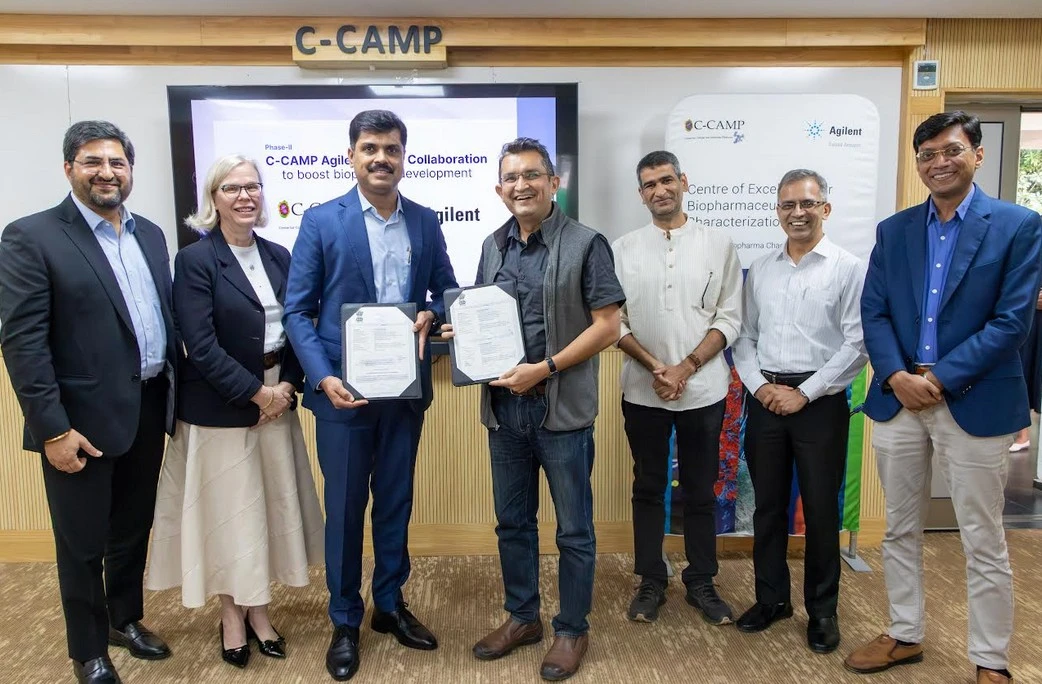
During the event, leadership teams from C-CAMP and Agilent inaugurated a new advanced analytical capability at the Centre of Excellence for Biologics. The facility now houses the Agilent Revident, a next-generation LC/Q-TOF mass spectrometry platform designed for high-resolution characterization in biopharmaceutical research, proteomics, metabolomics, and related analytical sciences. The new infrastructure is expected to strengthen both scientific and quality characterization of biopharmaceuticals in India, while expanding access to advanced analytical technologies for startups, researchers, and industry innovators.
Opening the event, Taslimarif Saiyed reflected on C-CAMP’s evolution since its establishment in 2009 as an initiative supported by India’s Department of Biotechnology. He described the organization as a “midfield player” that bridges academia, industry, translational research, and entrepreneurship to accelerate scientific innovation.
Saiyed emphasized that access to advanced technologies remains essential for democratizing scientific research. Over the years, C-CAMP has established nearly 20 high-end technology platforms spanning microscopy, genomics, flow cytometry, and mass spectrometry. According to him, the organization has supported more than 5000 research projects with 300 peer reviewed publications and trained over 2,200 researchers through intensive hands-on residential programs designed to create highly skilled users of advanced scientific instrumentation.
He also highlighted C-CAMP’s broader innovation ecosystem, which has supported more than 700 startups, facilitated nearly $700 million in funding, and contributed to the commercialization of more than 250 products, including over 30 products that have progressed through USFDA pathways.
A key theme of the event was the growing importance of biologics and biotherapeutics in India’s biotechnology strategy. Saiyed linked the collaboration to the Government of India’s recently announced “BioShakti” initiative, which aims to strengthen national biomanufacturing capabilities. He said the expanded partnership with Agilent would help establish stronger analytical and capability-building infrastructure for biologics research and innovation in India.
The second session featured Satish Kumar from Anthem Biosciences, who discussed the operational and analytical challenges involved in scaling biologics manufacturing in India. He emphasized that quality systems, regulatory compliance, and analytical rigor are becoming decisive factors for Indian pharmaceutical companies seeking global competitiveness.
Kumar described Anthem Biosciences’ expansion from small laboratory-scale bioreactors to large-scale 50,000-liter fermentation systems while maintaining international regulatory standards. He stressed that analytical characterization and process consistency are critical in biologics manufacturing, noting that even identical analytical methods run on instruments from different vendors can produce variations in purity profiles and product characterization. According to him, such challenges highlight the importance of robust analytical infrastructure and quality-driven development strategies in biologics and biosimilars.
One of the most compelling sessions came from Dr. Sawraj Singh of Ikesia Biologics, who shared his entrepreneurial journey through repeated setbacks and recovery in India’s emerging biologics sector.
Singh recounted leaving a multinational corporate career to build startups in fermentation and biologics, first through IOSynth Labs and later Ikesia Biologics. After surviving severe financial pressures during the COVID-19 pandemic, the company faced another major setback when a fire at the Bangalore Bioinnovation Centre destroyed much of its laboratory infrastructure shortly after operations had begun.
In one of the event’s strongest examples of ecosystem-driven support, Singh described how Agilent provided continued access to analytical instruments, consumables, and flexible financial support during the crisis, enabling the startup to continue serving clients despite losing its facilities. He credited the support from Agilent, C-CAMP, and the Bangalore Bioinnovation Centre with helping Ikesia Biologics gradually rebuild its operations and expand into biologics characterization, bioassays, and immunogenicity testing.
The final session was delivered by Iris Mangelschots, who outlined Agilent’s global innovation strategy and its plans for deeper engagement with India’s biologics ecosystem.
Mangelschots said Agilent increasingly views analytical technologies as integrated ecosystems that combine instrumentation, automation, software, artificial intelligence, data workflows, and advanced analytics. She highlighted collaborations with global pharmaceutical companies including Roche, AstraZeneca, and Merck involving automated analytical workflows, AI-enabled method development, and real-time analytical platforms.
She added that Agilent aims to bring similar co-creation models to India through its collaboration with C-CAMP, enabling startups and researchers not only to access advanced technologies but also to participate in shaping future analytical innovation roadmaps.
Following the talks, participants engaged in a panel discussion on biologics manufacturing, analytical infrastructure, translational science, startup growth, and India’s expanding role in global biopharmaceutical innovation. Discussions throughout the event reflected a broader consensus that partnerships between technology providers, research organizations, startups, and industry will play a crucial role in building globally competitive biologics capabilities in India.
The event concluded with a networking lunch, where scientists, entrepreneurs, industry leaders, and researchers continued discussions around future collaborations, technology access, and emerging opportunities within India’s biotechnology ecosystem.
New Book Launched – Molecules, Mentors & Mindsets: Building Indian Biopharma
Buy your copy today: https://biopatrika.com/science-society/book-molecules-mentors-mindsets-building-indian-biopharma-biocon/
Book Launch: Molecules, Mentors & Mindsets: Building Indian Biopharma | Biocon Focus