



Deciphering intersecting MAPK mediated immune modulation in NSCLC through systems perspective
Research Summary: We applied systems immunological modeling to investigate how aberrant MAPK signaling drives tumor progression and immune modulation, identified DUSP1, DUSP4, and SPRY2 as crucial modulators of tumor promoting signaling and macrophage driven immune regulation in NSCLC. Targeted inhibition of these proteins emerges as a promising therapeutic strategy opening new avenues for more effective treatment in lung cancer.
Researcher Spotlight
Ms. Manasi Vithoba Tukrul is a PhD scholar at BRIC-National Centre for Cell Science, under the guidance of Dr. Shailza Singh. Her research focuses on MAPK driven modulation in tumor microenvironment through systems and synthetic biology approaches.
Linkedin: https://in.linkedin.com/in/manasi-tukrul-3123a8208
Lab: Dr. Shailza Singh (Scientist ‘F’), National Centre for Cell Science, Pune
Lab website: https://sysmednccs.mystrikingly.com/
What was the core problem you aimed to solve with this research? Non‑small cell lung cancer (NSCLC) represents nearly 85% of total lung cancer cases, and remains a major global health challenge due to its complex etiology and resistance to therapy. In this study, we reconstructed a mathematical model supported by experimental validation to analyze the intricate regulation of EGFR, FGFR, and TNFR signaling in NSCLC cells and macrophages. Our goal was to dissect the complex dynamic interplay of DUSP1, DUSP4, and SPRY2, which we highlight as critical regulators of tumor promoting signaling tumor microenvironment. Through this integrative approach, we discovered that targeted inhibition of these proteins may disrupt interconnected feedback loops, thereby impairing NSCLC progression and immune modulation.
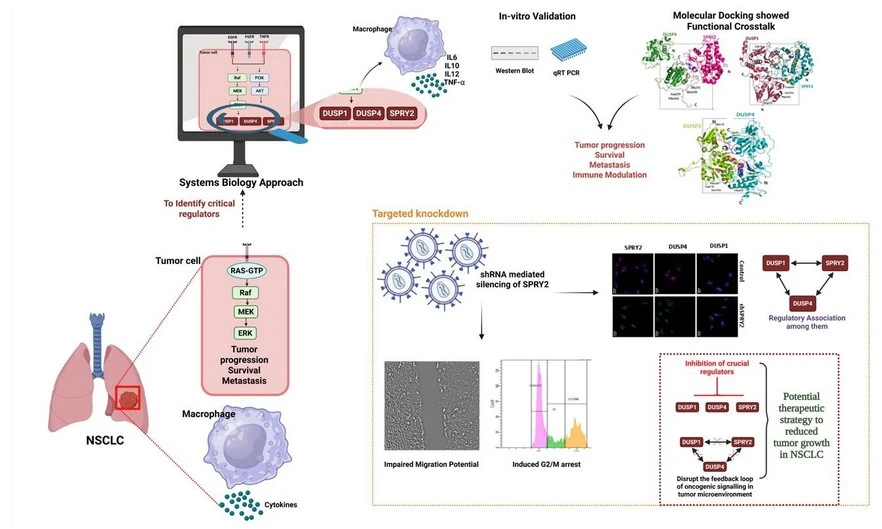
How did you go about solving this problem? We reconstructed a mathematical model to identify crucial regulators of EGFR, FGFR, and TNFR signaling in NSCLC cells initiating IL10, TLR4 signaling in macrophages. Through simulations, principal component analysis and flux evaluation revealed that DUSP1, DUSP4, and SPRY2 as critical high-flux regulators. Crosstalk analysis identified that these proteins form an interconnected signaling axis orchestrating IL6, IL10, IL12, TNF-α production and macrophage dependent modulation in the tumor microenvironment. Further investigation through functional assays demonstrated that silencing SPRY2 suppressed DUSP1 and DUSP4 expression, impeded cell migration, and induced G2/M arrest. These findings uncover a coordinated regulatory association among DUSP1, DUSP4, and SPRY2 that is essential for NSCLC pathogenesis.By integrating systems biology modeling with experimental validation, our study suggests that targeting DUSP1, DUSP4, and SPRY2 may represent an effective therapeutic strategy to disrupt feedback loops and impair NSCLC progression.
“Dissecting tumor microenvironment signaling, engineering synthetic gene circuits, and designing combinatorial therapies offer powerful strategies to attenuate NSCLC progression.” – Dr. Shailza Singh
How would you explain your research outcomes (Key findings) to the non-scientific community?
Lung cancer remains the most frequently diagnosed malignancy worldwide, with approximately 2.5 million new cases reported in 2022, accounting for 12.4% of all cancers. Non‑small cell lung cancer (NSCLC) represents nearly 85% of these cases.
The MAPK pathway, in particular the RAS-RAF-MEK-ERK axis and PI3K-AKT, controls cell survival and proliferation in NSCLC. ERK activation promotes tumor growth by increasing therapy resistance. We explored the intricate communication between NSCLC cells and immune cells that support tumor growth. We identified three powerful signaling molecules orchestrated in interconnected feedback loops, promoting cancer progression. By blocking these key regulators, we were able to reduce cancer cell migration and suppress tumor growth, underscoring a promising avenue for therapeutic intervention.
What are the potential implications of your findings for the field and society?
Our findings shed light on the complex interplay between MAPK-driven signaling in NSCLC cells and macrophages within the tumor microenvironment, revealed through an integrated systems biology approach. We discovered that the modulators DUSP1, DUSP4, and SPRY2 exhibit a coordinated regulatory association. Disrupting these interactions led to cell cycle arrest and a marked reduction in cancer cell migration, highlighting their importance in NSCLC pathogenesis and pointing to new therapeutic opportunities.
From a broader perspective, this study advances the development of more precise cancer treatments by targeting critical signaling regulators, with the potential to improve patient outcomes while minimizing off-target effects. Moreover, it underscores the value of systems-level approaches in paving the way for future personalized therapies for lung cancer patients.
What was the exciting moment during your research?
The most compelling aspect of our study was uncovering the functional interactions among DUSP1, DUSP4, and SPRY2, and observing that the cell line models strongly aligned with the computational predictions. Notably, no previous reports had demonstrated these specific interactions in NSCLC, making our findings particularly novel. Equally important, our systems biology perspective revealed how cancer cells modulate the tumor microenvironment, providing valuable insights that reinforced the strength of this integrative approach. Together, these results highlight the potential of systems biology not only to unravel hidden regulatory networks but also to guide the discovery of novel therapeutic strategies in future.
Paper reference– Tukrul, M., Gulhane, P. & Singh, S. Emergence of Sprouty role from the signaling interplay of DUSP1 and DUSP4 interactions in NSCLC pathogenesis. npj Syst Biol Appl (2026). https://www.nature.com/articles/s41540-026-00740-0
New Book Launched – Molecules, Mentors & Mindsets: Building Indian Biopharma
Buy your copy today: https://biopatrika.com/science-society/book-molecules-mentors-mindsets-building-indian-biopharma-biocon/
Book Launch: Molecules, Mentors & Mindsets: Building Indian Biopharma | Biocon Focus