


Nanoplastics disrupt brain lipidome and mitochondrial redox balance, leading to Parkinson’s disease
Research Summary: Drosophila brain lipidomics reveals nanoplastics alter mitochondrial redox state and lipid composition, impairing neuronal function and behavior, with antioxidant rescue highlighting redox-driven neurotoxicity mechanisms.
Researcher Spotlight
Priya Rathor is a PhD scholar working on Parkinson’s disease using Drosophila, integrating metabolomics, lipidomics, behavioral assays, and mitochondrial studies to investigate environmental neurotoxicity and develop phytochemical neuroprotective strategies.
Google Scholar https://scholar.google.com/citations?user=dOsfPAoAAAAJ&hl=en
ResearchGate https://www.researchgate.net/profile/Priya-Rathor-3
LinkedIn: https://www.linkedin.com/in/priya-rathore
Twitter: https://x.com/priyaratho98796?s=11
Lab: Dr. Ratnasekhar Ch, Senior Scientist, Metabolomics group Leader, CSIR-Central Institute of Medicinal and Aromatic Plants, Lucknow, 226015
Lab social media: Ratnasekhar Omics Lab | Metabolomics
What was the core problem you aimed to solve with this research?
Nanoplastics are increasingly detected in the environment and even in decedent human brain tissues (Nature Medicine) interestingly more concentrations were found in subjects having various neurological disorders. 50% of Brain dry mass is occupied by lipids but how environmentally their impact on brain lipid metabolism, which is linked to neurodegeneration, remains explored. We aimed to determine how nanoplastic exposure alters the brain lipidome and whether these changes contribute to Parkinson’s disease-like neurodegeneration.
How did you go about solving this problem?
We used Drosophila melanogaster as an in vivo model and subjected them to chronic exposure to polystyrene nanoplastics. An integrated approach combining high-resolution brain lipidomics, mitochondrial function assays, redox analysis, stable isotope tracing, neurotransmitter measurements, and behavioral studies was used to identify mechanistic links.
“Our study uncovers how environmental nanoplastics reshape brain lipid metabolism and mitochondrial function, driving Parkinson’s disease-like pathology.” – Dr. Ratnasekhar Ch
How would you explain your research outcomes (Key findings) to the non-scientific community?
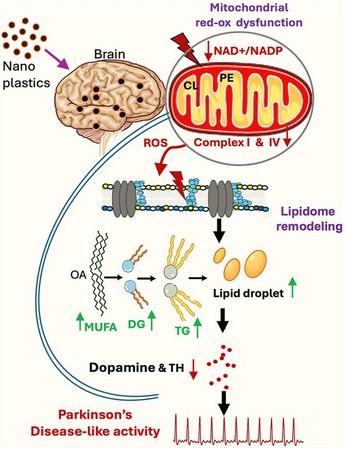
Our present study shows that very tiny plastic (nanoplastic) particles can enter the brain and disturb how brain cells produce and use energy. These particles have great potential to damage mitochondria, increase oxidative stress, and alter lipid droplet molecules needed for normal brain physiology. These key changes reduce the neurochemical dopamine, leading to movement and behavioral deficits similar to Parkinson’s disease. Importantly, we also found that antioxidant treatment could reverse many of these harmful effects, suggesting potential ways to reduce disease risk.
What are the potential implications of your findings for the field and society?
Our findings suggest that nanoplastics may pose a potential risk to brain health by affecting how brain cells produce energy and maintain normal function. This indicates that long-term exposure to very small plastic particles, which are now commonly found in food, water, and the environment, could have harmful effects that are not yet fully understood. The study highlights the importance of raising public awareness of plastic pollution and its potential impact on human health. It also emphasizes the need for more research to understand these risks in detail and to develop strategies to protect the brain, such as approaches that reduce oxidative stress and support normal cellular function. We are working in the direction of medicinal plant Phyto molecules which are part of our diet and can protect oxidative stress caused by MP/NP in the brain. This will open new doors in societal perspective that a polyphenol rich diet can eliminate the oxidative stress burden by MP/NP.
What was the exciting moment during your research?
The most exciting moment was when initial behavioral changes in flies exposed to nanoplastics prompted us to investigate the underlying cause. We first examined mitochondrial function and observed loss of membrane potential and increased mitochondrial ROS, indicating early dysfunction. This led us to explore redox balance, where we found altered NAD(H) and NADP(H) status along with increased lipid peroxidation. To understand metabolic changes, we performed stable isotope tracing, which revealed disrupted TCA cycle flux. These findings guided us to perform brain lipidomics, in which we observed clear remodeling of mitochondrial-associated lipids, such as cardiolipins and phosphatidylethanolamines, along with accumulation of neutral lipids and lipid droplets. Finally, linking these molecular changes to reduced dopamine levels and impaired behavior provided a complete mechanistic picture of how nanoplastics induce neurodegeneration, a picture further validated by antioxidant rescue.
Paper reference: Rathor, P., Tiwari, A. K., Patel, R. P., Verma, A., Singh, S. P., & Ch, R. (2026). Brain lipidomics identifies mitochondrial redox dysfunction and metabolic trade-offs associated with Parkinson’s disease-like pathology induced by Nanoplastics exposure. Free Radical Biology and Medicine https://doi.org/10.1016/j.freeradbiomed.2026.03.023
Nihart, A.J., Garcia, M.A., El Hayek, E. et al. Bioaccumulation of microplastics in decedent human brains. Nat Med 31, 1114–1119 (2025). https://doi.org/10.1038/s41591-024-03453-1
New Book Launched – Molecules, Mentors & Mindsets: Building Indian Biopharma
Buy your copy today: https://biopatrika.com/science-society/book-molecules-mentors-mindsets-building-indian-biopharma-biocon/
Book Launch: Molecules, Mentors & Mindsets: Building Indian Biopharma | Biocon Focus