


RNA Modifications: A New Layer of Malaria Parasite Regulation
Researchers uncovered a hidden RNA-based regulatory system in the malaria parasite, where chemical modifications on RNA help control protein production and parasite survival. The study identifies unique RNA-modifying proteins and reader molecules as promising targets for next-generation antimalarial therapies and drug-resistance research.
Dr Gayathri Govindaraju and Dr Arumugam Rajavelu | Rajiv Gandhi Centre for Biotechnology & IIT Madras
About the author

Dr. Gayathri Govindaraju is a postdoctoral researcher at Rutgers University, USA. The research described here was carried out during her PhD at the Rajiv Gandhi Centre for Biotechnology, Thiruvananthapuram, and her postdoctoral work at IIT Madras, under the mentorship of Dr. Arumugam Rajavelu, Associate Professor, IIT Madras.
What was the core problem you aimed to solve with this research?
Malaria, caused by Malaria parasite Plasmodium falciparum, remains one of the world’s deadliest infectious diseases. While most research has focused on DNA and proteins, RNA regulation in the parasite remained largely unexplored.
Our research asked whether P. falciparum chemically modifies its RNA molecules to regulate gene expression and how these modifications are interpreted inside the parasite. Specifically, we aimed to uncover the parasite’s “epitranscriptome,” a hidden layer of gene regulation that had never been explored in any Apicomplexan parasite before.
How did you go about solving this problem?
We combined biochemical, molecular biology, and functional approaches to investigate RNA modifications in P. falciparum.
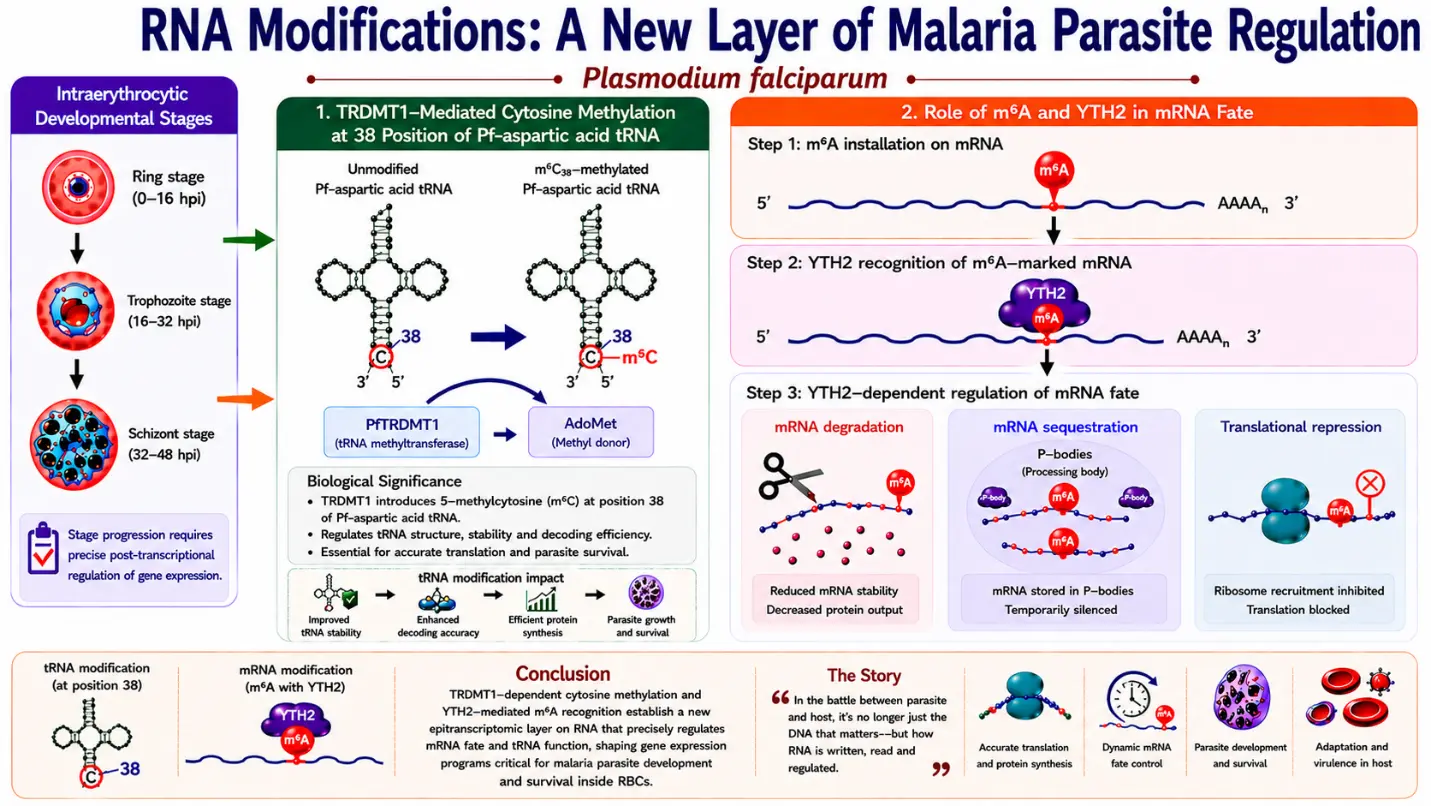
First, we studied an enzyme called TRDMT1, previously believed to function mainly as a DNA methyltransferase. We discovered that in the malaria parasite it instead modifies transfer RNA (tRNA), specifically methylating cytosine-38 in aspartic acid tRNA. This modification proved essential for efficient production of parasite proteins required for survival.
Next, we investigated messenger RNA (mRNA) modifications and identified the presence of N6-methyladenosine (m6A) marks on parasite mRNAs. We then discovered a specialized reader protein called YTH2 that recognizes these m6A marks and regulates how efficiently those mRNAs are translated into proteins.
Together, our work demonstrated that P. falciparum possesses a complete m6A regulatory system including writers, modified RNAs, and reader proteins, a system previously thought to exist mainly in higher organisms.
How would you explain your research outcomes to the non-scientific community?
Think of DNA as a permanent library archive and RNA as photocopied pages used for day-to-day work. RNA modifications act like highlighted notes on those pages, signaling which instructions should be prioritized or translated quickly.
We discovered that the malaria parasite uses this kind of chemical “highlighting” system on its RNA molecules. These marks help the parasite rapidly control which proteins are produced without changing its genetic code. This flexibility likely helps the parasite survive and adapt inside the human body.
“In the battle between parasite and host, it is no longer just the DNA that matters — but how RNA is written, read, and regulated.”
This work, carried out at Rajiv Gandhi Centre for Biotechnology and Indian Institute of Technology Madras, is among the first studies exploring epitranscriptomics in Apicomplexan parasites and contributes to India’s growing presence in this emerging research field.
What are the potential implications of your findings for the field and society?
Scientifically, this work opens a new dimension in malaria biology. Since the parasite has limited control over gene expression at the DNA level, RNA modifications may serve as an important mechanism for rapidly fine-tuning protein production during infection. Understanding this system is therefore critical for understanding parasite survival, adaptation, and immune evasion.
From a therapeutic perspective, proteins involved in this RNA modification pathway particularly TRDMT1 and the YTH2 reader protein are structurally distinct from human proteins. This makes them promising targets for developing selective antimalarial drugs.
Drug resistance remains a major global challenge in malaria treatment, and identifying new therapeutic targets is urgently needed. By uncovering this previously unknown regulatory pathway, our work provides new opportunities for drug discovery and future studies investigating how RNA methylation influences parasite survival and resistance.
More broadly, this research demonstrates that epitranscriptomics, previously studied mainly in cancer and viral biology, is also highly relevant to infectious diseases.
What was the most exciting moment during your research?
One of the most exciting moments was discovering that TRDMT1, long assumed to be a DNA methyltransferase, modifies tRNA in P. falciparum. This unexpected finding challenged existing assumptions and revealed how parasites can repurpose conserved enzymes for entirely different functions.
Equally exciting was identifying the YTH2 reader protein and showing that it binds m6A-modified mRNAs to regulate translation. At that moment “Eureka”, we realized we were observing a complete RNA regulatory circuit in the parasite, something never previously described in any Apicomplexan organism. Knowing this discovery emerged from Indian laboratories made it especially meaningful.
Key Publications
- Govindaraju G et al. BBA Gene Regul Mech. 2017;1860(10):1047–57.
- Govindaraju G et al. Epigenetics and Chromatin 2020 ;13(1) :33
- Govindaraju G, Chavali S, Rajavelu A. MBio. 2021;12(6):e0136721.
- Govindaraju G, Rajavelu A. Biomed J. 2025;48(2):100703.
New Book Launched – Molecules, Mentors & Mindsets: Building Indian Biopharma
Buy your copy today: https://biopatrika.com/science-society/book-molecules-mentors-mindsets-building-indian-biopharma-biocon/
Book Launch: Molecules, Mentors & Mindsets: Building Indian Biopharma | Biocon Focus