


Can an Antisense Therapy Bring Us Closer to a Functional Cure for Hepatitis B?
Today in Science | TIS 005 | 27 November 2026
For millions of people living with chronic hepatitis B, treatment often means taking antiviral medication for years, sometimes throughout life. Existing therapies can effectively suppress viral replication and reduce the risk of liver complications, but they rarely eliminate the infection. A new therapeutic approach is now offering a different possibility: reducing the production of viral RNA and proteins sufficiently to allow the immune system to regain control of the infection.
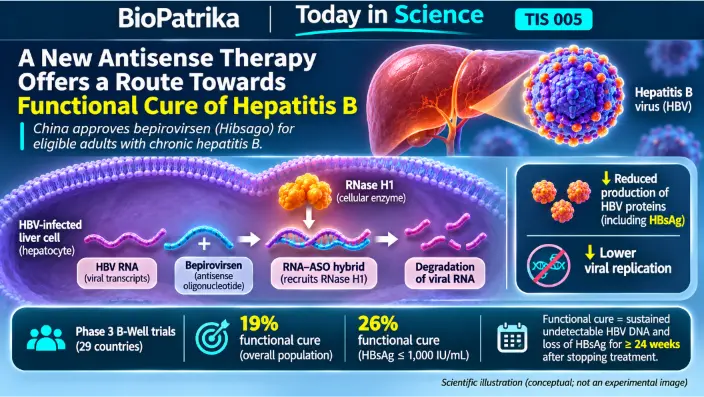
On 26 November 2026, China’s National Medical Products Administration (NMPA) approved Hibsago (bepirovirsen), developed by GSK, for eligible adults with chronic hepatitis B. The approval follows encouraging results from two global Phase 3 clinical trials, B-Well 1 and B-Well 2, published in The New England Journal of Medicine earlier this year. Bepirovirsen is a first-in-class antisense oligonucleotide designed to target hepatitis B virus (HBV) RNA. Its approval represents an important development in the pursuit of functional cure, a treatment goal that has remained difficult to achieve with conventional antiviral medicines.
Why is chronic hepatitis B difficult to cure?
Hepatitis B virus is a DNA virus that primarily infects liver cells, or hepatocytes. Following infection, viral DNA reaches the nucleus, where it forms a stable structure known as covalently closed circular DNA (cccDNA). This viral DNA acts as a persistent template for producing new viral RNA and proteins. One of the most important viral products is hepatitis B surface antigen (HBsAg), which forms part of the virus’s outer envelope.
The persistence of cccDNA is a major reason why chronic hepatitis B is difficult to eradicate. Even when antiviral medicines suppress the production of new viral particles, the viral genetic reservoir can remain inside infected liver cells and potentially support renewed viral activity.
Current standard treatments include nucleos(t)ide analogue medicines such as tenofovir and entecavir. These drugs inhibit the viral reverse-transcription process, reducing the production of new viral DNA and helping maintain low levels of circulating HBV DNA. They are effective at controlling infection and reducing disease progression, but generally do not eliminate the persistent viral templates or consistently produce loss of HBsAg.
This distinction is important. Viral suppression and functional cure are not the same. Suppression means keeping viral replication under control while treatment continues. Functional cure, in clinical research, generally refers to sustained loss of detectable HBsAg together with undetectable HBV DNA for at least 24 weeks after stopping all treatment.
The challenge is therefore not simply to stop the virus from replicating, but to reduce its ability to produce viral proteins and potentially restore effective immune control.
How does bepirovirsen work?
Bepirovirsen approaches the problem by targeting viral genetic instructions rather than directly inhibiting a viral enzyme. It belongs to a class of medicines called antisense oligonucleotides (ASOs), which are short, chemically modified strands of nucleic acid designed to bind complementary RNA sequences.
The HBV genome produces several RNA transcripts that are required for viral protein production and replication. Bepirovirsen is designed to recognise a conserved 20-nucleotide sequence present in multiple HBV RNA transcripts, including pregenomic RNA. Once the drug binds its target RNA, the resulting DNA–RNA hybrid recruits an endogenous cellular enzyme called ribonuclease H1 (RNase H1).
RNase H1 recognises the hybrid structure and cleaves the RNA strand. This process leads to the degradation of targeted viral RNA transcripts, reducing the production of HBV proteins, including HBsAg, and limiting the availability of pregenomic RNA needed for viral replication.
Reducing circulating HBsAg may have an additional immunological benefit. During chronic infection, persistently high levels of viral antigens are thought to contribute to impaired antiviral immune responses. Lowering the antigen burden may help the immune system regain some capacity to control the infection. Bepirovirsen also has immunostimulatory activity, which may contribute to its therapeutic effect, although the precise contribution of this activity to functional cure remains under investigation.
Importantly, bepirovirsen does not directly remove the persistent cccDNA reservoir from infected liver cells. Its therapeutic strategy is to suppress viral RNA and protein production sufficiently to create conditions in which sustained immune control becomes possible. This is why the term functional cure, rather than complete viral eradication, is scientifically more appropriate.
What did the Phase 3 trials demonstrate?
The clinical evidence supporting bepirovirsen comes from B-Well 1 and B-Well 2, two international, randomised, double-blind, placebo-controlled Phase 3 trials conducted across 29 countries. The trials enrolled adults with non-cirrhotic chronic hepatitis B who were already receiving stable nucleos(t)ide analogue treatment and had baseline HBsAg levels above 100 and up to 3,000 IU/mL.
Participants received weekly subcutaneous bepirovirsen or placebo for 24 weeks, while continuing their existing antiviral treatment. Eligible participants subsequently discontinued their background antiviral medication, and the primary outcome was assessed at week 72, 24 weeks after all treatment had been stopped.
Both trials met their primary endpoint. In B-Well 1, 20% of participants receiving bepirovirsen achieved functional cure, compared with none in the placebo group. In B-Well 2, the corresponding figures were 19% and zero.
In the pooled analysis, 233 of 1,220 participants receiving bepirovirsen achieved functional cure, compared with none of the 614 participants receiving placebo. A key secondary analysis showed an even higher response in participants with baseline HBsAg levels of 1,000 IU/mL or lower: 26% achieved functional cure compared with none in the corresponding placebo group.
These results are particularly encouraging because they demonstrate that a defined treatment course can enable a proportion of carefully selected patients to maintain viral control after discontinuing all therapy. However, functional cure was not achieved by everyone, and the results should not be extrapolated to all people living with chronic hepatitis B.
Safety also requires attention. In the pooled Phase 3 analysis, adverse events occurred in 91% of participants receiving bepirovirsen compared with 73% receiving placebo. Serious adverse events were reported in 7% and 4%, respectively. Grade 3 or higher adverse events during treatment occurred in 16% of the bepirovirsen group compared with 3% of the placebo group. Increased alanine aminotransferase, a marker of liver inflammation or injury, was among the important treatment-associated adverse events. These findings underline the need for appropriate monitoring during therapy.
The Chinese approval applies to a defined group of non-cirrhotic adults already receiving nucleos(t)ide analogue therapy, with suppressed HBV DNA and specified HBsAg levels. The US FDA had also approved Hibsago in October 2026 for certain adults without cirrhosis, under its own eligibility criteria.
For the broader field of antiviral drug development, bepirovirsen illustrates how RNA-targeting medicines can complement conventional antiviral strategies. Rather than relying solely on blocking viral replication, researchers are increasingly exploring ways to reduce viral antigen production and improve the conditions for immune-mediated control.
Chronic hepatitis B remains a major global health challenge, with long-term infection contributing to cirrhosis and liver cancer. Bepirovirsen will not eliminate the need for screening, vaccination, monitoring or existing antiviral treatment. Nevertheless, the Phase 3 findings provide an important step towards a treatment strategy in which some patients may eventually achieve sustained control without lifelong medication.
The bigger question now is whether combining RNA-targeting therapies with approaches that directly address the persistent viral reservoir can bring the field closer to a more complete cure for hepatitis B.
Primary research paper
Hou J, Lim S-G, Buti M, et al. Phase 3 Results of Bepirovirsen Treatment for Chronic Hepatitis B Virus Infection.
New England Journal of Medicine (2026), 394:2395–2406. Published 28 May 2026.
Read the original NEJM publication