

Two Experimental Drug Combinations Advance in Global Tuberculosis Trial, Raising Hopes for Shorter Treatment
An international Phase 2 clinical trial published in The New England Journal of Medicine identifies two promising four-drug combinations for further evaluation, targeting different vulnerabilities in Mycobacterium tuberculosis.
Tuberculosis (TB) remains one of the world’s most persistent infectious disease challenges. Although effective treatment is available, patients with drug-susceptible pulmonary TB generally require a combination of antibiotics over approximately six months. The prolonged treatment period, potential adverse effects and challenges with adherence continue to complicate disease management. Researchers are therefore investigating whether new combinations of antibiotics can achieve faster bacterial clearance while maintaining long-term protection against relapse.
A new international Phase 2 clinical trial, PARADIGM4TB, has identified two promising four-drug combinations containing investigational antibiotics ganfeborole and BTZ-043. The findings were published on 19 November 2026 in The New England Journal of Medicine. The study evaluated ten experimental treatment combinations and selected two for further clinical development, providing an important step towards potentially shorter TB treatment regimens.
Targeting different vulnerabilities in the tuberculosis bacterium
The study investigated two investigational antibiotics that act through distinct mechanisms.
Ganfeborole, also known as GSK3036656, targets leucyl-tRNA synthetase, an enzyme required for bacterial protein synthesis. This enzyme attaches the amino acid leucine to its corresponding transfer RNA (tRNA), an essential step in translating genetic information into proteins. By inhibiting this process, ganfeborole disrupts the ability of Mycobacterium tuberculosis to produce proteins necessary for growth and survival.
The second candidate, BTZ-043, belongs to the benzothiazinone class of antibiotics. It inhibits DprE1, an enzyme involved in the synthesis of arabinan, an essential component of the mycobacterial cell wall. The cell wall provides structural protection and helps the bacterium survive under challenging conditions. Disrupting its formation compromises bacterial viability.
These drugs are particularly interesting because they target biological processes different from those addressed by several established TB medicines. Combining drugs with complementary mechanisms may improve bacterial killing and reduce the likelihood of resistance emerging during treatment.
The researchers evaluated these investigational antibiotics alongside established drugs, including bedaquiline, delamanid, moxifloxacin, pretomanid, pyrazinamide and linezolid. The objective was to identify combinations capable of producing sufficiently strong antibacterial activity while maintaining an acceptable safety profile.
What did the PARADIGM4TB trial demonstrate?
The trial enrolled 401 adults with rifampicin-susceptible pulmonary TB across 14 clinical sites in five countries. Participants were randomly assigned to receive the standard four-drug regimen of isoniazid, rifampicin, pyrazinamide and ethambutol for 24 weeks, a bedaquiline–delamanid–moxifloxacin combination for 16 weeks, or one of ten investigational four-drug combinations for 16 weeks.
The primary endpoint measured changes in the time required for M. tuberculosis to grow in positive sputum cultures. This microbiological measure, known as time to positivity, provides an indication of how rapidly the bacterial burden is declining during treatment.
Two experimental combinations emerged as priorities for further evaluation.
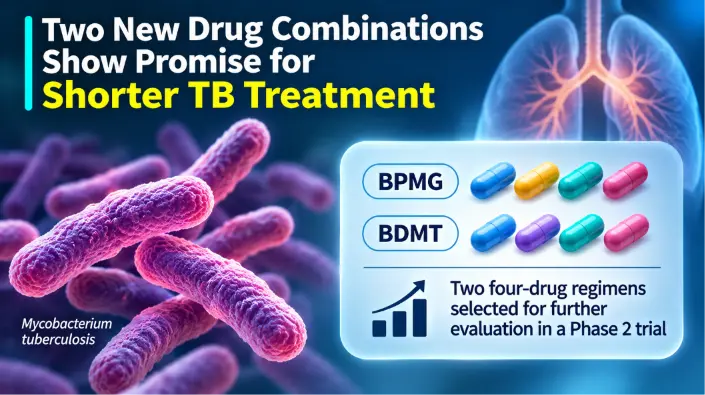
The first, abbreviated BPMG, combines bedaquiline, pretomanid, moxifloxacin and ganfeborole. The second, BDMT, combines bedaquiline, delamanid, moxifloxacin and BTZ-043.
Compared with the standard HRZE regimen, BPMG demonstrated a relative improvement of 9.1% in the primary microbiological endpoint, while BDMT showed an improvement of 20.5%. The Bayesian posterior probabilities of superiority over HRZE were 0.83 for BPMG and 0.99 for BDMT.
The findings supported advancing both combinations for further investigation. However, the trial was designed to identify promising regimens for subsequent development, rather than establish definitive treatment efficacy or demonstrate that patients can already be cured with a shorter course.
Safety was another important consideration. Grade 3 or higher adverse events occurred in 38% of participants receiving BPMG, 28% receiving BDMT and 24% receiving standard HRZE. One participant receiving BDMT discontinued treatment because of drug reaction with eosinophilia and systemic symptoms (DRESS). Another experimental combination containing BTZ-043 was discontinued because of hepatotoxicity.
These findings highlight why drug combinations must be assessed not only for antibacterial activity but also for their potential interactions and cumulative toxicity.
What comes next?
The next stage of PARADIGM4TB will investigate how much treatment duration can be reduced while maintaining sustained bacterial clearance and preventing relapse. The research team will evaluate the optimal treatment duration for the two selected combinations before considering progression towards larger Phase 3 trials.
The study is part of the UNITE4TB consortium, an international collaboration involving academic institutions, clinical research organisations and pharmaceutical companies across multiple countries. Its platform-based approach allows several drug combinations to be evaluated within a coordinated clinical trial, potentially accelerating the identification of promising TB treatments.
For a disease that continues to cause more than a million deaths globally each year, the development of shorter and more effective treatment regimens remains a major public health priority. Reducing treatment duration could improve adherence, reduce the burden on patients and healthcare systems, and potentially limit the emergence of drug resistance.
The PARADIGM4TB findings do not yet establish a new standard of care. Nevertheless, they provide an encouraging example of how combining drugs that target different bacterial processes could reshape future TB treatment strategies.
The next challenge is to establish whether these promising combinations can deliver durable cure in a shorter period without compromising safety.