


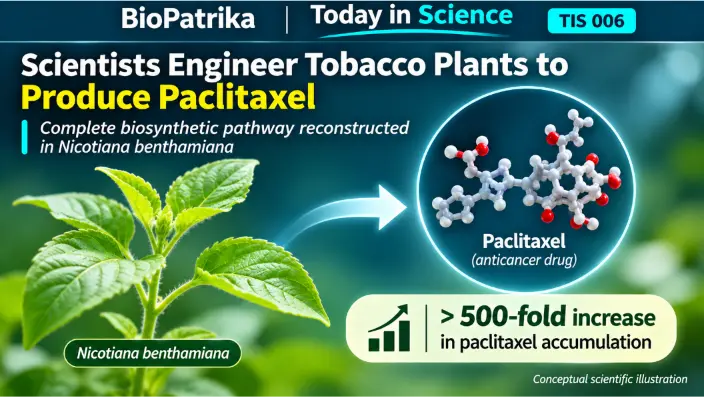
Scientists Engineer Tobacco-Related Plants to Produce Paclitaxel, Achieving a More Than 500-Fold Increase in biosynthesis
Today in Science | TIS 006 | 28 November 2026
What if plants could be engineered to manufacture complex medicines that are currently difficult and expensive to produce? Researchers have taken an important step towards this possibility by reconstructing the complete biosynthetic pathway of paclitaxel, an important chemotherapy drug, in a tobacco-related plant. In a study published in Nature Chemical Biology on 23 November 2026, scientists demonstrated the production of paclitaxel in Nicotiana benthamiana and increased its accumulation by more than 500-fold through targeted genetic and metabolic engineering.
Paclitaxel, also known by its original brand name Taxol, is widely used in the treatment of several cancers, including breast, ovarian and lung cancers. The discovery offers a new perspective on plant-based biomanufacturing and demonstrates how understanding complex metabolic pathways can open opportunities for producing valuable pharmaceutical compounds.
Why is paclitaxel difficult to manufacture?
Paclitaxel is a natural product originally isolated from the bark of the Pacific yew tree (Taxus brevifolia). It works by binding to microtubules, the protein structures that help maintain cell architecture and organise chromosome separation during cell division. By stabilising microtubules and preventing their normal disassembly, paclitaxel disrupts mitosis and ultimately promotes cancer-cell death.
Despite its therapeutic importance, producing paclitaxel is challenging. Its molecular structure is complex, involving multiple chemical modifications that must occur in a precise sequence. The natural abundance of the compound in yew trees is relatively low, making direct extraction an inefficient source for large-scale production.
Current manufacturing approaches largely rely on plant cell cultures derived from yew species or semi-synthesis using naturally occurring paclitaxel precursors extracted from yew needles. Both approaches require specialised processes and careful control of production.
Scientists have spent decades investigating the enzymes responsible for converting simple metabolic precursors into paclitaxel. Although several enzymes and intermediate reactions had been identified, competing biosynthetic models and unresolved steps prevented a complete, experimentally validated pathway from being established.
The new study addresses this long-standing challenge.
Reconstructing a complex biosynthetic pathway
The research team systematically investigated the enzymes involved in paclitaxel production, testing competing models of the pathway and validating the structures of key intermediate molecules. Several intermediates were isolated and characterised using nuclear magnetic resonance (NMR) spectroscopy, providing chemical evidence for the proposed transformations and helping establish the correct order of reactions.
The researchers then reconstructed the complete pathway in Nicotiana benthamiana. This plant is widely used in biotechnology because it can be genetically manipulated and supports the expression of proteins from other organisms. It has become an important experimental platform for producing recombinant proteins, vaccines and specialised metabolites.
Reconstructing paclitaxel biosynthesis required introducing genes encoding multiple enzymes responsible for successive chemical reactions. However, an important discovery was that the pathway does not operate in a single cellular compartment.
Instead, different stages of paclitaxel production occur across several parts of the plant cell, including plastids, the endoplasmic reticulum, cytosol and peroxisomes. Intermediate molecules must move between these compartments for subsequent enzymatic reactions to take place.
This intracellular organisation adds another layer of complexity to metabolic engineering. Introducing the correct enzymes is not sufficient; researchers must also ensure that enzymes are located in appropriate cellular compartments and that their intermediate products can reach the next step in the pathway.
Once the pathway had been reconstructed, the team used targeted engineering strategies to improve paclitaxel accumulation. Initial production was approximately 0.104 micrograms per gram of dry plant material. Through pathway optimisation, the researchers increased this to 61.05 micrograms per gram—a more than 500-fold improvement.
The resulting concentration is comparable to reported paclitaxel levels in yew bark. This represents an important proof of concept for producing a complex plant-derived pharmaceutical compound in an alternative plant host.
What does this mean for biopharmaceutical manufacturing?
The study has implications beyond paclitaxel itself. It demonstrates how synthetic biology and metabolic engineering can be used to reconstruct complex natural-product pathways in plants. By combining enzyme discovery, chemical characterisation, genetic engineering and intracellular pathway optimisation, researchers can potentially develop alternative platforms for producing valuable therapeutic molecules.
Plant-based production systems offer several potential advantages. Plants can be cultivated using agricultural infrastructure, support complex protein expression and provide cellular environments containing organelles and metabolic machinery that may be difficult to reproduce in microorganisms. However, these advantages do not automatically translate into lower manufacturing costs or higher production efficiency.
The current study remains a laboratory-scale proof of concept. The reported yield, although comparable to yew bark, is not yet evidence of an economically competitive industrial process. Further work will be needed to improve production levels, establish stable genetic integration of the pathway, optimise cultivation and harvesting, and develop efficient downstream purification processes.
The researchers also highlight the importance of understanding how pathway intermediates move between cellular compartments. Improving this transport and coordinating the activity of multiple enzymes could be essential for increasing production further.
For the biotechnology industry, the findings demonstrate the growing potential of engineered plants as production platforms for complex natural products. The same principles could eventually be applied to other molecules whose biosynthesis involves multiple enzymes, specialised metabolic pathways and intricate cellular organisation.
The study does not introduce a new cancer treatment or replace existing paclitaxel manufacturing methods. Instead, it provides a scientifically validated foundation for exploring a new production strategy.
The larger achievement is the reconstruction of a complex natural biosynthetic pathway in a plant host. It brings researchers closer to using engineered biological systems as factories for producing medicines that nature makes only in limited quantities.
Source: Liang F, Fan Z, Koutsaviti A, et al. Complete biosynthesis and production of paclitaxel in a plant host. Nature Chemical Biology (2026). Read the original Nature Chemical Biology paper