



Aging Isn’t Just Later: It Begins in Development’s Blueprint
Research Summary: Genetically modulating aging pathways in larval Drosophila midgut progenitors reshapes adult intestinal homeostasis, driving aberrant proliferation, skewed differentiation, barrier dysfunction, and genomic instability—establishing progenitors as developmental determinants of gut homeostasis.
Researcher Spotlight
Atharva Anand Mahajan is a doctoral researcher in the Stem Cell and Tissue Homeostasis Laboratory, where his work focuses on understanding stem cell homeostasis through the lens of nutrient-sensing pathways.
Linkedin: https://in.linkedin.com/in/atharva-mahajan20
Twitter: https://x.com/AtharvaMahajan
Instagram: https://www.instagram.com/atharva_m720
Lab PI name: Dr. Rohan Khadilkar, ACTREC Mumbai
Lab social media: https://scthlab.wixstudio.com/scthlab

What was the core problem you aimed to solve with this research?
The core problem we set out to address was a gap in the aging field: while stem cell exhaustion and epithelial decline in the adult gut are well studied, no one had asked whether the seeds of that later dysfunction are planted much earlier — during development, in the progenitor cells that will eventually build the adult organ.
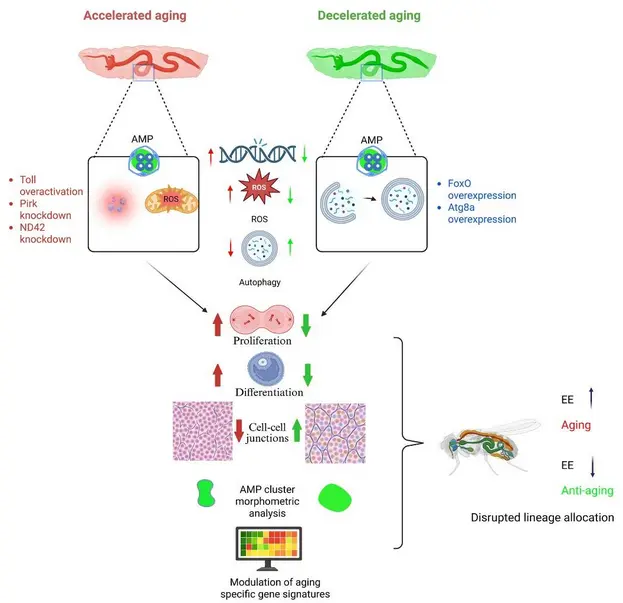
Specifically, we wanted to know: do aging-associated pathways operating in *larval* adult midgut progenitors (AMPs) — before the adult gut even exists — determine how well that gut maintains homeostasis later in life?
This mattered because AMPs are the developmental source of all adult intestinal cell types (stem cells, enterocytes, enteroendocrine cells), so if their “aging state” during development is misregulated, it could pre-program problems (like premature stem cell exhaustion, barrier breakdown, or skewed cell-fate decisions) long before the organism itself is “old.”
How did you go about solving this problem?
To solve this, we used the fruit fly gut as our model, focusing on its adult midgut progenitors (AMPs), which generate the entire adult intestine. We used precise genetic tools to switch on aging-related stress pathways (inflammation, oxidative stress) or protective pathways (such as Foxo and autophagy) specifically in these progenitor cells while the gut was still developing, and then confirmed that the manipulations were working as intended by measuring oxidative stress, autophagy, and DNA damage. We examined how this affected cell multiplication, cell-type balance, gut barrier integrity, and the physical organization of progenitor clusters, and independently validated these genetic findings using chemical treatments (paraquat and rapamycin) that mimic aging and anti-aging effects. Gene expression analysis (RNA sequencing) was used to confirm these changes matched known signatures of natural aging, and finally, the flies were followed into adulthood to see whether the early-life changes persisted, revealing that manipulating aging pathways in developing progenitor cells has lasting consequences for gut health well beyond development.
Dr. Rohan Khadilkar says “This study is extremely exciting as it delves into the mechanisms underlying stem cell aging which can serve as a blueprint for the perturbations that can occur later in life and what is fascinating is that it is all developmentally determined”.
How would you explain your research outcomes (Key findings) to the non-scientific community?
The gut has “builder cells” (progenitors) that make all its tissue during development. We found that if these builder cells experience “aging stress” (inflammation, oxidative damage) even while the gut is still being built, the finished gut ends up weaker — cells overgrow, the wrong cell types get made, and the gut lining becomes leaky.
The reverse was also true: boosting the cells’ natural repair systems (like autophagy) kept the gut healthier.
Strikingly, these early problems didn’t just fade away — they persisted into adulthood, showing up even weeks after the flies were fully grown. Gene activity in these guts also matched patterns seen in naturally old intestines.
Why it matters: How well an organ ages later in life may depend in part on what happens to its building blocks early on, suggesting that protecting cells during development could be a strategy for promoting long-term health.
What are the potential implications of your findings for the field and society?
These findings suggest that aging doesn’t just happen slowly over a lifetime — some of it may actually be set very early, when the gut is still being built. For the field, this is an important shift: it means that to really understand aging, we may need to study young, developing cells, not just old ones. It also shows that fruit flies can be a useful, fast way to test which factors (such as inflammation, oxidative stress, or the body’s natural repair systems) matter most during this early window — work that could later guide similar studies in mice or even humans. For the wider public, while these results are only in flies so far, they raise an interesting possibility: that protecting our bodies early in life — even before birth or in childhood — might help our organs stay healthier for much longer, rather than only trying to fix problems once we’re already old.
What was the exciting moment during your research?
Seeing that guts subjected to aging-associated perturbations during larval life still showed EE lineage skewing and dysfunction at 30 days post-eclosion was the most striking “WOW” — it directly proves the central hypothesis that early progenitor states can imprint long-term consequences, rather than being washed out by normal development. Also, discovering that aging pathways don’t just affect how many progenitor cells there are, but actually reshape the physical organization of AMP clusters.
Paper reference: Malik, S., Mahajan, A.A., Pillai, S.J., Shinde, I., Shameem, M., Pande, S., Chandrani, P., Inamdar, M.M. and Khadilkar, R.J. (2026), Developmental regulation of progenitor aging shapes long-term intestinal homeostasis in Drosophila. FEBS Lett. https://doi.org/10.1002/1873-3468.70462