



Human Neutrophils Can Degrade Gold Nanomaterials, Challenging Long-Held Assumptions About Gold Inertness
Research Summary: Gold is considered an inert material that has applications in various biomedical fields. Here, we investigated the biodegradability of gold nanosheets mediated by human myeloperoxidase in neutrophil-like immune cells.
Researcher Spotlight
Pavithra Kurungottu is a doctoral research student in the department of chemistry at the Indian Institute of Science Education and Research, Thiruvananthapuram. Her prime area of research is the development of biodegradable materials for biomedical applications.
Linkedin- https://www.linkedin.com/in/pavithra-kurungottu-226b712a6?
Instagram- https://www.instagram.com/pavithra_kurungottu?
Lab: Dr. Rajendra Kurapati, Indian Institute of Science Education and Research, Thiruvananthapuram (IISER TVM)
Lab social: https://www.linkedin.com/in/dr-rajendra-kurapati-bioengg-?
What was the core problem you aimed to solve with this research?
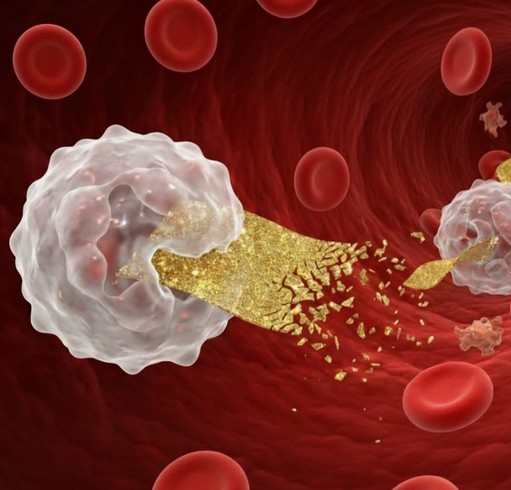
Gold has been used for various biomedical applications since ancient times. But none of the gold-based materials has been clinically tested, mainly because of a lack of studies on their biological fate and long-term in vivo biocompatibility. Very recently, the biotransformation of gold nanoparticles was demonstrated in fibroblast cells incubated for 6 months. However, the biodegradation of gold nanomaterials in blood remains crucial and has not been reported to date, particularly through interactions with primary immune cells, such as neutrophils, which are considered the body’s frontline defenders. Taking this into account, we sought to understand the biodegradability of gold nanosheets interacting with neutrophil-secreted human myeloperoxidase (hMPO), using neutrophil-like human myeloid leukemia (HL-60) cells, which are known to secrete MPO upon activation. Also, we investigated the cytotoxicity and photothermal anticancer properties of gold nanosheets.
How did you go about solving this problem?
We have conducted a test-tube model and in vitro cellular biodegradation studies to demonstrate the biodegradation of gold nanosheets. First, nanosheets were incubated with human myeloperoxidase, and partial degradation of the gold nanomaterials was observed after 20 hours. Next, in vitro biodegradation of gold nanosheets was performed by incubating them with HL-60 cells for 14 days (in collaboration with Dr. Bonam’s lab @ CSIR-IICT Hyderabad). In both cases, we observed significant changes in nanosheet morphology, becoming more fragmented, along with an increase in the number of spherical gold nanoparticles, mostly generated by the breakdown of nanosheets.
“There has been a dogma of gold inertness in the human body. This work demonstrated that gold can be degraded by the blood cells, such as neutrophils.” – Dr. Rajendra Kurapati
How would you explain your research outcomes (Key findings) to the non-scientific community?
Understanding the biodegradation and toxicity of any material is crucial before its clinical applications, for example, using nanomaterials for cancer treatment. Gold nanomaterials are widely studied for nanomedicine, cancer treatment, and other biomedical applications. But the long-term effects of gold nanomaterials on our bodies (including degradation in human blood) are not known, which is crucial. In this work, we demonstrated that gold nanomaterials can undergo biodegradation in human blood after interacting with primary immune cells or whole blood cells, such as neutrophils.
What are the potential implications of your findings for the field and society?
Understanding the biodegradability of gold nanosheets will open new avenues for gold-related research and future clinical applications. Indeed, more studies should be conducted regarding this, which we are currently pursuing. We are extending the biodegradability studies to in vitro neutrophil cells (blood-derived) and in vivo settings (in collaboration with Dr. Bonam’s lab @ CSIR-IICT Hyderabad), which will further help in understanding the biodegradability of gold nanosheets.
What was the exciting moment during your research?
The research problem itself was exciting and challenging, as this was mostly ignored by the scientific community, i.e., biodegradation of gold nanomaterials. So, when we found out that visible changes were occurring to the gold nanosheets after the treatment, it was an EUREKA moment!
Paper reference: https://doi.org/10.1002/smsc.202500491; https://onlinelibrary.wiley.com/doi/full/10.1002/smsc.202500491
New Book Launched – Molecules, Mentors & Mindsets: Building Indian Biopharma
Buy your copy today: https://biopatrika.com/science-society/book-molecules-mentors-mindsets-building-indian-biopharma-biocon/
Book Launch: Molecules, Mentors & Mindsets: Building Indian Biopharma | Biocon Focus