


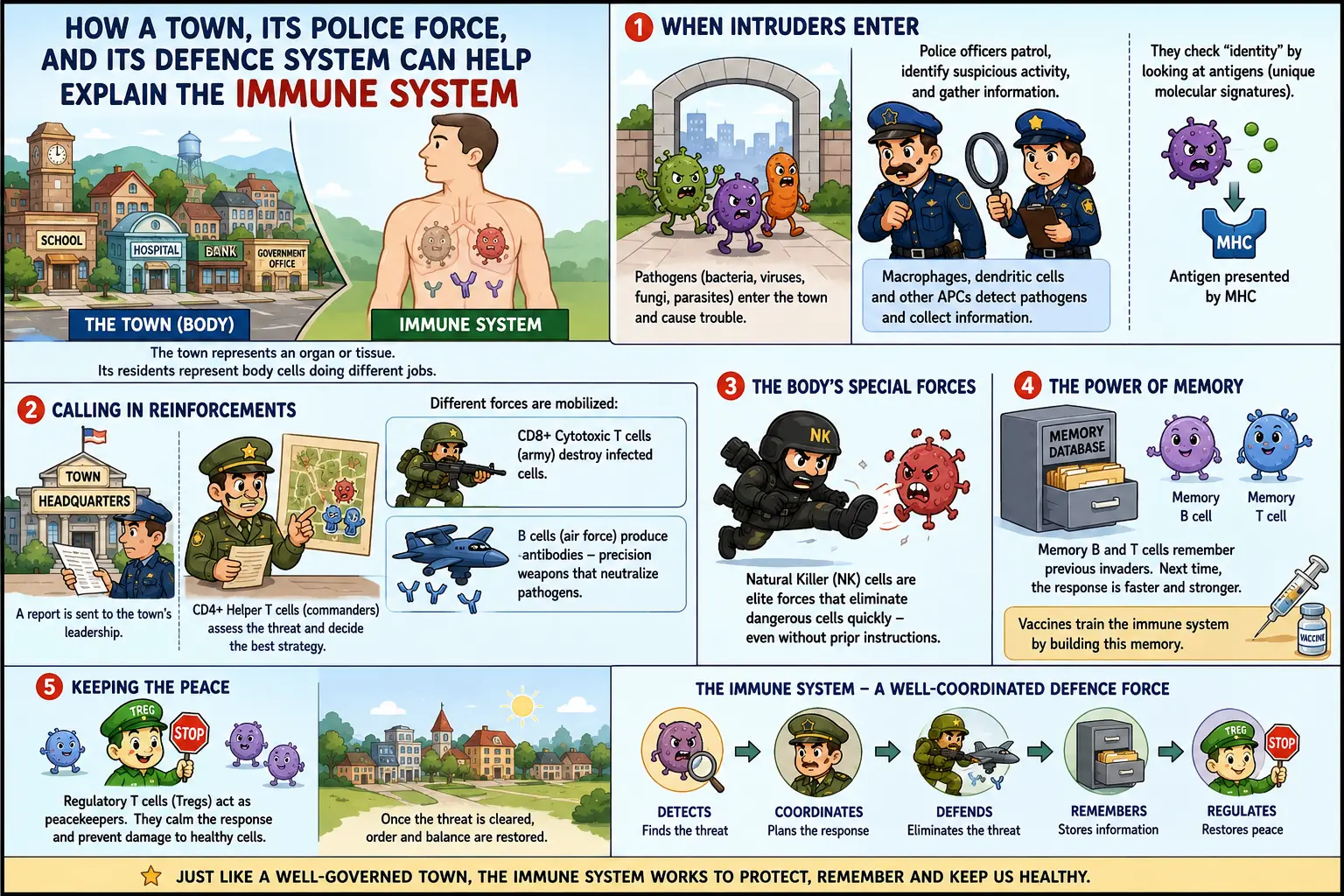
How a Town, Its Police Force, and Its Defence System Can Help Explain the Immune System
The human body is home to trillions of cells, each performing specialized functions that maintain life. Some cells transport oxygen, whereas others process nutrients. Furthermore, many cells operate in the background to maintain physiological balance and defend against diseases. Among these, immune cells serve as the body’s defence force, constantly monitoring threats and responding to infections.
The study of these cells and their interactions is known as immunology, —a fascinating but often complex field of biology. Fortunately, some of its key concepts can be understood through simple real-world analogies.
The Body as a Well-Organized Town
Imagine a peaceful town where people live, work, and contribute to society. The town has schools, hospitals, banks, government offices, and a police force that maintains the law and order.
In this analogy, the town represents an organ or tissue of the body, and its residents represent the various cells that perform specialized functions. Just as teachers, doctors, farmers, and engineers contribute to society in different ways, the cells in the body perform diverse tasks that collectively sustain life.
Most of the time, the town operates smoothly. However, problems arise when outsiders enter and disrupt the peace.
When Intruders Enter
Suppose a group of visitors arrives from a neighbouring city. Initially, they appear harmless, but some eventually violate local laws and create disturbances.
These troublemakers represent pathogens, such as bacteria, viruses, fungi, and or parasites, that invade the body.
The first responders are the town’s police officers, who patrol the streets, identify suspicious individuals, and gather information about the threat. In the immune system, these officers are represented by macrophages, dendritic cells, and other antigen-presenting cells.
Rather than checking identity cards, immune cells examine molecular signatures called antigens, which are—unique markers found on pathogens. These antigens are displayed using specialized molecules known as the Major Histocompatibility Complex (MHC), allowing the immune system to recognize what has entered the body.
Calling in Reinforcements
Once sufficient evidence is collected, a report is sent to the town’s leadership.
In immunological terms, this role is performed by CD4⁺ helper T cells, often referred to as the coordinators of the immune response. Similar to military commanders, they assess the threats and determine the most effective strategy.
Depending on the nature of the invader, helper T cells mobilize different branches of the immune defence system.
One of these is the CD8⁺ cytotoxic T-cell response, which functions like a highly trained army. These cells identify and destroy infected cells to prevent pathogen spread.
Another crucial branch involves B cells, which can be compared to an air force equipped with precision-guided weaponry. These weapons are antibodies, —specialized proteins designed to recognize and neutralize specific pathogens.
Together, these responses form the body’s adaptive immune system, a highly targeted defence mechanism capable of responding with remarkable precision.
The Body’s Special Forces
Not all threats follow predictable rules.
Some infected or abnormal cells attempt to evade detection by the immune system. To deal with these situations, the immune system deploys Natural Killer (NK) cells, which function like elite special forces. These cells can rapidly identify and eliminate dangerous cells without prior instructions.
This ability makes NK cells particularly important in the early response against viral infections and certain cancers.
The Power of Memory
One of the most remarkable features of the immune system is its ability to recall.
After an infection is cleared, specialized memory B cells and memory T cells remain. These cells act as an intelligent database, storing information about previous invaders.
If the same pathogen attempts to invade the body again, the immune system mounts a much faster and stronger response.
Vaccines work by taking advantage of this biological memory, training the immune system to recognize pathogens before an actual infection occurs.
Keeping the Peace
An effective defence system must know not only when to fight but also when to stop.
Once a threat is eliminated, regulatory immune cells help calm the immune response and prevent unnecessary damage to healthy tissues. These cells function as peacekeepers, ensuring that order is restored after the battle is over.
Without these regulatory mechanisms, the immune system can become overactive and attack the body’s tissues, leading to autoimmune diseases.
Why Analogies Matter in Science
Immunology is often perceived as one of the most challenging areas of biology because it involves numerous cell types, signalling molecules, and complex interactions. However, analogies can serve as powerful learning tools that connect unfamiliar scientific concepts to everyday experiences.
While no analogy perfectly captures the complexity of the immune system, comparing immune cells to police officers, military commanders, soldiers, and peacekeepers helps to illustrate how these cells cooperate to defend the body.
The immune system is not merely a collection of individual cells. It is a highly coordinated network that continuously monitors, responds, remembers, and adapts, similar to a well-governed society working together to maintain order and protect its citizens.
Author: Kruttika Godbole
Acknowledgement: The town-based analogy was inspired by immunology educator Dr. Narendra Chirmule, whose teaching approach emphasizes understanding complex scientific concepts through relatable, real-world examples. Additional inspiration was drawn from publicly available educational resources on immunology and science communication topics.
Edited by: Yogita Labrath