


Nanobody-cocktail prevents lethal effects of Indian cobras and king cobras
Research Summary: A recombinant nanobody-based antivenom protects mice against envenoming by spectacled, monocled cobras and king cobras from India, even when administered 20 minutes after venom injection.
Researcher Spotlight
Arpan Samanta is a PhD scholar in the Evolutionary Venomics Lab, Indian Institute of Science. His research focuses on discovering recombinant antibodies against medically important snakes of India.
Twitter: https://x.com/mearpan09
Lab PI name: Prof. Kartik Sunagar
University: Indian Institute of Science
Lab social media: https://www.venomicslab.com/
What was the core problem you aimed to solve with this research?
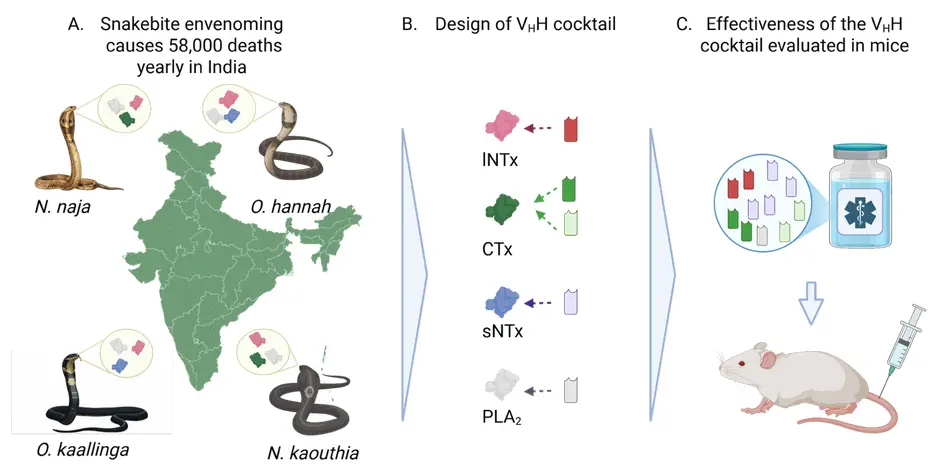
Snakebite is a neglected tropical disease, causing more than 50,000 deaths each year in India, mainly affecting rural agricultural communities. Current animal plasma–derived antivenoms have several limitations, including batch-to-batch variability, limited cross-neutralisation of geographically distinct venoms, risk of severe immunological reactions, and high production costs. These antivenoms are produced against the so-called “big four” snakes (Indian cobra, common krait, Russell’s viper, and saw-scaled viper) and offer little to no efficacy against other clinically important, yet neglected, snake species.
How did you go about solving this problem?
Venoms are complex mixtures of toxins. We used proteomics to identify the major toxins in the venom of cobras and king cobras from India and employed five nanobodies specific to these toxins, originally discovered against African snakes. Then we rationally prepared a mixture of these nanobodies to neutralise the venoms. We used both in vitro and in vivo approaches to show the effectiveness of our designed recombinant antivenom. The recombinant antivenom showed high thermostability, binding affinity and remarkable neutralisation potency. While the venom-injected mice died within 30-40 minutes of injection, the recombinant antivenom saved the envenomed mice even when administered 20 minutes after venom injection.
“This work brings us closer to replacing century-old antivenoms with precise, scalable and ethical recombinant medicines that save lives.” – Prof. Kartik Sunagar
How would you explain your research outcomes (Key findings) to the non-scientific community?
Snakebite is a major problem in India, especially in rural agricultural areas. Although antivenom is produced by immunising horses with snake venoms, to treat snakebites in India, it has several problems. One of the major problems is that it is produced only for four snakes: the Indian cobra, the common krait, the Russell’s viper, and the saw-scaled viper, despite India having several venomous snakes. The antivenom production strategy has also not changed for over 100 years; it shows batch-to-batch variability, causes severe damage to the horses used for its production, shows limited cross-neutralisation of geographically distinct venoms, and poses a risk of severe immunological reactions in India.
So, we developed a recombinant antivenom using five camelid nanobodies that can overcome the drawbacks of the antivenom currently on the market. The recombinant antivenom is produced in bacterial cells, thereby eliminating the need for horse immunisation, and shows effective neutralisation against the venoms of the Indian spectacled cobra, monocled cobra, and king cobra. We assessed this recombinant antivenom against venom collected from different parts of India, and it showed complete neutralization. While the venom-injected mice died within 30-40 minutes of injection, the recombinant antivenom saved the envenomed mice even when administered 20 minutes after venom injection. Our study highlights that the use of recombinant antivenom can abolish the painful horse immunisation and can offer broad neutralisation across India.
What are the potential implications of your findings for the field and society?
Our work provides a proof of concept for using recombinant antivenom in snakebite treatment. As India is the most affected country in the world by snakebite, our study represents a significant breakthrough in improving treatment in India. We showed that our recombinant antivenom can work against cobra and king cobra venom collected across different parts of India. Although the use of this recombinant antivenom for treatment needs clinical trials, our work has the potential to save 50,000 people in India who lose their lives due to snakebite each year.
What was the exciting moment during your research?
There were multiple exciting moments during the research. But the most exciting one was observing the mice recovering after the recombinant antivenom treatment. Once we showed that the recombinant antivenom works against multiple venoms, we began lowering the dose and increasing the duration of antivenom administration. Finally, we observed that while venom-injected mice died within 30-40 minutes of injection, our designed antivenom rescued them from lethal envenoming at a very low dose, even when administered 20 minutes after venom injection. At that moment, we were amazed by the effectiveness of this designed antivenom.
Paper reference: Samanta, A., Rudresha, G. V., Ahmadi, S., Thumtecho, S., Boyens-Thiele, L., Ebersole, T. W., Burlet, N. J., Dahl, C. H., Lalremsanga, H. T., Buell, A. K., Ljungars, A., Laustsen, A. H., & Sunagar, K. (2026). Oligoclonal nanobody-based recombinant antivenom protects mice challenged with venom from cobras and king cobras from India. Science translational medicine, 18(866), eaed4290.n https://doi.org/10.1126/scitranslmed.aed4290