


Aptamer-Loaded Liposomes Reverse Antibiotic Resistance in Bacteria
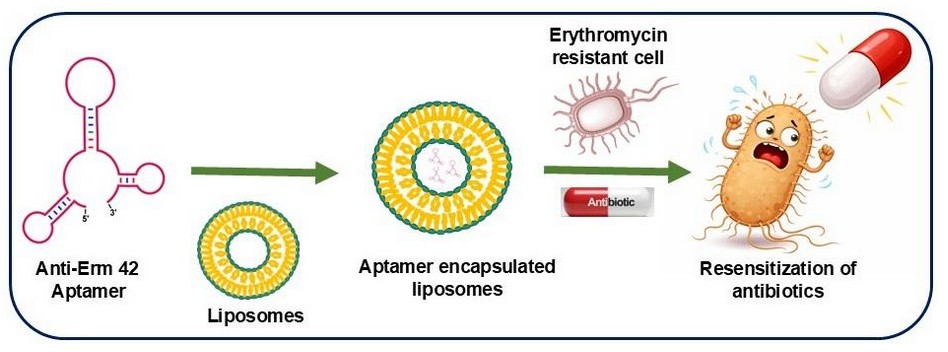
Research Summary: We developed a liposome-based delivery system for DNA aptamers targeting Erm methyltransferase, thereby restoring erythromycin sensitivity in resistant bacteria and offering a novel strategy to combat antibiotic resistance.
Researcher Spotlight

Dr. Swagata Patra is a postdoctoral researcher at IIT Bombay specializing in nano–bio interface design, developing aptamer-based therapeutics and nanocarrier systems to address antibiotic resistance and cancer.
Linkedin: www.linkedin.com/in/swagata-patra-42588831a
Google scholar: https://scholar.google.com/citations?user=GxSiyboAAAAJ&hl=en
Researchgate: https://www.researchgate.net/profile/Swagata-Patra-2
Lab: Dr. Ruchi Anand, Indian Institute of Technology Bombay
Lab website: https://structuralbioiitb.wixsite.com/ruchianand
Twitter: https://x.com/TheRALab1
What was the core problem you aimed to solve with this research?
Antibiotic resistance is a major global health challenge, projected to cause millions of deaths in the coming decades. Our lab at IIT Bombay focuses on overcoming resistance by deciphering and targeting the underlying molecular mechanisms along with developing new antibiotics. In our recent works, we take this one step ahead and go on to design DNA-based aptamers that target a family of enzymes called Erythromycin resistance methyltransferases (Erm) (Badgujar et al. ACS Infectious Diseases (2025)), which site specifically modifies a unique nucleotide in the core of the bacterial ribosome thereby blocking the activity of several clinically important antibiotics (macrolides, lincosamides and streptogramin B antibiotics). While DNA aptamers can selectively inhibit these enzymes, the key challenge is to deliver them into bacterial cells. The problem is exacerbated by the protective cell envelope and its intrinsic charged nature. Overcoming this delivery barrier to resensitize pathogens was the central problem that we have aimed to address.
How did you go about solving this problem?
To address this challenge, we designed a liposome-based delivery system to transport DNA aptamers into bacterial cells. We formulated cationic liposomes using DOTAP, DOPE, and DSPE–PEG to encapsulate and protect the aptamers while enabling efficient membrane fusion and intracellular release. Once inside the cell, the aptamers specifically bind to and inhibit Erm, thus preventing ribosomal modification and the onset of resistance. This allows erythromycin (a macrolide) to regain its ability to bind the ribosome and effectively kill resistant bacteria.
“Given the long, expensive path from drug discovery to clinic, deactivating resistance mechanisms is a more practical route as we can reverse resistance and use existing antibiotics whose safety and effects are established over the years” – Dr. Ruchi Anand
How would you explain your research outcomes (Key findings) to the non-scientific community?
We developed a strategy to deliver negatively charged DNA aptamers into bacterial cells using molecular carriers, enabling targeted deactivation of resistance mechanisms and thereby resensitizing bacteria to antibiotic treatment. Once this resistance is blocked, the antibiotic, which were previously ineffective, is able to act normally and kill the bacteria effectively. This approach shows that even existing antibiotics can be made useful again against difficult infections.
What are the potential implications of your findings for the field and society?
Our findings suggest a new strategy to combat antibiotic resistance without the need to develop entirely new antibiotics. By restoring the effectiveness of existing drugs, this approach could help prolong their clinical utility and reduce treatment failures. In the long term, it may enable the development of innovative therapies for drug-resistant infections, ultimately improving patient outcomes and alleviating the burden on healthcare systems.
What was the exciting moment during your research?
One of the most exciting moments came when we were observing our samples under the confocal microscope. We could clearly see the fluorescent signal from the aptamer-loaded liposomes inside the bacterial cells, confirming successful internalization. That was the first real indication that our delivery system was working as intended. But the truly thrilling moment followed when we observed significant bacterial killing in the presence of our system combined with erythromycin. Seeing both delivery and functional impact come together was incredibly rewarding and strongly validated our hypothesis.
Paper reference: Liposome-based delivery of DNA aptamers to inhibit erythromycin methyltransferase-mediated antibiotic resistance. Swagata Patra,* Damini Sahu, Leena L. Badgujar, P. I. Pradeepkumar, and Ruchi Anand*. Chem. Commun., 2026,62, 4050-4053. https://doi.org/10.1039/D5CC06813D
#430
Explore more
New Book Launched – Molecules, Mentors & Mindsets: Building Indian Biopharma
Buy your copy today: https://biopatrika.com/science-society/book-molecules-mentors-mindsets-building-indian-biopharma-biocon/
Book Launch: Molecules, Mentors & Mindsets: Building Indian Biopharma | Biocon Focus