


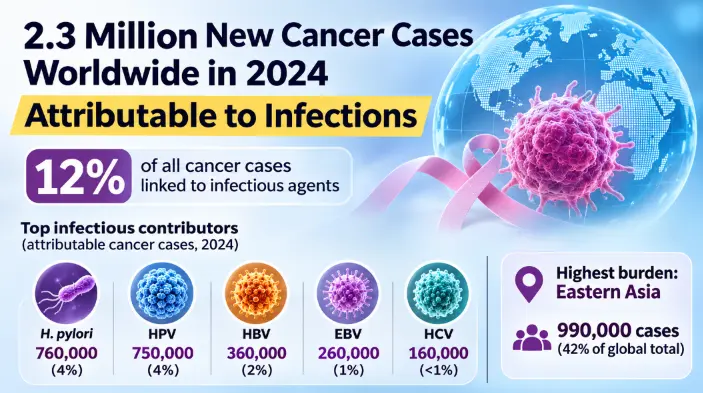
2.3 Million New Cancer Cases Worldwide in 2024 Attributable to Infections, Global Study Finds
Around 12% of all new cancer cases worldwide in 2024 were attributable to infectious agents, according to a new global analysis published in The Lancet Oncology. Helicobacter pylori (H. pylori) and human papillomavirus (HPV) were the leading contributors, together accounting for more than 1.5 million cancer cases. The findings highlight the importance of vaccination, infection screening and treatment as essential components of cancer prevention.
Cancer is often associated with genetic mutations, environmental exposures, lifestyle factors and ageing. However, infections caused by certain viruses, bacteria and parasites also contribute substantially to the global cancer burden. Many of these infection-associated cancers are potentially preventable through vaccination, early diagnosis and effective treatment.
A new study titled “Global burden of cancer attributable to infections in 2024: a worldwide incidence analysis” provides an updated assessment of this burden using the latest global cancer incidence estimates. The research was conducted by Harriet Rumgay, Damien Georges, Yue Huang, Mayo Hirabayashi, Richa Shah, Catherine de Martel, Jin Young Park, Isabelle Soerjomataram and Gary M. Clifford.
2.3 million cancer cases linked to infections worldwide
The researchers estimated that approximately 2.3 million new cancer cases in 2024 were attributable to infectious agents, representing 12% of all cancer cases globally.
The analysis used cancer incidence data from the Global Cancer Observatory’s GLOBOCAN 2024 database to estimate population-attributable fractions (PAFs), absolute numbers of cases and age-standardised incidence rates (ASIRs).
The study examined 12 infectious agents classified as Group 1 carcinogens by the International Agency for Research on Cancer (IARC). These included:
- Helicobacter pylori (H. pylori)
- Human papillomavirus (HPV)
- Hepatitis B virus (HBV)
- Hepatitis C virus (HCV)
- Epstein–Barr virus (EBV)
- Kaposi’s sarcoma-associated herpesvirus
- Human T-cell lymphotropic virus
- Schistosoma haematobium
- Opisthorchis viverrini
- Clonorchis sinensis
- Merkel cell polyomavirus
- Human immunodeficiency virus (HIV)
The findings demonstrate that infectious agents remain an important and potentially preventable contributor to cancer incidence across different populations and geographical regions.
Which infections contribute most to cancer?
Among the infectious agents examined, H. pylori and HPV accounted for the largest numbers of infection-attributable cancer cases.
The estimated global contributions were:
| Infectious agent | Attributable cancer cases | Population-attributable fraction |
|---|---|---|
| H. pylori | 760,000 | 4% |
| HPV | 750,000 | 4% |
| HBV | 360,000 | 2% |
| EBV | 260,000 | 1% |
| HCV | 160,000 | Less than 1% |
Together, these five infectious agents accounted for the majority of the estimated infection-attributable cancer burden.
The findings also highlight the different biological pathways through which infections contribute to cancer development.
1. Helicobacter pylori: A major contributor to infection-related cancer
H. pylori is a bacterium that colonises the stomach and is a recognised cause of gastric cancer. Persistent infection can lead to chronic inflammation of the stomach lining, gastric atrophy and intestinal metaplasia, increasing the risk of cancer development.
The study attributed approximately 760,000 cancer cases to H. pylori in 2024, making it the largest infectious contributor in the analysis.
Testing and treatment of H. pylori infection, particularly in populations with elevated gastric cancer risk, represent important opportunities for cancer prevention.
2. Human papillomavirus: Preventable cancers through vaccination
HPV is a group of viruses transmitted primarily through sexual contact. Persistent infection with high-risk HPV types can cause cervical cancer and several other cancers, including anal, vulvar, vaginal, penile and oropharyngeal cancers.
The study estimated that HPV was responsible for approximately 750,000 new cancer cases in 2024.
HPV vaccination offers an effective strategy to prevent infections caused by cancer-associated HPV types. Screening programmes that identify precancerous lesions also play an important role in preventing cervical and anal cancers.
3. Hepatitis B and C viruses: Infection and liver cancer
Chronic infection with hepatitis B virus and hepatitis C virus can cause persistent liver inflammation, fibrosis and cirrhosis, increasing the risk of hepatocellular carcinoma.
The study attributed approximately 360,000 cancer cases to HBV and 160,000 cases to HCV.
HBV vaccination, together with testing and treatment for chronic hepatitis infections, can reduce the risk of infection-associated liver cancer.
4. Epstein–Barr virus: An important emerging area for cancer prevention
EBV is a widespread herpesvirus associated with several malignancies, including nasopharyngeal carcinoma, certain lymphomas and some gastric cancers.
The study attributed approximately 260,000 cancer cases to EBV in 2024.
The researchers also conducted a focused analysis of EBV-attributable cancers, identifying regional differences in the distribution of cancer types.
Unlike HPV and HBV, there is currently no licensed preventive vaccine against EBV. The findings therefore highlight the importance of research and development aimed at new prevention tools, including potential EBV vaccines.
Eastern Asia carries the largest burden
The geographical distribution of infection-attributable cancers varied considerably across regions.
Eastern Asia recorded the largest number of cases, with approximately 990,000 cases, accounting for 42% of the global total.
The age-standardised incidence rate for infection-attributable cancers was 31.9 per 100,000 people in eastern Asia, compared with the global average of 22.7 per 100,000.
Other regions with rates above the global average included:
| Region | Age-standardised incidence rate per 100,000 |
|---|---|
| Eastern Asia | 31.9 |
| Sub-Saharan Africa | 28.5 |
| Central and eastern Europe | 24.3 |
| Southeastern Asia | 23.1 |
| Global average | 22.7 |
These differences reflect variations in infection prevalence, population characteristics, cancer patterns and access to preventive healthcare.
The substantial burden in eastern Asia and sub-Saharan Africa highlights the need for prevention strategies tailored to regional disease patterns and healthcare infrastructure.
What makes this study different from previous estimates?
Previous global estimates suggested that approximately 2.2 million cancer cases worldwide were attributable to infections in 2018.
The new analysis updates this picture using GLOBOCAN 2024 cancer incidence estimates and expanded evidence on infectious agents and cancer associations.
An important contribution is the inclusion of 16 additional causal infection–cancer type pairs compared with the previous 2018 global estimates. These include cancers associated with HIV and Merkel cell polyomavirus, along with additional cancer types linked to EBV, HBV, HCV and Kaposi’s sarcoma-associated herpesvirus.
The updated analysis provides a more comprehensive understanding of how infectious agents contribute to cancer incidence across countries, age groups and sexes.
Preventing infection-related cancers: What interventions can make a difference?
One of the most important messages from this study is that a substantial proportion of infection-attributable cancers could potentially be prevented using interventions that are already available.
The researchers highlight several established public health strategies:
1. HPV and HBV vaccination
Vaccination against HPV and HBV can prevent infections associated with cervical, liver and other cancers. Expanding vaccination coverage remains a central component of cancer prevention.
2. Testing and treatment of infections
Early identification and treatment of H. pylori, HIV, HBV and HCV can reduce the health consequences of persistent infections and help prevent associated cancers.
3. Safe injection practices
Preventing the transmission of blood-borne infections through safe injection practices is particularly important for reducing HBV and HCV transmission.
4. HIV prevention
Access to condoms and pre-exposure prophylaxis (PrEP), alongside HIV testing and treatment, can help reduce HIV transmission and associated cancer risks.
5. Screening and treatment of precancerous lesions
Screening programmes that identify precancerous cervical and anal lesions can enable early intervention before invasive cancer develops.
The need for new vaccines and equitable prevention strategies
Despite the availability of several effective prevention approaches, infection-associated cancers remain a major global health challenge.
Many interventions are cost-effective and scientifically established, yet their implementation remains limited by financial constraints, social barriers, healthcare infrastructure and policy challenges. These gaps often affect populations with the greatest burden of infection-related cancers.
The study also highlights the need for investment in new preventive tools, particularly vaccines targeting EBV, H. pylori and Kaposi’s sarcoma-associated herpesvirus.
Developing these tools could expand the possibilities for preventing cancers for which effective vaccines are not yet available.
A global cancer prevention opportunity
The findings reinforce an important message: cancer prevention extends beyond early diagnosis, lifestyle modification and treatment. Controlling infections that contribute to cancer development is an essential part of reducing the global cancer burden.
With approximately 2.3 million new cancer cases attributable to infections in 2024, the potential impact of vaccination, screening, infection control and treatment is substantial.
The challenge now is to translate established scientific evidence into accessible public health interventions, particularly in low-income and middle-income countries where the burden remains high.
Read the research: Global burden of cancer attributable to infections in 2024: a worldwide incidence analysis – The Lancet Oncology