

FDA Updates Regulations to Expand Use of Innovative Alternatives to Animal Testing
New rule clarifies that validated non-animal methods can be used in drug and biologics development while maintaining existing safety standards
The U.S. Food and Drug Administration (FDA) has issued a direct final rule updating its regulations to clarify that non-animal methods can be used, where appropriate, to generate safety information for drugs and biological products before they are tested in humans. (U.S. Food and Drug Administration)
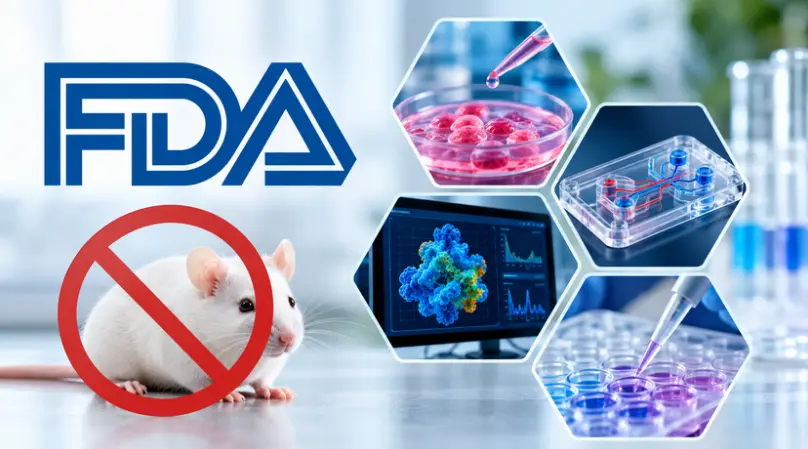
The regulatory update reflects advances in scientific technologies, including human-cell-based systems, organs-on-chips, computer models and other New Approach Methodologies (NAMs) that can provide information relevant to human biology.
Moving beyond a one-size-fits-all approach
The updated regulations replace terminology such as “animal tests” and “animal studies” with the broader terms “nonclinical tests” and “nonclinical studies.” Related terminology, including “preclinical” and “in vitro,” is also being revised.
The FDA said the changes are intended to remove language that could imply that animal testing is the only acceptable approach for generating safety information for regulatory decisions involving products intended for human use.
Importantly, the rule does not eliminate or prohibit animal studies. It also does not change existing evidentiary standards or impose new costs or requirements on drug developers. Rather, developers may use alternative approaches when they are scientifically appropriate and adequately validated for the relevant regulatory question.
NAMs gain a larger role in drug development
New Approach Methodologies (NAMs) encompass a broad range of technologies and approaches that can support the 3Rs—Replacement, Reduction and Refinement of animal testing.
These include:
- Complex in vitro models
- 2D cell-based assays
- Organ- and tissue-based systems
- Organs-on-chips
- In chemico approaches
- In silico/computational models
The FDA’s updated framework recognizes that different scientific questions may require different types of evidence.
The agency stated that NAMs may be used to generate safety information when the methods are adequately validated and appropriate for the product and regulatory question.
FDA launches NAMs database
Alongside the regulatory update, the FDA has launched a database of NAM use-case examples drawn from publicly available FDA review materials.
The initial database contains examples showing how NAMs have been incorporated into specific applications for approved drugs. The database includes methods such as BCOP, EpiSkin SIT, h-CLAT, DPRA, KeratinoSens, U-SENS and EpiDerm SIT, among others.
Examples include the use of NAMs in FDA reviews of products such as Symdeko, Veklury (remdesivir), Sunlenca (lenacapavir), Cobenfy, Fabhalta and Myqorzo.
The FDA emphasizes that the database is illustrative rather than exhaustive. Inclusion of a particular method in the database does not constitute FDA guidance or mean that the method will automatically be accepted for another product or future submission. Regulatory conclusions remain dependent on the specific method, endpoint, product, data package and application.
What this means for drug developers
The regulatory clarification could provide developers with greater flexibility when designing nonclinical development programs.
Instead of treating animal studies as the default route for every safety question, developers can consider whether an appropriately validated NAM can provide the evidence required for a particular scientific and regulatory purpose.
For emerging technologies such as organ-on-chip systems, advanced human cell models and computational toxicology, regulatory clarity is an important component of translating these technologies from research tools into drug-development applications.
At the same time, the FDA’s position remains evidence-based: a NAM must be appropriate and sufficiently validated for the question being addressed. The agency’s database itself notes that acceptance of a method is context-specific.
Public comment and next steps
The FDA is inviting comments from clinicians, caregivers, the scientific community, industry and other stakeholders on the rule.
Because the agency issued both a direct final rule and a companion proposed rule, the FDA said that if it receives significant adverse comments on the direct final rule, it will withdraw the direct final rule and continue the rulemaking process through the standard notice-and-comment pathway using the companion proposal.
The development marks another step toward integrating New Approach Methodologies into modern nonclinical drug development, while retaining the requirement that evidence used to support first-in-human studies meet appropriate safety and regulatory standards.
Source: U.S. FDA News Release
NAMs Database: FDA New Approach Methodologies Database