


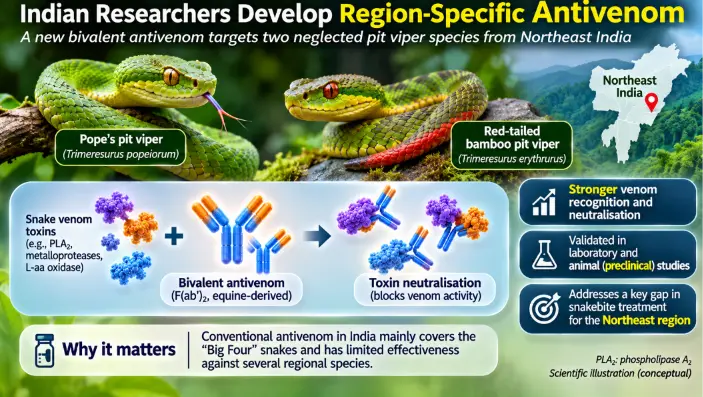
Indian Researchers Develop Region-Specific Antivenom Against Two Neglected Pit Viper Species
A new bivalent antivenom developed by researchers in Northeast India demonstrates improved venom neutralisation in laboratory and animal studies, addressing a significant gap in India’s snakebite treatment landscape.
Snakebite envenomation remains a major public health challenge in India, particularly in regions where medically important snake species are not adequately covered by conventional antivenoms. Researchers led by the Institute of Advanced Study in Science and Technology (IASST), Guwahati, have developed a new bivalent antivenom designed specifically against two pit viper species found in Northeast India: Pope’s pit viper (Trimeresurus popeiorum) and the red-tailed bamboo pit viper (Trimeresurus erythrurus).
The development, announced by the Department of Science and Technology on 25 November 2026, addresses a longstanding limitation of India’s commercially available polyvalent antivenom. The new formulation demonstrated superior venom recognition and neutralisation compared with conventional Indian polyvalent antivenom in laboratory and preclinical investigations. The findings were published in the International Journal of Biological Macromolecules.
Why conventional antivenom may not be sufficient
India’s commercially available polyvalent antivenom is primarily manufactured using venom from four major venomous snakes, collectively known as the Big Four: Russell’s viper, spectacled cobra, common krait and saw-scaled viper. These species account for a substantial proportion of serious snakebite incidents across the country.
However, India’s venomous snake diversity extends well beyond these four species. Northeast India, in particular, is home to several medically significant snakes whose venom compositions differ from those used in conventional antivenom production.
Pope’s pit viper and the red-tailed bamboo pit viper are two such examples. Their venom contains a complex mixture of biologically active proteins and enzymes capable of disrupting blood coagulation, damaging tissues and affecting organ function. Because venom composition varies between snake species, antibodies generated against one set of venoms may not effectively recognise or neutralise toxins from another.
This phenomenon is known as limited paraspecific neutralisation. Although conventional antivenoms can sometimes provide partial cross-protection against related snake species, their effectiveness cannot be assumed across all venomous snakes.
The resulting treatment gap highlights the need for antivenoms developed using venoms from regionally important species.
How was the new antivenom developed?
The research team developed an equine-derived bivalent F(ab’)₂ antivenom, referred to as Bi-AV. The formulation was designed against the venoms of T. popeiorum and T. erythrurus, collected from Northeast India, including Mizoram and Meghalaya.
Equine antivenoms are produced by immunising horses with carefully selected venom antigens and subsequently purifying the antibody components from their plasma. The resulting F(ab’)₂ fragments contain the antigen-binding regions of antibodies and can recognise and bind venom toxins. Removing the Fc portion produces an antibody fragment commonly used in antivenom formulations.
The researchers evaluated the new antivenom using several complementary approaches. These included antibody-binding assays, immunoblotting, measurements of venom enzyme activity and experiments assessing the neutralisation of venom-induced biological effects.
Bi-AV showed stronger binding affinity towards both pit viper venoms than the commercially available Indian polyvalent antivenom. Immunoblotting also revealed improved recognition of several venom components, particularly low-molecular-weight toxins such as phospholipase A₂ (PLA₂).
The researchers further demonstrated more effective neutralisation of important venom-associated enzymatic activities, including snake venom metalloproteases, PLA₂, L-amino acid oxidase and fibrinogenolytic activity.
These enzymes contribute to different aspects of venom toxicity. Metalloproteases can damage blood vessels and surrounding tissues, while PLA₂ enzymes can disrupt cell membranes and contribute to inflammation and tissue injury. Other venom components interfere with blood coagulation and normal physiological processes.
Importantly, the study went beyond biochemical assays. In animal experiments, the new antivenom improved survival and reduced several venom-associated haematological, biochemical and histopathological abnormalities in mice. It also demonstrated protective activity in rescue-type experiments designed to approximate treatment following venom exposure.
The formulation additionally showed neutralising activity against T. popeiorum venom collected from Meghalaya, suggesting some cross-regional effectiveness.
What comes next?
The findings represent an important research advance, but the antivenom is not yet ready for routine clinical use. Its effectiveness has so far been demonstrated through laboratory and preclinical investigations. Further studies will be required to establish its safety, dosing, manufacturing consistency and therapeutic efficacy in humans, followed by the necessary regulatory assessments.
The research involved collaboration between IASST Guwahati, Premium Serums and Vaccines Pvt. Ltd., Pune, Amrita Research Centre Delhi-NCR, Mizoram University and Aaranyak, Guwahati. The participation of an industry partner also highlights the importance of academic–industry collaboration in translating venom research into potential therapeutic products. The paper reports that two authors are employees of the company involved in manufacturing the research-grade antivenom.
For India, the broader significance extends beyond these two pit viper species. The country needs a more comprehensive approach to snakebite management that accounts for regional differences in snake populations and venom composition. Region-specific antivenoms, supported by rigorous clinical evidence, could eventually complement existing treatments and improve access to appropriate care.
The study provides a promising foundation for that direction. Its next major milestone will be determining whether the improved neutralisation observed in laboratory and animal studies translates into safe and effective treatment for people bitten by these snakes.
- Original research paper – International Journal of Biological Macromolecules / PubMed.
- Department of Science and Technology – Government of India announcement.