


Homing Pigeons May Navigate Using Magnetic Cells in Their Liver
For decades, scientists have been fascinated by the remarkable navigational abilities of homing pigeons. How these birds reliably find their way home across unfamiliar landscapes has remained one of biology’s most enduring mysteries. While previous studies have suggested that pigeons use a combination of visual landmarks, the Sun, and Earth’s magnetic field, the biological mechanism underlying magnetic navigation has remained controversial.
Now, a new study published in Science has uncovered surprising evidence that pigeons may rely on specialized iron-containing immune cells in their liver to detect Earth’s magnetic field when other navigational cues are unavailable.
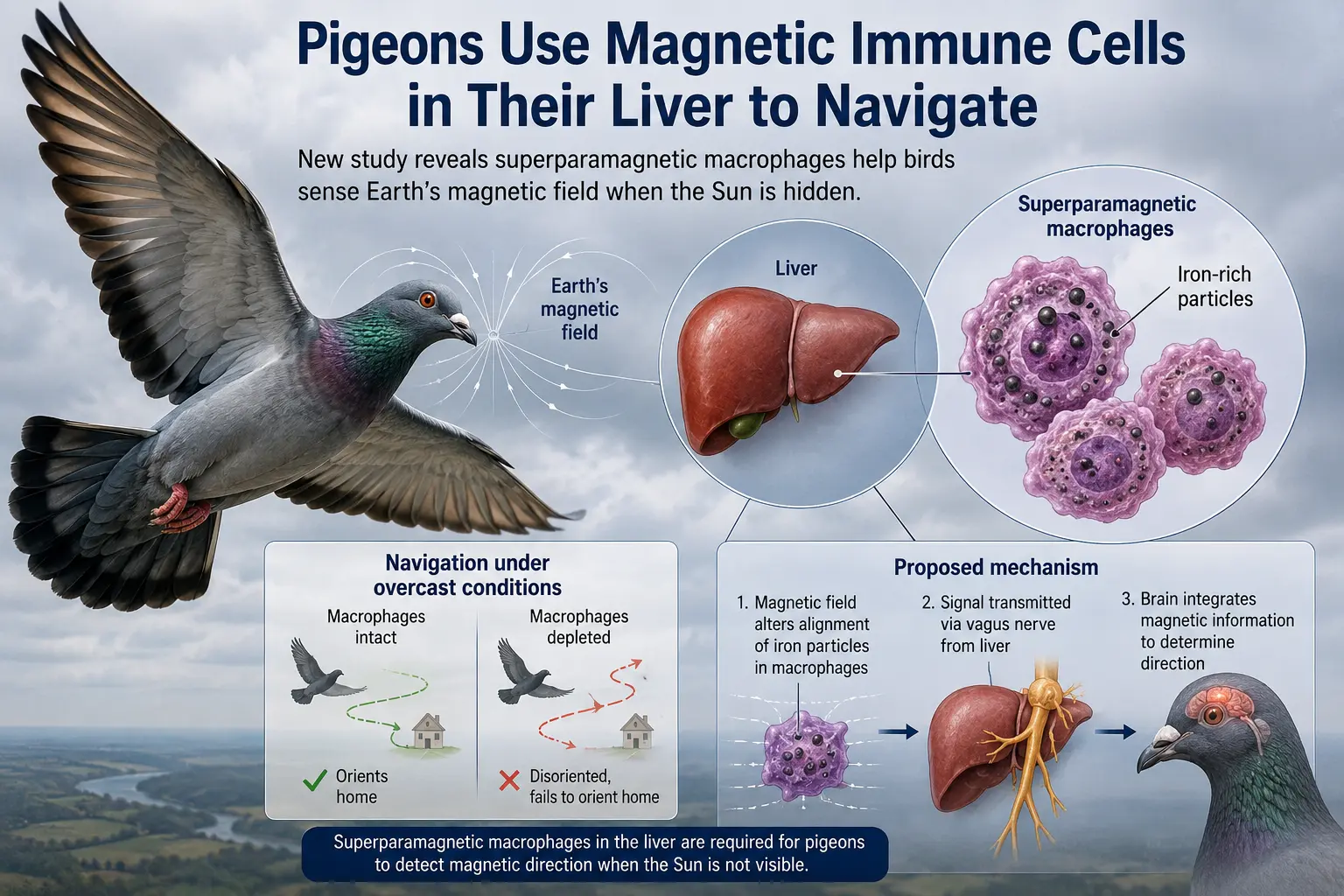
Researchers report the discovery of superparamagnetic macrophages—a type of immune cell containing iron-rich particles—in the liver of homing pigeons. When these cells were experimentally depleted, pigeons flying under overcast skies lost their ability to orient toward home. However, when the Sun was visible, the birds navigated normally even in the absence of these cells, suggesting that solar cues remain their primary navigation system.
The findings point to an entirely new mechanism of magnetoreception and challenge long-standing theories about how birds perceive Earth’s magnetic field.
A Long-Standing Scientific Debate
Scientists have proposed several mechanisms to explain magnetic sensing in birds. Earlier theories suggested that magnetite particles in the beak, light-sensitive proteins called cryptochromes in the eye, changes in ion-channel activity, or specialized structures within the vestibular system could act as magnetic sensors.
While evidence has supported aspects of these models, none has fully explained how birds detect magnetic direction under diverse environmental conditions.
The new study introduces a fourth possibility: magnetic sensing by specialized liver macrophages.
Using a combination of physical measurements, microscopy, functional experiments, and genomic analyses, researchers identified a population of iron-loaded macrophages predominantly located in the pigeon’s liver. These cells exhibited superparamagnetic properties, meaning they can respond strongly to magnetic fields without becoming permanently magnetized.
What Happens When Magnetic Macrophages Are Removed?
To test whether these cells contribute to navigation, researchers selectively depleted the macrophages and monitored the pigeons’ homing behavior.
The results were striking.
Under overcast conditions, when the Sun was not visible, pigeons lacking the magnetic macrophages became disoriented and failed to show their usual homeward orientation. In contrast, pigeons with intact macrophages navigated normally.
When the Sun was visible, both groups successfully oriented toward home, indicating that pigeons preferentially rely on solar information when available but switch to magnetic navigation when visual cues are limited.
The experiments suggest that the liver-based macrophages are specifically required for magnetic orientation rather than general navigation.
How Could Liver Cells Sense Earth’s Magnetic Field?
The researchers propose an intriguing biological model.
Macrophages naturally accumulate iron while recycling aged red blood cells. In pigeons, ferritin-bound iron particles within these macrophages may interact collectively through magnetic forces, increasing their sensitivity to Earth’s weak magnetic field.
Rather than acting as individual magnetic sensors, large populations of macrophages may function together as a coordinated sensing network. This collective signal could then be transmitted to the brain through nerve pathways associated with the liver, particularly branches of the vagus nerve.
The authors suggest that changes in magnetic alignment could alter the physical organization or polarization of macrophages, triggering communication with nearby nerve endings. The brain would then integrate this information with visual, spatial, and other sensory inputs to calculate direction.
Interestingly, the circling behavior commonly observed when pigeons are released may help align these magnetic particles before the birds begin directed flight.
Beyond Birds: A Broader Role for Immune Cells?
The implications of the study extend beyond avian navigation.
One advantage of the proposed mechanism is that it could explain magnetic sensing in animals that lack functional cryptochromes or operate in environments with little or no light. Examples include bats, blind mole rats, and several marine species.
Sharks are known to detect geomagnetic fields and can travel remarkably straight paths over long distances. Scalloped hammerhead sharks have even been observed orienting toward seamounts associated with magnetic anomalies.
If similar magnetic macrophages exist in other animals, they could represent a previously unrecognized biological solution for navigation.
The findings also contribute to an emerging concept in neuroscience and immunology: that tissue-resident macrophages may act as sensory cells capable of transmitting environmental information directly to the brain.
A New Chapter in Magnetoreception Research
Although further studies will be needed to verify the mechanism and determine whether it operates in other species, the discovery provides compelling evidence that immune cells may play an unexpected role in navigation.
For more than half a century, researchers have searched for the biological compass that guides migratory and homing animals. This study suggests that part of that compass may not reside in the eye, brain, or beak—but in the liver.
Reference
Lisowski et al. Homing pigeon navigation relies on superparamagnetic macrophages under overcast conditions. Science (2026).
Meta Description:
Scientists discover superparamagnetic macrophages in pigeon livers that help birds navigate using Earth’s magnetic field when the Sun is hidden by clouds.
New Book Launched – Molecules, Mentors & Mindsets: Building Indian Biopharma
Buy your copy today: https://biopatrika.com/science-society/book-molecules-mentors-mindsets-building-indian-biopharma-biocon/
Book Launch: Molecules, Mentors & Mindsets: Building Indian Biopharma | Biocon Focus