


How genome architectural landmarks became mutational hotspots in cancer
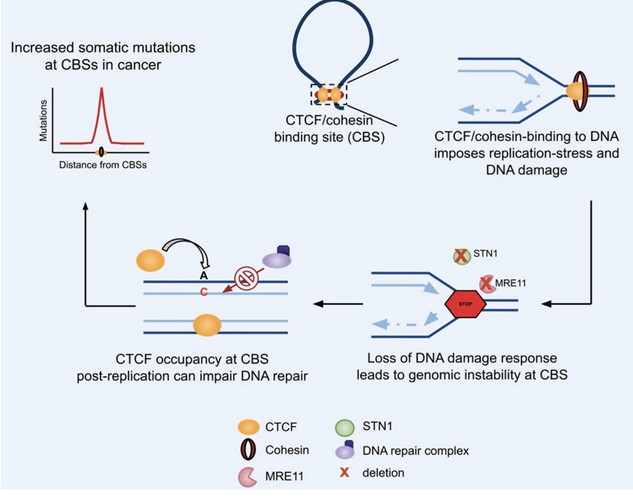
Research Summary: Our study revealed that CTCF and cohesin remain bound to chromatin during DNA replication, creating replication challenges. When DNA repair pathways fail, these regions become genomically unstable, leading to mutation hotspots in cancer genomes.
Researcher Spotlight
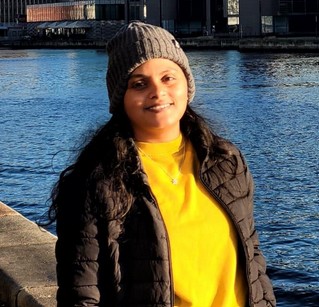
Faseela Elangoli Ebrahimkutty is a postdoctoral researcher at the University of Copenhagen exploring DNA repair and functional cancer genomics. During her PhD at NCBS-TIFR, Bangalore, she investigated how genome architecture contributes to mutations in cancer.
Linkedin: https://www.linkedin.com/in/faseela-elangoli-ebrahimkutty-412a66a4/
Twitter: https://x.com/faseelaee
Instagram: https://www.instagram.com/faseela.ee/
Lab: Prof. Sabarinathan Radhakrishnan, National Centre for Biological Sciences-Tata Institute of Fundamental Research (NCBS-TIFR), Bangalore
Lab social media: https://sites.google.com/view/onkoslab/home
What was the core problem you aimed to solve with this research?
CTCF and cohesin are key genome architectural proteins that organize DNA into chromatin loops and topologically associated domains (TADs). They bind to highly conserved CTCF/cohesin binding sites (CBSs), which are known mutation hotspots in cancer genomes. However, why these regions are particularly vulnerable to mutations remained unclear.
How did you go about solving this problem?
We combined molecular biology, cell biology, and computational approaches to understand why CBSs become mutation hotspots in cancer. We first investigated whether CTCF and cohesin remain associated with chromatin during DNA replication using complementary approaches, including chromatin fractionation, FRAP, and ChIP-seq.
We then examined whether these regions experience replication-associated stress by mapping the recruitment of DNA damage response and repair factors during S phase. Finally, we analyzed whole-genome sequencing data from patient tumors to determine whether CBSs accumulate more mutations, particularly in cancers with defects in DNA repair pathways.
Together, these approaches revealed how persistent CTCF/cohesin occupancy during replication contributes to genome instability and helps explain mutation patterns observed in cancer.
“Our study helps explain why somatic mutations accumulate disproportionately in functionally important regulatory regions of the cancer genome. We find that 3D chromatin architecture shapes this pattern, linking DNA damage and repair processes directly to mutational vulnerability.” – Prof. Sabarinathan Radhakrishnan
How would you explain your research outcomes (Key findings) to the non-scientific community?
Our research uncovered why certain important regions of our genome become mutation hotspots in cancer. Our genome is not just a linear string of DNA; it is carefully folded and organised inside our cells with the help of proteins like CTCF and cohesin. These proteins act like architects, creating loops and structures that help control how genes function.
We found that when cells copy their DNA, these genome-organising proteins remain attached to DNA and can create challenges for the DNA-copying (replication) machinery. This can slow down or disrupt the replication process, causing stress and damage at these locations. Normally, cells have repair systems that identify and fix this damage, preventing lasting changes. However, when these repair pathways are defective, the damage can persist, and errors can accumulate over time. By studying cancer genomes, we found that these genome architectural sites show increased mutation rates in tumors with defective DNA repair systems.
Our study reveals that the same proteins that help organise and maintain the genome can also create regions of vulnerability during DNA replication.
What are the potential implications of your findings for the field and society?
Our findings reveal that the way our genome is organised inside cells can influence the mutational landscape of cancer genomes and provide a mechanistic explanation for why CBSs become mutation hotspots. We show that persistent binding of these genome architectural proteins during DNA replication creates replication-associated stress and, when DNA repair pathways are compromised, makes these regions prone to genomic instability and mutation accumulation.
More broadly, our findings uncover an important link between chromatin architecture, DNA replication, and mutational processes. Understanding the mechanisms that shape mutation patterns will improve how we interpret cancer genome data, particularly mutations in non-coding regulatory regions, and deepen our understanding of how cancer genomes evolve.
What was the exciting moment during your research?
The most exciting moment was when our experimental findings came together with observations from human cancer genomes. We found that CBSs accumulated significantly higher mutations in tumors with defective DNA repair pathways, such as combined loss of MRE11 and STN1, while this pattern was not observed at control genomic regions. This connection revealed that replication-associated vulnerabilities at genome architectural sites can leave a detectable signature in cancer genomes.
Paper reference: Faseela EE, Notani D, Sabarinathan R. “CTCF/cohesin-binding sites are susceptible to replication-associated DNA damage and genomic instability in cancer cells”. iScience. 2026 Jan 8;29(2):114646. doi: 10.1016/j.isci.2026.114646. https://www.sciencedirect.com/science/article/pii/S2589004226000210