



The repurposed role of introns in transposon and gene silencing
Research Summary: Our research finds that spliceosomal proteins which tend to slow down at introns with inefficient splice sites (cryptic introns) recruit Tgs1-mediated RNA methylation to direct de novo heterochromatin formation and RNA interference mediated silencing at retrotransposons and cryptic intron containing genes such as those involved in stress response.
Researcher Spotlight
Dr. Drisya Vijayakumari is a Postdoctoral Fellow at the National Institutes of Health, USA. Her research focuses on understanding factors and mechanisms that connect pre-mRNA splicing to efficient gene silencing
Twitter: @drisyav1
Bluesky: @drisyav.bsky.social
Lab: Prof. Shiv Grewal, National Cancer Institute, National Institutes of Health, USA
Lab social media: @grewalsh (Twitter/X)
Bluesky: @grewalsh.bsky.social
What was the core problem you aimed to solve with this research?
Our study aimed to uncover how cells selectively identify and mark specific RNAs for RNAi-mediated silencing to regulate gene expression and suppress retrotransposons.
How did you go about solving this problem?
We began the study with an unbiased forward genetic screen to identify genes that allowed splicing of cryptic (inefficiently spliced) introns. This screen repeatedly identified the RNA methyltransferase Tgs1 and Coilin-related proteins (Eas1 and Mug174) as regulators of cryptic intron splicing.
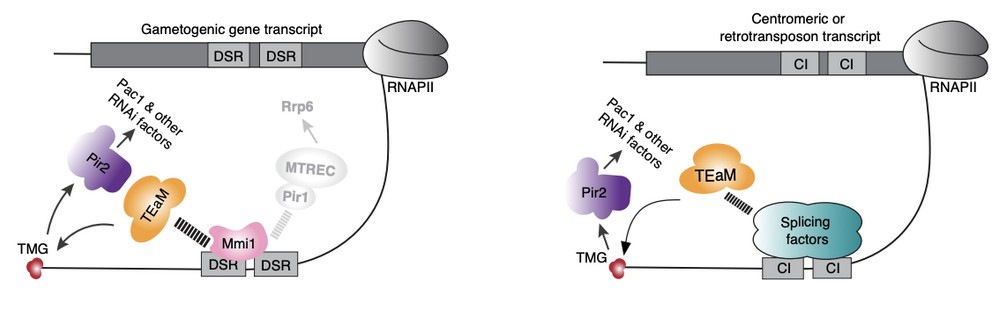
We used protein interaction studies to identify that the factors obtained in the screen also interact with each other and are components of a protein assembly which we call TEaM. Through RNA immunoprecipitation assays we showed that Tgs1 as part of TEaM complex is recruited to cryptic intron-containing RNAs by spliceosomal proteins, or to gametogenic transcripts by a YTH-family RNA-binding protein. Tgs1 catalyzes TMG capping of these associated transcripts, which further helps recruit Pir2/ARS2 and RNA-processing factors to direct target RNAs into the RNAi pathway. Finally, using genome-wide RNA-seq, small RNA-seq, and heterochromatin analyses, we showed that disrupting this pathway impairs siRNA production, weakens heterochromatin formation, and derepresses retrotransposons. Together, our findings support a model in which spliceosome-guided Tgs1-mediated RNA methylation directs selective RNAi-mediated gene silencing and maintains genome stability.
“Our study reveals that spliceosomal proteins associated with inefficiently spliced introns direct RNA methylation to fine-tune gene expression and preserve genome integrity through retrotransposon and centromeric silencing” – Prof. Shiv Grewal
How would you explain your research outcomes (Key findings) to the non-scientific community?
Our cells constantly produce many different RNA molecules, which carry the instructions needed to make proteins. However, some RNAs come from retrotransposons—genetic elements that can copy and insert themselves into new locations in the genome, potentially causing harmful mutations. A major question has been how cells distinguish these unwanted RNAs from normal ones.
In our study, we discovered a quality-control system that helps cells make this distinction. We found that the cell uses proteins normally involved in RNA processing to recognize certain abnormal RNA molecules. These RNAs are then tagged with a small chemical modification, which acts like a “label” telling the cell that they should be destroyed rather than used. This label facilitates recruitment of additional proteins that process the unwanted RNAs into small molecules capable of shutting them off. As a result, the cell silences retrotransposons and other potentially harmful genetic elements while also helping regulate the activity of certain genes.
Overall, our findings reveal a new way that cells protect their genetic information. By identifying and silencing harmful RNAs before they can cause damage, this pathway helps maintain genome stability and supports normal cell function.
What are the potential implications of your findings for the field and society?
This study uncovers a previously unknown mechanism by which cells identify and silence harmful RNAs, linking RNA splicing, RNA modification, and RNA interference (RNAi) to protect genome integrity. By revealing how cells distinguish unwanted RNAs from normal cellular RNAs, this work significantly advances our understanding of gene regulation, heterochromatin formation, and genome stability. Because many of the proteins involved are conserved across species, these findings provide a strong foundation for investigating similar mechanisms in the context of RNA processing and transposable element regulation defects associated with human diseases such as cancer, neurodegenerative disorders, and aging, while informing the development of RNA-based diagnostics and therapeutic strategies. More broadly, it demonstrates how fundamental discoveries in molecular biology can drive future advances in medicine and biotechnology.
What was the exciting moment during your research?
The most exciting moment of this research was discovering that proteins previously implicated in snRNA processing—with snRNAs being central to pre-mRNA splicing, are identified to function as key regulators of splicing factor-dependent RNA silencing. Discovering that spliceosomal proteins recruit the newly identified components of the TEaM protein assembly to specific RNAs, which are then marked by Tgs1-mediated RNA methylation and directed into the RNAi pathway, revealed an entirely new mechanism linking RNA processing with gene silencing. Seeing multiple independent experiments converge on this unexpected model from the genetic screen to protein interaction studies and genome-wide analyses, provided strong evidence of a previously unknown pathway for protecting genome stability.
Paper reference): Vijayakumari, D., Gottfried, X., Groubert, B. et al. Spliceosomal proteins direct RNA methylation to modulate gene expression and silence retrotransposons. Nat Commun (2026). https://doi.org/10.1038/s41467-026-75362-5