


Neuralink Receives FDA Approval to Begin Pivotal Clinical Trial of Its Brain–Computer Interface
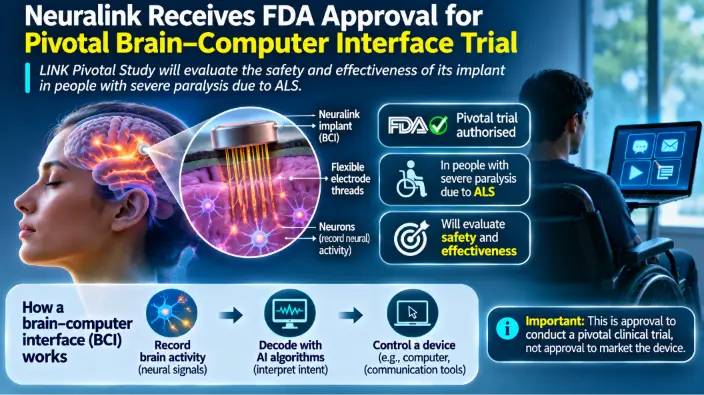
The LINK Pivotal Study will evaluate the safety and effectiveness of Neuralink’s implantable brain–computer interface in people with severe paralysis associated with amyotrophic lateral sclerosis.
Brain–computer interfaces (BCIs) are moving closer to becoming practical assistive technologies for people who have lost the ability to communicate or control digital devices through conventional physical movements. In a significant regulatory development, Neuralink announced on 25 November 2026 that the US Food and Drug Administration (FDA) had approved the launch of its LINK Pivotal Study, a pivotal clinical trial of its implantable brain–computer interface.
The study will evaluate the safety and effectiveness of the Neuralink system in individuals with severe paralysis due to amyotrophic lateral sclerosis (ALS). It will assess whether participants can use neural signals to control digital devices through thought, while also examining the long-term safety and reliability of the implanted system across multiple clinical sites.
The announcement marks an important step in the clinical development of implantable neurotechnology. However, approval to conduct a pivotal clinical trial should not be confused with regulatory approval to market the device. The Neuralink implant remains investigational.
How does a brain–computer interface work?
The human brain communicates through electrical and chemical signals generated by networks of neurons. When a person intends to perform an action, such as moving a hand, speaking or controlling a cursor, specific populations of neurons generate characteristic patterns of electrical activity.
In people with severe neurological conditions, the brain may retain the ability to generate these signals even when the pathways connecting the brain to muscles are damaged or interrupted.
ALS, for example, is a progressive neurodegenerative disease that affects motor neurons responsible for controlling voluntary muscles. As the disease advances, individuals may gradually lose the ability to walk, move their arms, swallow or speak. In some cases, cognitive abilities remain relatively preserved even when physical communication becomes extremely difficult.
A brain–computer interface attempts to bypass the damaged communication pathways by directly recording neural activity and translating it into commands that can operate an external device.
Neuralink’s system uses an implantable device containing multiple flexible electrode threads. These threads are inserted into the brain using a specialised robotic surgical system. The electrodes record electrical activity from nearby neurons, which is then processed by computational algorithms to identify patterns associated with intended movements.
Machine-learning models are trained to interpret these neural signals and translate them into digital commands. Depending on the application, this may allow a participant to move a computer cursor, select items on a screen, interact with software or communicate through a digital interface.
The central idea is to restore a functional communication pathway between the brain and the external environment without requiring the person to perform the physical movement itself.
What will the LINK Pivotal Study investigate?
According to Neuralink’s announcement, the LINK Pivotal Study will build on its earlier early-feasibility investigations conducted in the United States, Canada and the United Kingdom. The company reports that more than 30 implanted participants have collectively contributed thousands of hours of real-world use.
Participants in these earlier studies have used the technology for activities including controlling computers, playing video games, pursuing education and communicating with family members.
The new pivotal study will move the evaluation towards a more formal assessment of safety and effectiveness. A pivotal trial generally represents an important stage in the clinical development of a medical device because its findings are intended to provide evidence supporting future regulatory decisions.
For Neuralink, an important objective will be determining whether participants can reliably use the system to control digital devices in ways that improve independence in everyday life.
Long-term safety is equally important. Implantable brain–computer interfaces involve neurosurgical procedures and the placement of electrodes within delicate brain tissue. Researchers must therefore assess potential complications associated with surgery, tissue responses, device stability, electrode performance and the reliability of neural-signal recording over time.
Another challenge is maintaining accurate signal interpretation. Neural activity can vary between individuals and over time. Changes in electrode position, biological responses around implanted electrodes and variations in neural activity may influence the quality of recorded signals. Algorithms must therefore remain reliable and adaptable during long-term use.
The pivotal study will help determine how effectively the system performs under these real-world conditions.
From experimental demonstrations to clinical applications
The progress of implantable BCIs has been supported by advances in neuroscience, microelectronics, signal processing and artificial intelligence. Earlier academic studies have demonstrated that intracortical neural recordings can be translated into text and synthesised speech, enabling people with severe paralysis to communicate through digital systems.
A 2025 study published in Nature demonstrated a brain-to-voice neuroprosthesis that decoded neural activity from a participant with ALS and generated synthesised speech with real-time audio feedback.
More recently, a 2026 study published in Nature Medicine demonstrated long-term, independent use of an intracortical brain–computer interface by a person with ALS. The participant used the system at home for more than 3,800 hours over 19 months, communicating through speech decoding and controlling a computer.
These studies demonstrate the broader scientific potential of BCIs, although they involve different research systems and should not be interpreted as clinical evidence for Neuralink’s specific implant.
Neuralink’s pivotal trial is therefore an important step towards establishing whether its own system can meet the requirements of a clinically useful medical device.
Beyond controlling computers, future applications of BCI technology may include communication restoration, environmental control and access to assistive technologies for individuals with severe motor impairment. However, these possibilities will require dedicated clinical evidence for each intended application.
The regulatory milestone is encouraging, but significant questions remain. How reliably can the implant function over several years? What are the risks associated with long-term implantation? How much training will participants require? And will the benefits translate into meaningful improvements in independence and quality of life?
The LINK Pivotal Study is expected to address some of these questions. Its results will be important not only for Neuralink but also for the wider field of neurotechnology, where the challenge is shifting from demonstrating that brain signals can control machines to establishing that implanted systems can deliver safe, reliable and meaningful benefits in everyday life.
The larger goal of brain–computer interface research is not simply to connect the brain to a computer. It is to restore communication, choice and independence for people whose neurological conditions have taken away conventional ways of interacting with the world.
- Neuralink official announcement – 25 November 2026.
- Neuralink clinical trials and investigational-device information.
- Nature Medicine (2026) – Long-term independent use of an intracortical BCI.