

Women scientists from ASEAN and India gathered in Phnom Penh to advance inclusive science, technology and innovation
- The second edition of the ASEAN–India Women Scientists Conclave strengthens regional cooperation across ASEAN and India
- AIWSC 2026 was hosted by the Indian Institute of Technology Gandhinagar (IITGN) and the Ministry of Industry, Science, Technology & Innovation (MISTI) of Cambodia, in collaboration with the Department of Science and Technology (DST), Government of India and the ASEAN Secretariat.
- It was supported through the ASEAN–India Science & Technology Development Fund (AISTDF) by the Government of India.
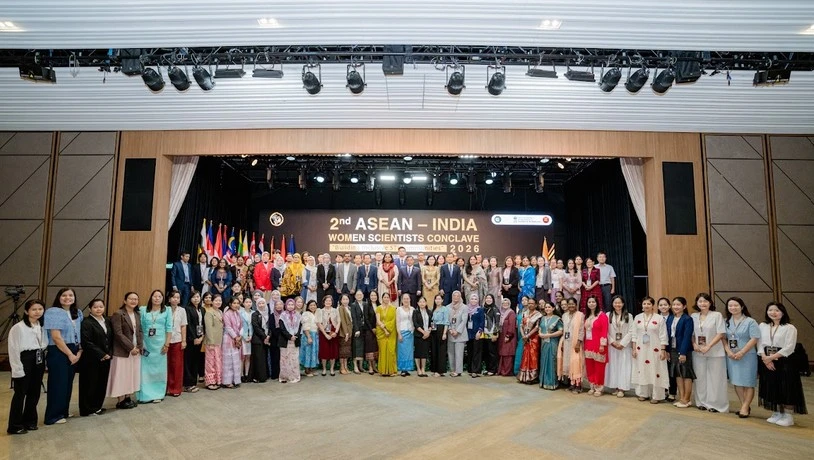
Gandhinagar | July 24, 2026: The 2nd ASEAN–India Women Scientists Conclave (AIWSC) 2026, held in Phnom Penh, Cambodia, from July 8 to 10, 2026, brought together more than 135 participants, including 90 women scientists from across ASEAN Member States and India for three days of scientific exchange, dialogue and collaboration under the theme “Building Inclusive STI Communities.” The conclave sought to strengthen regional cooperation in science, technology and innovation (STI) and to advance the participation and leadership of women in these fields.
AIWSC 2026 was hosted by the Indian Institute of Technology Gandhinagar (IITGN) and the Ministry of Industry, Science, Technology & Innovation (MISTI) of Cambodia, in collaboration with the Department of Science and Technology (DST), Government of India and the ASEAN Secretariat. It was supported through the ASEAN–India Science & Technology Development Fund (AISTDF) by the Government of India.
The central aim of the conclave was to foster STI ecosystems that are equitable, collaborative and accessible to all. Discussions acknowledged that, despite steady progress, women in the region continue to face barriers relating to career advancement, access to research funding, leadership opportunities and work–life balance. The theme underscored that inclusion extends beyond representation to the creation of enabling environments through mentorship, equitable institutional policies, leadership development and supportive innovation ecosystems.
In a message to delegates, Prof Umesh V Waghmare, Secretary, Department of Science and Technology, Government of India, said, “India and ASEAN share a relationship built on trust, mutual respect and a common vision, and science, technology and innovation have been among the strongest pillars of this partnership. We firmly believe that the future of science and innovation must be inclusive, and that women scientists, innovators and entrepreneurs are making extraordinary contributions across every field. I am confident that the conversations initiated here will translate into meaningful partnerships and impactful scientific collaborations in the years ahead.”
Over three days, delegates participated in plenary lectures, panel discussions, thematic roundtables, a pitching competition, and institutional visits, all designed to foster scientific exchange and identify opportunities for future collaboration.
Two panel discussions brought together policymakers, diplomats and researchers to share experiences and policy perspectives on strengthening women’s participation and leadership. Speaking on ‘ASEAN–India Women Scientists’ Role in STI,’ Dr Nagaboopathy Mohan, Scientist/Director of International Cooperation, DST, India, noted, “Through dedicated schemes and mobility and fellowship opportunities, DST has sought to support women at different stages of their careers. There is clear scope to extend such measures through the ASEAN–India partnership.”
Representing India in the panel discussion celebrating outstanding women scientists, Prof Sivapriya Kirubakaran, Professor and Head, Department of Chemistry, IITGN, reflected on the importance of nurturing the next generation of women researchers and of building networks that connect research with real-world impact across ASEAN and India. Professor Kirubakaran served as a convenor, leading the India organising team alongside counterparts from MISTI, Cambodia, to ensure the smooth execution of the event. “I am grateful to the Department of Science and Technology and the Ministry of External Affairs, Government of India, for entrusting IIT Gandhinagar with the opportunity to partner with MISTI in organising this landmark event,” she said.
A central feature of the conclave was a pitching competition across four global challenge areas: food security, sustainable energy solutions, equitable access to education, and emerging and trending technologies. Women scientists and researchers from ASEAN and India presented scalable solutions to independent panels, with recognition given at a closing awards ceremony. Dr Ratna Ghosal, Associate Professor at the Biological and Life Sciences division of Ahmedabad University, was recognised as the winner of the Emerging/Trending technologies theme for her outstanding presentation titled ‘Tracking free-ranging Mugger Crocodiles using UAV imagery and CNNs.’
Speaking about her conclave experience, Dr Ghosal said, “Participating in the 2nd ASEAN–India Women Scientists Conclave was a truly enriching experience. Receiving this recognition is deeply meaningful to me, but I see it as a tribute to India’s extraordinary biodiversity. Our rich ecological heritage continually inspires us to pursue better science in our mission to conserve nature, and I am proud that this work ultimately contributes to protecting the natural world.”
On the final day, all delegates undertook academic visits to the Institute of Technology of Cambodia (ITC) and the Royal University of Phnom Penh (RUPP), where they toured research facilities and engaged with local scientists. The interactions enabled delegates to explore research facilities, engage with local scientists and identify opportunities for future collaboration.
Speaking at the closing ceremony, H.E. HEM Vanndy, Cambodia’s Minister of Industry, Science, Technology & Innovation, stated that investing in women is essential to building a more innovative and resilient future. “As women are often the first and most influential mentors to our sons and daughters, empowering them creates lasting benefits for families and society. When society unleashes the potential of women in STEM or STI, we don’t just empower individuals, but we unlock the keys to solving the most complex challenges facing humanity,” Minister Vanndy said.
Mr Vanlalvawna Bawitlung, Ambassador of India to the Kingdom of Cambodia, underscored the importance of science diplomacy in strengthening regional ties. “The ASEAN–India Women Scientists Conclave is a shining example of the growing depth and breadth of ASEAN–India cooperation. It reflects our shared commitment to promoting greater participation and leadership of women in science and technology,” he said.
Congratulating the organisers on the successful conclusion of the conclave, Dr Rosa Da Costa Tilman, Director of the National Linguistic Institute, Universidade Nacional Timor Lorosa’e (UNTL), Timor-Leste, a delegate and panellist at the event, said, “The 2nd ASEAN–India Women Scientists Conclave created an environment that fostered meaningful discussions and new collaborations. It was a privilege to meet and learn alongside such inspiring women scientists from across ASEAN and India, and I look forward to the collaborations and long-lasting friendships that began in Phnom Penh.”
Reflecting on the significance of the conclave, Prof Rajat Moona, Director, IITGN, said, “Scientific excellence thrives in environments where diverse perspectives are valued, and researchers are empowered to learn from one another. Platforms such as the ASEAN–India Women Scientists Conclave help strengthen regional research ecosystems by encouraging knowledge exchange, leadership and long-term institutional engagement.”
| Note: The conclave was attended by various dignitaries from India and Cambodia, including Mr Vanlalvawna Bawitlung, Ambassador of India to Cambodia; Mr Hem Vanndy, Minister of Industry, Science, Technology & Innovation, Cambodia; Dr Nhim Khemara, Permanent Secretary of State, MISTI; Dr Kao Kim Hourn, Secretary-General of ASEAN; Mr Souksavath Sihapanya, Director General, DoS, MoES, COSTI Chair 2026, Lao PDR; and Dr Hul Seingheng, Cambodia COSTI Chairperson & Under-Secretary of State, MISTI, among others. |