



Paradox of active glassy dynamics in epithelia
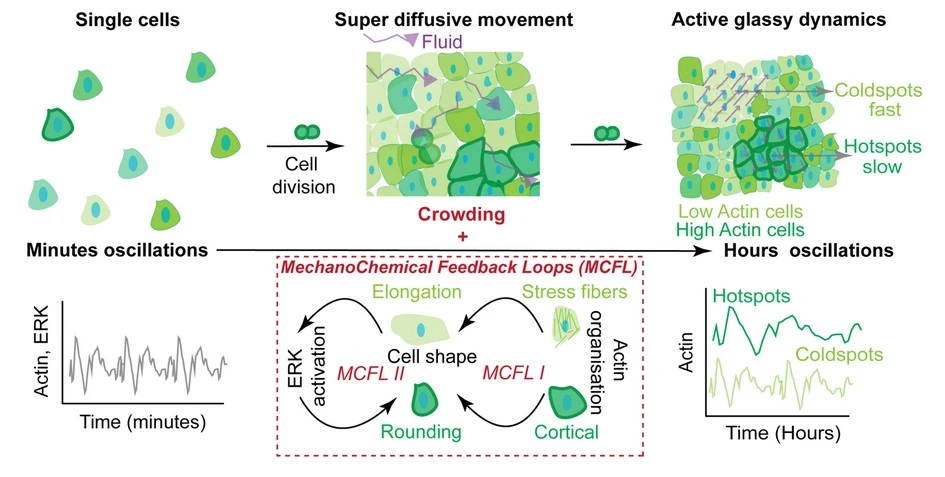
Research Summary: Crowded epithelial cells display slow glass-like dynamics despite internal cellular activity which should paradoxically fluidize the system. We show that biochemical signalling couples to physical properties of cells via their cytoskeleton, and this coupling allows cells to slow down, talk to their neighbors, and show emergent collective behaviour, which is not possible if they stand without neighbors.
Researcher Spotlight
Sindhu Muthukrishnan is a PhD student at the department of Bioengineering, Indian Institute of Science, in Dr Medhavi Vishwakarma’s Epithelial Mechanobiology lab, studying the interplay of epithelial tissue mechanics and signalling.
Linkedin- https://www.linkedin.com/in/sindhu-m-20271a138/
Twitter: https://x.com/sindhu__16
Lab: Dr. Medhavi Vishwakarma, Indian Institute of Science
Lab social media: https://x.com/Medhavishwa
Lab website: https://vishwakarmalab.com/
What was the core problem you aimed to solve with this research?
The central question we sought to address was how epithelial tissues exhibit arrested, collective glass-like dynamics despite internal activity and motility in cells, which would be expected to fluidize the tissue with fast, disordered dynamics rather than the observed slow, collective dynamics.
How did you go about solving this problem?
To address this problem, we simultaneously measured cytoskeletal dynamics and physical properties of epithelia such as cellular movement, forces, using traction force microscopy and timelapse microscopy. These experiments revealed slow actin oscillations, glassy dynamics, and mechanochemical feedback- coupling of biochemical signalling and physical properties of the epithelium. To integrate these observations into a mechanistic framework, we collaborated with physicists from Dr.Sumantra Sarkar’s group, who developed an active vertex model incorporating mechanochemical feedback.
“We find how active cells interact with one another to allow for emergent collective behaviour- crucial to eliminate transformed cells, and tissue repair.” – Dr. Medhavi Vishwakarma
How would you explain your research outcomes (Key findings) to the non-scientific community?
Epithelial tissues line our organs and consist of tightly packed sheets of cells. Neighbouring cells are connected through adhesion proteins, which are linked to the actin cytoskeleton. This cytoskeletal network determines cell shape and enables cells to generate forces that push and pull on one another.
Under crowded conditions, epithelial tissues exhibit arrested, collective, glass-like dynamics. Paradoxically, although individual cells are internally active and motile, this activity does not lead to fast and disordered fluid dynamics.
Instead, we show that biochemical signaling is coupled to physical properties such as cell shape and movement through the actin cytoskeleton. This coupling enables active cells to cooperate with their neighbours, slow down, and generate emergent collective behaviors that do not arise in isolated cells.
Moreover, when the tissue becomes crowded, rapid single-cell minute oscillations are coupled to the much slower collective dynamics of the tissue, giving rise to emergent oscillations on the timescale of hours.
What are the potential implications of your findings for the field and society?
Our findings have broad implications for biophysics by showing how mechanochemical feedback integrates physical forces and biochemical signaling to regulate collective cell behavior and tissue organization, required for many biological processes. For example, during embryonic development from a ball of cells to a complete organism, coordinated cell movement is essential for shaping tissues and organs.
Generally, this study bridges the gap between biology and physics by showing that tissue mechanics and biochemical signalling cannot be understood in isolation. Integrating these perspectives will be essential for developing a more predictive understanding of how living tissues function in both health and disease.
What was the exciting moment during your research?
I was excited when the slow actin oscillations disappeared upon treating the cells with an ERK inhibitor, which inhibits the fast single cell oscillations. Since the second year of my PhD, we have been trying to understand what drives the actin oscillations. This experiment finally answered that question by confirming our hypothesis that minute-scale ERK oscillations couples with slow glassy dynamics and gives rise to the hour-scale actin oscillations observed in epithelial tissues.
Paper reference: Muthukrishnan, S., Dewan, P., Tejaswi, T. et al. Glassy dynamics in active epithelia emerge from an interplay of mechanochemical feedback and crowding. Nat Commun (2026).https://doi.org/10.1038/s41467-026-74163-0