



The More, the Merrier—Until It’s Candida auris
Research Summary: Candida auris is one of the world’s most drug-resistant fungal pathogens. Our study reveals genome-level adaptations beyond point mutations that provide additional ways to withstand antifungal treatment.
Researcher Spotlight
Aswathy Narayanan is a postdoctoral researcher in Prof. Kaustuv Sanyal’s group at JNCASR, Bangalore, Aswathy Narayanan is interested in fungal genome evolution and antifungal drug resistance.
Lab: Prof. Kaustuv Sanyal, Jawaharlal Nehru Centre for Advanced Scientific Research
Website: https://molecularmycologylab.wixsite.com/kaustuv
What was the core problem you aimed to solve with this research?
Candida auris is a multidrug-resistant fungal pathogen that the World Health Organization has classified as a critical priority pathogen. Antifungal resistance is often explained by point mutations in a handful of well-characterised genes. However, predominantly asexual fungi such as C. auris also possess remarkably plastic genomes, allowing them to adapt rapidly to environmental stress. We wanted to understand whether this genomic plasticity itself contributes to the exceptional antifungal drug resistance observed in Indian C. auris clinical isolates, and, if so, what structural genomic changes underlie this adaptation.
How did you go about solving this problem?
We began by analysing the genomes of a diverse collection of Candida auris clinical isolates obtained through our collaborators at PGIMER, Chandigarh. Working closely with colleagues at IISER Thiruvananthapuram, we carried out a genome-wide screen for copy number variation to identify recurrent structural changes across the isolates. We then followed up on the most interesting genomic regions experimentally to understand how these structural changes influenced antifungal adaptation.
“An exciting discovery revealing genetic compensatory mechanisms used by the superbug in Indian hospitals to withstand antifungal drugs.” – Prof. Kaustuv Sanyal
How would you explain your research outcomes (Key findings) to the non-scientific community?
Fungal infections are becoming increasingly difficult to treat because some fungi are evolving ways to survive antifungal drugs. Most studies have focused on small changes, or mutations, in their DNA that make them resistant. Our research looked beyond these mutations to understand whether fungi have other ways of adapting.
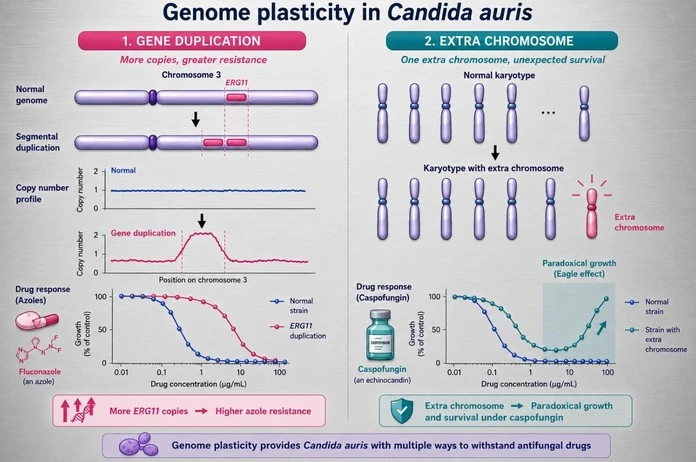
We discovered two such strategies in the emerging fungal pathogen Candida auris. First, the fungus can make extra copies of a gene targeted by one of the major antifungal drugs, making that treatment less effective. Second, and more surprisingly, we found that some strains carry an additional chromosome—an extra piece of DNA—that helps them survive treatment with another important antifungal drug called caspofungin. Instead of being killed, these fungi can reorganise their protective outer cell wall and withstand the drug more effectively.
Our findings show that drug resistance is not always caused by mutations alone. Sometimes, larger changes in the genome, such as extra chromosomes, can also help pathogens survive. Understanding these hidden mechanisms is important for developing better diagnostic tools and more effective treatments against fungal infections.
What are the potential implications of your findings for the field and society?
Fungal pathogens have received far less attention than bacterial or viral pathogens, despite causing a substantial global disease burden. Over the past decade, however, this has begun to change, reflected by initiatives such as the World Health Organization’s Fungal Priority Pathogens List (FPPL). Our study contributes to this growing understanding by highlighting that antifungal adaptation is not driven solely by classical resistance mutations. We identified genome plasticity, particularly the formation of additional chromosomes, as a mechanism that can reduce susceptibility to antifungal drugs and promote the pathogens’ survival under drug stress.
These findings have important implications for both research and clinical practice. They suggest that surveillance and diagnostic approaches should not only focus on known resistance mutations but also consider larger-scale genomic changes that may influence treatment outcomes. Our work also demonstrates that targeting the fungal stress response pathways alongside conventional antifungal therapy enhances drug activity, providing further support for the development of combination therapies. More broadly, understanding these adaptive strategies will be essential as we continue to confront emerging multidrug-resistant pathogens such as Candida auris.
What was the exciting moment during your research?
One of the most exciting moments during this project came when I realised that the additional chromosome I had observed on a pulsed-field gel was associated with an unusual response to the antifungal drug caspofungin. When I performed the standard antifungal susceptibility assay, the isolate behaved exactly as expected at low drug concentrations—it was inhibited. Surprisingly, at much higher concentrations, it began growing again. My first thought was that I had made a mistake in the assay, so I repeated the experiment several times. The results were always the same. It was only later that I learnt I was observing a known but relatively understudied phenomenon called paradoxical growth, or the Eagle effect, in which certain fungi resume growth at high concentrations of echinocandins. It was fascinating to discover that a tiny extra chromosome could influence such a poorly understood and counterintuitive biological phenomenon.
Paper reference: Narayanan, A., Joshi, S., Harchand, R., Prasad, R., Rudramurthy, S. M., Nishant, K. T., & Sanyal, K. (2026). Segmental duplications and supernumerary chromosomes drive antifungal drug resistance in Candida auris. Nature communications, 10.1038/s41467-026-75437-3. Advance online publication. https://doi.org/10.1038/s41467-026-75437-3