



Pleotropic roles of AP-3 complex in Dense Core Vesicle function
Research Summary: This study establishes AP-3 as a critical regulator of dense-core vesicle maturation, selective cargo sorting and regulated secretion in neuroendocrine cells.
Researcher Spotlight
Shashank Saxena is a PhD student at the National Brain Research Centre, Manesar. His research focuses on intracellular trafficking, dense core vesicle biology, cargo sorting, and regulated secretion using advanced imaging and molecular approaches.
LinkedIn: https://www.linkedin.com/in/shashank-saxena-252b53129/
Twitter: https://x.com/SHASHANKSAXENA5
Lab: Dr. Bhavani Shankar Sahu, National Brain Research Centre, Manesar
What was the core problem you aimed to solve with this research?
The core problem was to understand how the AP-3 complex regulates dense-core vesicle function, and how its loss disrupts selective cargo sorting, vesicle maturation, and regulated secretion.
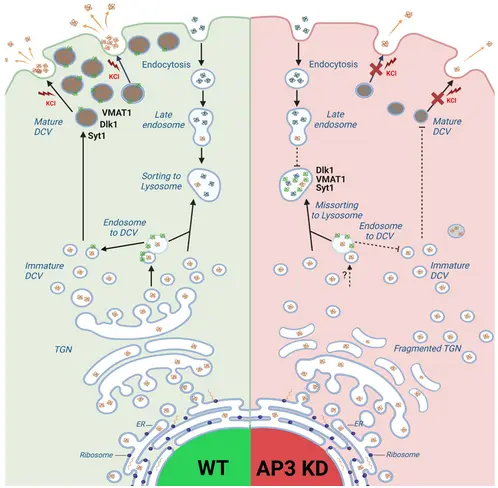
How did you go about solving this problem?
We addressed this problem using a combination of cellular, molecular and imaging approaches in PC12 cells. We depleted AP-3 complex and assessed its effects on dense-core vesicle (DCV) biogenesis, trafficking, maturation, and secretion. Stimulus coupled-secretion assays, RUSH trafficking, transmission electron microscopy, and SILAC-based proteomics were used to identify functional and morphological defects. We further validated specific AP-3-dependent cargos, including SYT1, VMAT1, identified a novel cargo DLK1, and examined their contribution to DCV function. Together, these approaches established how AP-3 selectively sorts cargo to maintain functional DCVs.
“The AP-3 complex acts like a cellular postal worker, packaging neurotransmitter cargo into dense-core vesicles for delivery. Without functional AP-3, these vital chemical packages are misrouted directly into lysosomes for degradation, leaving brain cells unable to send proper chemical signals.” – Dr. Bhavani Shankar Sahu
How would you explain your research outcomes (Key findings) to the non-scientific community?
Our research shows that cells have a sophisticated sorting system that ensures the right proteins and molecules are packaged into specialized structures called dense-core vesicles, which are responsible for storing and releasing important hormones, neuropeptides and neurotransmitters. We identified the AP-3 protein complex as an important part of this system. We found that when AP-3 is absent, the vesicles are formed incorrectly, have an altered composition, and are unable to release their contents efficiently. In particular, improper sorting or loss of vesicle content lead to defective vesicle maturation and secretion. Using microscopy, biochemical experiments, proteomics, and genetic approaches, we demonstrated that AP-3 selectively directs specific proteins into these vesicles. Overall, our findings provide new insight into how cells maintain the quality and functionality of their secretory machinery and ensure proper communication between cells.
What are the potential implications of your findings for the field and society?
Our findings provide new insight into how cells selectively sort and package proteins into dense-core vesicles, a process essential for the regulated release of hormones, neuropeptides, and other signaling molecules. By establishing AP-3 as an important regulator of vesicle composition, maturation, and secretion, this work advances our understanding of the fundamental mechanisms governing cellular communication. Since defects in vesicle trafficking and secretion are associated with several neurological, endocrine, and metabolic disorders, understanding AP-3-dependent cargo sorting may help identify mechanisms underlying disease-associated cellular dysfunction. In the longer term, these findings could contribute to the identification of new molecular targets or biomarkers for disorders involving impaired intracellular trafficking and regulated secretion. More broadly, the study provides a framework for understanding how cells maintain the quality and functionality of their secretory machinery.
What was the exciting moment during your research?
The most exciting moment for me was when the different experiments started coming together and I realized that we were uncovering something beyond what we initially expected. Seeing the defects in vesicle secretion, and then finding corresponding changes in vesicle morphology and cargo composition through electron microscopy and proteomics, was incredibly rewarding. I was particularly excited when we identified a novel protein DLK1 that depended on AP-3 for proper sorting. It was one of those moments in research where individual observations suddenly connected into a bigger picture.
Paper reference: Saxena S, Mukherjee C, Ghosh V, Chauhan BS, Sahu BS. AP-3 complex sorts preferential cargo to govern dense core vesicle function in neuroendocrine cells. J Biol Chem. 2026 Aug 5;302(9):113396. doi: 10.1016/j.jbc.2026.113396. Epub ahead of print. PMID: 42556728.