



Cell death shapes antiviral response at high MOI
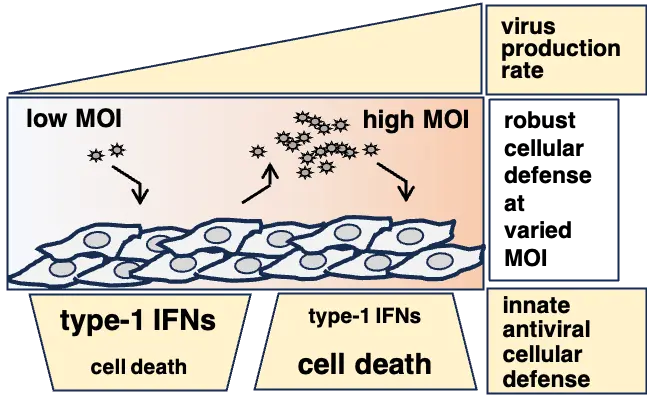
Research Summary: Cell death – more so than type-1 interferons – limits Chandipura virus propagation at cell-saturating high multiplicity of infection.
Researcher Spotlight
First authors: Bhawna & Swapnava Basu
Bhawna, a joint PhD student at the National Institute of Immunology and the Indian Institute of Technology Delhi, is an experimental biologist interested in deciphering host-virus interactions to better understand viral pathogenesis and antiviral immune responses.
Swapnava Basu, a PhD student at the National Institute of Immunology, is a computational biologist who is passionate about integrating experimental data with mathematical modelling to uncover biological mechanisms.
Bhawna- www.linkedin.com/in/bhawna-35b708342
Swapnava Basu- https://www.linkedin.com/in/swapnava-basu-aa47a9286/
Twitter: https://x.com/BasuSwapnava
Lab: Dr. Soumen Basak, National Institute of Immunology
Lab website: https://www.nii.res.in/en/faculty/dr-soumen-basak
What was the core problem you aimed to solve with this research?
Chandipura virus (CHPV) has been associated with several recent outbreaks in different parts of India. This study addresses a key knowledge gap regarding how changes in the effective multiplicity of infection (MOI) during Chandipura virus (CHPV) infection shape the balance between type-I interferon responses and cell death pathways. While each of these antiviral processes has been studied independently, their integrated regulation across different MOI conditions has not been systematically investigated previously.
How did you go about solving this problem?
We addressed this problem through a combination of experimental studies and mathematical modelling. Wild-type, interferon receptor-deficient, and cell death mutant mouse embryonic fibroblasts were infected with CHPV across a range of MOIs. We then quantified viral progeny production, type-I interferon responses, and CHPV-induced cell death under these conditions. To disentangle the relative contributions of interferon-mediated antiviral activity and cell death, we developed a mathematical model incorporating viral replication, interferon production, and cell death dynamics. By integrating experimental observations with model-based analyses, we demonstrated that cell death, rather than type-I interferon responses, is the dominant factor limiting CHPV propagation at cell-saturating high MOI.
“This work highlights cell death – more so than type-1 interferons – as a powerful innate defense mechanism that restrains Chandipura virus spread at high infection levels.” – Dr. Soumen Basak
How would you explain your research outcomes (Key findings) to the non-scientific community?
This study shows that our cells are smarter than we think. We discovered that when attacked by Chandipura virus, our cells don’t rely on just one defense. Instead, they activate different immune responses depending on how many viruses are attacking:
- Few invaders? Release interferons to slow them down.
- Many invaders? Triggers cell death to stop spread
These findings improve our understanding of how the body naturally limits the spread of viral infections and may help guide future strategies for controlling diseases caused by Chandipura virus and related viruses.
What are the potential implications of your findings for the field and society?
NF-κB signaling controls both the antiviral interferon and cell death pathways, albeit reciprocally. Our findings highlight the therapeutic potential of targeting NF-κB signaling and accounting for input MOI dynamics to optimize antiviral and anti-inflammatory treatment strategies.
What was the exciting moment during your research?
The most exciting moment came when we observed a sharp decline in progeny virus production as the MOI increased from 2 to 20 during CHPV infection of WT MEFs. This unexpected finding challenged our assumption that higher viral input would lead to greater viral output and motivated us to investigate the underlying antiviral mechanisms. We then examined how type-I interferon responses and cell death pathways contribute to controlling infection across different MOIs using both WT and mutant cell lines.
Paper reference: Bhawna , Basu S, Mian SY, Arora S, Ratra Y, Ganguly K, Bais SS, Banerjee M, Singh A, Basak S.0.A dominant role of cell death in limiting Chandipura virus propagation at cell-saturating high multiplicity of infection. mBio0:e01013-26.