



Chlorogenic acid does not prevent chronic Parkinson’s pathology in mice
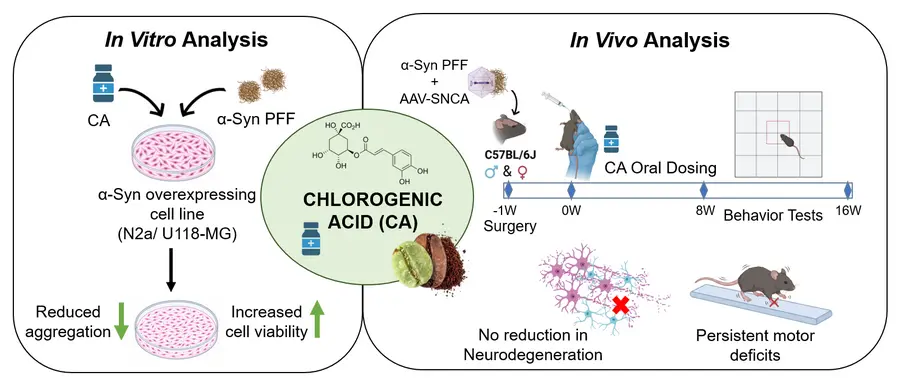
Research Summary: Chlorogenic acid, a major component of coffee, showed protective effects in laboratory-grown cells but failed to protect brain cells, prevent protein aggregation, or reduce Parkinson’s-related symptoms in mice.
Researcher Spotlight
Akshaya Rajan is a graduate student in the Thakur Neurodegeneration lab, IISER-TVM, supervised by Dr. Poonam Thakur. Her project focuses on understanding the metabolic changes associated with Parkinson’s disease.
Linkedin- Akshaya Rajan
Twitter- @Akshaya_cgr
Instagram- Akshaya.cgr
Lab PI name: Dr. Poonam Thakur
University: Indian Institute of Science, Education and Research, Thiruvananthapuram
Lab social media: @poonam_thakur6
What was the core problem you aimed to solve with this research?
Parkinson’s disease (PD) is a complex, progressive disorder for which current treatments mainly manage symptoms without slowing disease progression. Although chlorogenic acid (CA) has shown promising neuroprotective effects in acute toxin-based models, these models do not fully reflect the chronic and progressive nature of Parkinson’s disease.
Therefore, we aimed to determine whether CA could retain its neuroprotective effects in a chronic progressive mouse model that better captures key features of the disease and its potential for therapeutic translation.
How did you go about solving this problem?
We approached this problem using both in vitro and in vivo aspects. We tested the neuroprotective potential of CA in the N2a and U118-MG cell lines and found that CA significantly reduced aggregate formation and improved cell viability. Based on this, we evaluated CA in a chronic, progressive mouse model of PD.
The treatment was administered orally for 16 weeks, during which motor symptoms were monitored, and brain histopathological analysis was performed. We included equal numbers of male and female mice to account for sex-related differences, which are often overlooked in preclinical studies. We also performed pharmacokinetic analysis to confirm that CA reached the brain. This helped us determine whether any effects observed in the mice could be attributed to CA actually reaching the brain.
“It is great to see that the PD model developed in our lab is providing a robust platform for identifying which drugs or compounds can translate into neuroprotective agents in the clinical studies.” – Dr. Poonam Thakur
How would you explain your research outcomes (Key findings) to the non-scientific community?
Despite decades of research, there is still no drug that can cure PD. Developing effective treatments is challenging because Parkinson’s is a complex and progressive disease, and potential drugs must also reach the brain and work under these conditions. Coffee and its compounds have shown promising protective effects in several brain disorders, and CA, a compound naturally found in coffee, has also shown encouraging results in laboratory and preclinical studies. However, an important question remained: “Could CA still provide protection in a model that more closely reflects the chronic and progressive nature of Parkinson’s disease?”
Our study showed that while CA had protective effects in laboratory-grown cells, these benefits did not translate to a chronic mouse model that more closely reflects PD. At the dose and treatment duration tested, CA did not reduce Parkinson’s-related symptoms or major pathological changes in the mice. It showed a modest reduction in inflammation in female mice alone. These findings highlight that promising results in simpler laboratory models do not always translate into benefits in more complex disease conditions.
What are the potential implications of your findings for the field and society?
Our findings have important implications for how potential PD therapies are evaluated. First, they highlight the importance of choosing appropriate disease models. Compounds that show promising effects in acute models may not necessarily work in chronic models, which better capture the complex and progressive nature of PD. Our findings also highlight the importance of considering sex as a biological variable in preclinical research, as we observed some sex-related differences in behavioral symptoms and in the effects of CA on inflammation.
From a broader perspective, these findings can help guide more efficient drug development by identifying limitations of promising candidates at an earlier stage and potentially preventing resources from being invested in compounds based on results from models that may not adequately reflect human disease. Finally, reporting neutral or unexpected findings is equally important for the scientific community, as such results help researchers make informed decisions and design better studies in the future.
What was the exciting moment during your research?
One of the most exciting moments was seeing the contrast between our cell culture and animal studies. CA reduced the accumulation of aggregated proteins in both neuronal and glial cell cultures, so we were interested to see whether this protective effect would also occur in the chronic PD mouse model. Surprisingly, despite these promising cellular effects, CA did not reduce aggregate deposition or protect neurons in the mice. We also observed interesting sex-related differences in the behavioral features of the disease; gait abnormalities were more evident in male mice, whereas grip-related deficits were more pronounced in females. These unexpected findings made the study particularly interesting and highlighted how responses can differ as we move from simple laboratory models to a complex living system.
Paper reference: Rajan, A., Prakash, S., Singh, D., Thakur, P. Chlorogenic Acid Fails to Confer Neuroprotection in a Chronic Mouse Model of Parkinson’s Disease. Mol Neurobiol 63, 863 (2026). https://link.springer.com/article/10.1007/s12035-026-06157-4