



Integrative modelling of innate immune response dynamics during virus infection
Research Summary: Viruses and the innate immune system engage in a molecular tug-of-war. This mechanistic mathematical model reveals infection tipping points and guides the design of antiviral treatment strategies.
Researcher Spotlight
First authors: Ramya Boddepalli & Harsh Chhajer
Ramya Boddepalli, a PhD student in the Department of Chemical Engineering at the Indian Institute of Science, Bangalore, is interested in mathematical modeling of virus-host interactions to understand the dynamics of viral infection and immune response.
LinkedIn: https://www.linkedin.com/in/ramya-boddepalli-a96266137
Harsh Chhajer studied various aspects of positive-sense RNA viruses, including kinetics, immune responses, and drug therapies, as part of his doctoral studies in the Department of Bioengineering at the Indian Institute of Science. He now works as a postdoctoral researcher at the University of Oslo, where he infers mechanisms of translation regulation.
LinkedIn: https://www.linkedin.com/in/harsh-chhajer-58083912b
Lab: Dr. Rahul Roy, Indian Institute of Science
Lab social media: https://nanobiology.nanobiophotonics.org/home
What was the core problem you aimed to solve with this research?
Positive-sense RNA viruses, including Hepatitis C virus (HCV), Dengue virus, and Japanese Encephalitis virus (JEV), infect hundreds of millions of people worldwide. Although we know many of the molecular processes involved in viral replication and the innate immune response, we still have only a limited understanding of how they interact dynamically within an infected cell during the crucial early stages of infection.
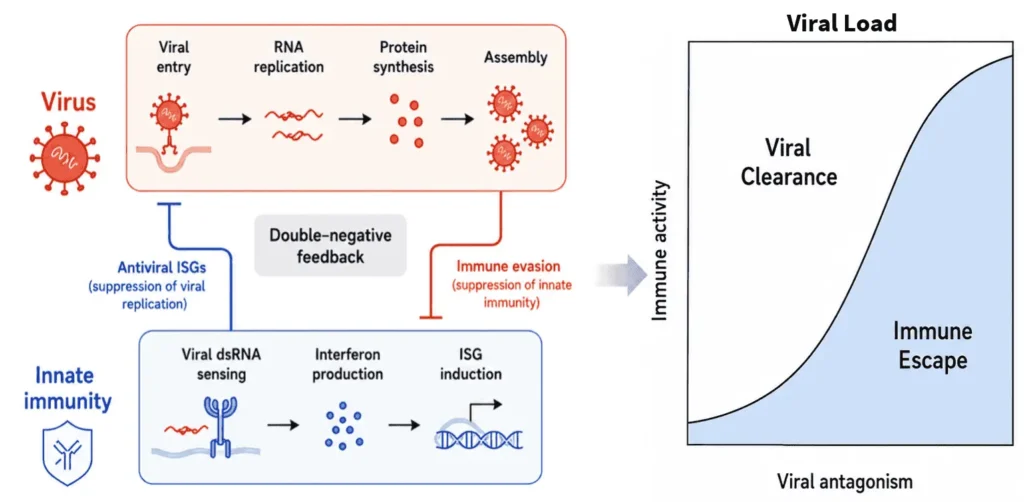
The virus and the host cell are engaged in a constant molecular tug-of-war. As the virus replicates and attempts to evade immune detection, the cell tries to recognize the infection and activate antiviral defenses through interferon signaling. Many viruses further complicate this interaction by actively suppressing the very immune pathways designed to eliminate them.
Because these processes occur simultaneously and influence one another, studying them independently provides only a partial picture. We wanted to understand how this dynamic interplay determines whether an infection is rapidly cleared, remains controlled, or persists. More broadly, we wanted to understand why seemingly similar viruses—or even the same virus in different individuals—can produce remarkably different disease outcomes.
How did you go about solving this problem?
Studying this complex interaction experimentally is challenging because dozens of molecular processes occur simultaneously and influence one another over time. Experimentally exploring every possible combination of viral replication, immune activation, and immune evasion would be practically impossible.
To address this, we developed a comprehensive mechanistic mathematical model that integrates the viral life cycle with the host innate immune response into a single framework. Unlike many previous models that focused primarily on either viral replication or immune signaling, our model captures both processes together, allowing them to interact dynamically.
This approach allows us to computationally explore thousands of biological scenarios, identify the molecular processes that most strongly influence infection, and test potential intervention strategies before conducting laboratory experiments. Rather than treating infection as a “black box,” the model explicitly represents the underlying biology, enabling both prediction and mechanistic understanding.
“This work gives us molecularly defined targets to predict how interventions change infection outcomes — powerful for designing broad-spectrum, host-targeted antivirals.” – Dr. Rahul Roy
How would you explain your research outcomes (Key findings) to the non-scientific community?
One of our most striking findings is that viral infection behaves much like a seesaw balanced near a tipping point. Small changes in the balance between viral replication and the body’s innate immune response can dramatically alter the outcome, leading either to rapid viral clearance or persistent infection.
The model also reveals that viruses with similar life cycles can interact very differently with the innate immune system. Some viruses trigger strong antiviral responses, whereas others evade or suppress these defenses more effectively. This suggests that infection within a tissue may be highly heterogeneous, with some cells successfully controlling infection while neighboring cells remain susceptible.
Our study also highlights the importance of treatment timing. Simulations suggest that interferon, one of the body’s natural antiviral molecules, may be considerably more effective when administered before or very early during infection than after the virus has become well established. These findings illustrate how mechanistic models can be used to explore and optimize antiviral intervention strategies before experimental testing.
Finally, the model identifies molecular signals whose dynamics change as infection progresses. These signals could serve as candidate biomarkers for monitoring infection progression and assessing disease severity, although their utility would require experimental validation.
What are the potential implications of your findings for the field and society?
For the research community, this model provides a foundation that can be expanded and integrated with multiscale models to connect molecular events inside individual cells with infection dynamics across tissues and organs. It can also guide experimental research by identifying the biological processes that strongly influence infection outcomes. Perhaps its greatest impact, however, is as a predictive platform for evaluating antiviral therapies in silico. Because the model explicitly captures the underlying biology, it can be used to investigate why antiviral treatments succeed or fail, compare potential drug targets, optimize treatment timing and dosing, and explore combination therapies, such as interferon together with direct-acting antivirals, before laboratory testing. By prioritizing the most promising therapeutic strategies computationally, the framework can accelerate antiviral drug development while reducing experimental time and cost.
What was the exciting moment during your research?
One of the most rewarding moments came when the model began explaining differences between viruses that we had not explicitly programmed into it.
For example, Japanese Encephalitis virus and Hepatitis C virus have broadly similar life cycles, yet they interact with the innate immune system in very different ways. The model showed that JEV rapidly triggers a strong immune response despite its rapid replication, whereas HCV establishes infection by delaying and suppressing immune activation. Seeing these distinct behaviors emerge naturally from the underlying biological mechanisms was exciting because it demonstrated that the model was capturing meaningful biology rather than simply reproducing known observations. It reinforced our confidence that mechanistic models can do more than fit experimental data; they can also provide new biological insights and generate hypotheses for future experiments.
Paper reference: https://journals.plos.org/ploscompbiol/article?id=10.1371/journal.pcbi.1014395