


Deep sleep helps anxious individuals differentiate noise from actual change
Research Summary: We found that higher trait anxiety amplified reward updating under stable, noisy conditions; while deep/N3 sleep promoted adaptive learning by distinguishing noise from true changes when outcomes were uncertain.
Researcher Spotlight
Rakshita Deshmukh is a PhD student working with Dr. Arjun Ramakrishnan at the Department of Biological Sciences and Bioengineering, IIT Kanpur. Her research investigates how deep sleep may help reduce anxiety and promote adaptive learning under uncertainty.
Linkedin: https://www.linkedin.com/in/rakshita-deshmukh-8028b919a
Twitter: @sleepy_neuron
Lab PI name: Dr. Arjun Ramakrishnan
University: IIT Kanpur
Lab social media: https://sites.google.com/view/decisionlabiitk/home
What was the core problem you aimed to solve with this research?
Everyday, we must decide whether an unexpected outcome reflects random variation or a sign that something has genuinely changed. Imagine visiting your favourite restaurant for your usual pasta, only to find it tastes terrible. Has the restaurant’s quality declined, or were the ingredients simply not up to the mark that day? These reflect two kinds of uncertainty: volatility, or genuine change in the environment, and stochasticity, or random noise in a stable world. Appropriate learning means updating our beliefs when things truly change, while resisting the urge to overreact to random fluctuations, i.e., increasing learning under volatility and decreasing it under stochasticity.
However, our internal states also shape how we interpret uncertainty. Trait anxiety, a stable personality characteristic reflecting a persistent tendency to worry, is closely linked to how we respond to uncertainty. But what exactly goes wrong? Do individuals with higher trait anxiety overestimate change in general, or do they specifically misinterpret random noise for genuine change? Most previous research has focused on volatility, leaving this distinction unresolved.
We also know that anxiety and sleep influence each other bidirectionally: anxiety can disrupt sleep, while sleep can shape how we feel the next day. In particular, deep (NREM-3/N3 stage) sleep is associated with reduced next-day anxiety. But could N3 sleep also recalibrate how we learn under uncertainty, helping us distinguish random fluctuations from genuine environmental changes? This was the question we set out to investigate.
How did you go about solving this problem?
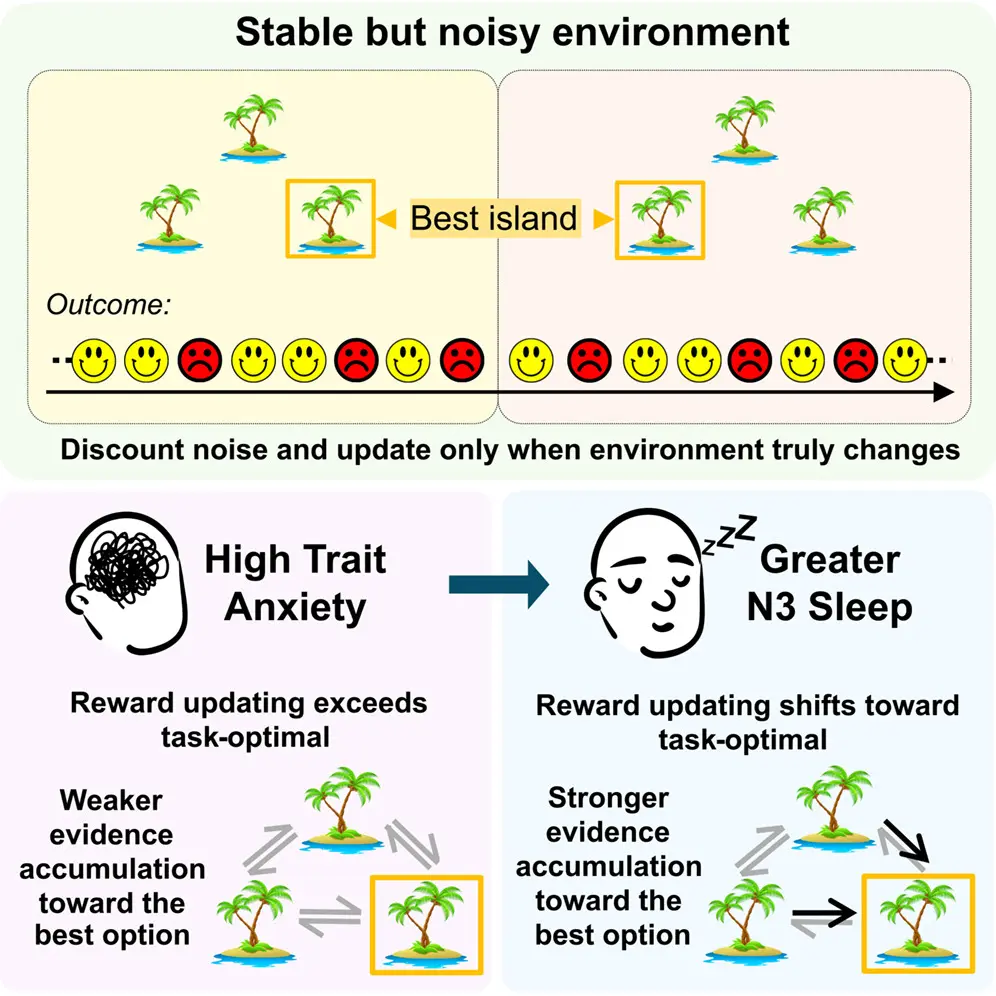
We designed a fishing game in which participants repeatedly chose among three islands to catch as many fish as possible. One island was always the best, but we varied two things independently:
- Noise / Stochasticity: how reliably the best island paid off (80%, 70% or 60% of the time).
- Change / Volatility: how often the best island secretly switched (every 25 or every 10 out of 50 trials).
This lets us separate the two kinds of uncertainty within a single task.
We ran two preregistered experiments with students at IIT Kanpur. In the first, 48 participants played the game and completed a standard trait anxiety questionnaire. In the second, 40 participants played before and after a night in our sleep lab. We recorded their sleep with a wearable EEG headband to measure deep (N3) sleep and tracked their anxiety in the evening and the next morning.
To see what was happening “under the hood,” we used two kinds of computational models. Hierarchical Bayesian reinforcement-learning models estimated how quickly each person updated their beliefs. Drift-diffusion models showed how efficiently they built up evidence for the best island. We also simulated thousands of artificial agents to find the ideal learning rate for each condition, which gave us a benchmark to compare people against.
“What excites me is that anxiety selectively alters how we interpret uncertainty while deep sleep helps recalibrate this process.” – Dr. Arjun Ramakrishnan
How would you explain your research outcomes (Key findings) to the non-scientific community?
Imagine you’ve found the best fishing spot on a lake. It gives you plenty of fish most days, but some days, you come back empty-handed. An experienced fisher knows that one disappointing day doesn’t necessarily mean the fish have moved; sometimes, outcomes are simply unpredictable.
We found that people with higher trait anxiety seemed more likely to interpret these random fluctuations as signs that something had changed. When the environment was stable but unpredictable: the fish were still there, but were not being caught consistently; they tended to update their choices more than was helpful, potentially making it harder to stick with the best fishing spot. Interestingly, this pattern was not apparent when the fish genuinely moved more frequently: participants with higher trait anxiety appeared just as capable of adapting to real changes as others.
Sleep offered a promising clue. People who experienced more deep (N3) sleep tended to wake up feeling less anxious. Among those with higher trait anxiety, more N3 sleep was also associated with learning that appeared more adaptive, better identification of rewarding fishing spots, and greater rewards the next morning. Since we measured naturally occurring sleep rather than experimentally manipulating it, we cannot conclude that deep sleep directly caused these improvements. However, our findings suggest that deep sleep may be one factor that supports both emotional recovery and more adaptive decision-making under uncertainty.
What are the potential implications of your findings for the field and society?
Our findings suggest that anxiety is not simply a tendency to perceive change everywhere, but may involve selectively misinterpreting noise for genuine change. We also identify deep N3 sleep as a potential link between anxiety and adaptive decision-making. Future studies could test whether experimentally enhancing N3 sleep through non-invasive stimulation improves uncertainty learning, potentially informing non-pharmacological sleep-based interventions for anxiety.
What was the exciting moment during your research?
One of the most exciting moments in our research was discovering that the excessive updating we observed in individuals with high trait anxiety during stable, noisy conditions in our first behavioural experiment was attenuated following a night of sleep in our second experiment. Most excitingly, greater deep sleep (N3) was associated with a shift towards more task-optimal learning after sleep. Although this specific hypothesis was not preregistered, the finding emerged from our subsequent analyses and offered a compelling direction for further investigation. It suggested that sleep may do more than simply reduce anxiety; it may also help us distinguish random fluctuations from meaningful changes in our environment, supporting more adaptive decision-making under uncertainty.
Paper reference: Deshmukh, R and Ramkrishnan, A. (2026). Trait anxiety selectively amplifies reward learning under uncertainty, while N3 sleep attenuates it. iScience, 29 (10), 117745. https://doi.org/10.1016/j.isci.2026.117745