



When dopamine talks to glutamate receptors: Implications in receptor trafficking
Research Summary: Dopamine, a non-cognate ligand of group I metabotropic glutamate receptors, unexpectedly activates them, triggering subsequent receptor internalization, and recycling. This ultimately drives synaptic AMPA receptor internalization, potentially regulating synaptic plasticity.
Researcher Spotlight
Dr. K Aruna recently completed her PhD in the Department of Biological Sciences at Indian Institute of Science Education and Research Mohali, under the supervision of Prof. Samarjit Bhattacharyya. Her research explored how dopamine regulates group I mGluR trafficking and influences neuronal plasticity.
Instagram : @aruna_nadal
Facebook : Aruna Nadal
Lab PI name: Prof. Samarjit Bhattacharyya
University: Indian Institute of Science Education and Research Mohali
Lab website: https://sites.google.com/site/drsamarjitbh
What was the core problem you aimed to solve with this research?
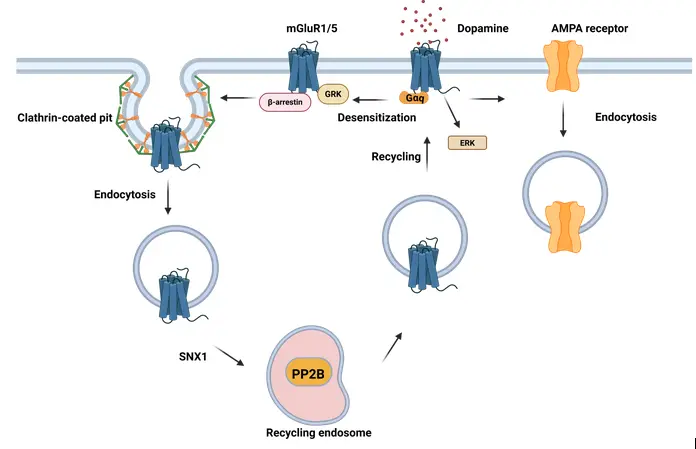
Dopamine is well established as an important modulator of hippocampus-dependent learning and memory, while group I metabotropic glutamate receptors are central to the regulation of synaptic plasticity. However, how these two neurotransmitter systems communicate at the molecular level remains poorly understood. In particular, it was unclear whether dopamine could directly influence glutamate receptors as a non-cognate ligand and whether such interactions could regulate receptor trafficking and synaptic function. Our research addressed this gap by investigating whether dopamine activates group I metabotropic glutamate receptors (mGluR1/5), alters their activity, internalization, and recycling, and consequently regulates synaptic AMPA receptor endocytosis, which is the cellular correlate of synaptic plasticity. This work reveals a potential crosstalk between dopaminergic and glutamatergic systems in the hippocampal region of the brain which could regulate various forms of synaptic plasticity, including learning, and memory.
How did you go about solving this problem?
I approached the problem step-by-step: first asking whether dopamine can alter mGluR trafficking, and then determining how this happens, and finally asking whether this non-canonical signaling has consequences for synaptic AMPA receptor trafficking and synaptic function. I used a combination of cellular, biochemical, and pharmacological approaches in primary hippocampal neurons and HEK293 cells. I first examined whether dopamine could induce internalization of group I mGluRs using dual antibody feeding assay. I then investigated the underlying mechanisms of dopamine-mediated mGluR internalization by studying the involvement of dopamine receptors, G-protein signaling, GRKs, β-arrestins, clathrin, and dynamin using both pharmacological blockers and knockdown approaches. To determine whether dopamine activates mGluRs, I assessed downstream Gαq signaling and ERK1/2 phosphorylation. Finally, I examined receptor recycling and determined whether dopamine-induced mGluR activation influences synaptic AMPA receptor endocytosis in hippocampal neurons, potentially linking receptor trafficking to synaptic plasticity.
“Our study shows an unexpected role of dopamine in the regulation of group I mGluRs and mGluR-mediated synaptic AMPAR endocytosis.” – Prof. Samarjit Bhattacharyya
How would you explain your research outcomes (Key findings) to the non-scientific community?
Think of a neuron as a house with many different doorbells, each responding to a different chemical message. Group I metabotropic glutamate receptors (mGluR1 and mGluR5) are two such doorbells on the neuronal surface, normally activated by glutamate. Our study uncovered an unexpected twist: dopamine, another important brain chemical, can also trigger these receptors to move away from the cell surface to inside the neuron. Once internalized, dopamine directs these receptors to recycling endosomes-the cell’s sorting and temporary storage compartments. Remarkably, dopamine sends mGluRs through a faster recycling route than glutamate, allowing them to return to the cell surface sooner and become available for signaling again. This receptor trafficking also influences AMPA receptors, key regulators of communication between neurons. Because changes in AMPA receptor availability at synapses are central to synaptic plasticity, learning, and memory, our findings reveal an unexpected connection between dopamine and glutamate receptor trafficking. Overall, this study identifies a previously unrecognized route through which dopamine can regulate glutamate receptor dynamics and reshape the molecular processes underlying neuronal communication and plasticity.
What are the potential implications of your findings for the field and society?
The take-home message of my work is that dopamine and glutamate may not operate as two separate systems in the brain, but as an interconnected molecular network. By uncovering an unexpected way in which dopamine can regulate glutamate receptor trafficking and AMPA receptor availability at the neuronal membrane, my work provides a new framework for understanding how neuromodulation can rapidly reshape synaptic plasticity. Since disruption of dopamine and glutamate signaling has been implicated across multiple brain disorders, this study could ultimately contribute to identifying new strategies for understanding the role of these receptors in synaptic plasticity and might have clinical relevance to the function of these receptors in various neuropsychiatric disorders.
What was the exciting moment during your research?
This work was truly a ‘eureka’ moment for me. The project felt like putting together a jigsaw puzzle, where each experiment revealed a new piece and gradually helped us see the bigger picture. The most exciting discovery was that dopamine, which had not previously been reported as an activator of group I mGluRs, could regulate the internalization and trafficking of these receptors in hippocampal neurons through mechanisms distinct from those triggered by their conventional ligand, glutamate. What made the finding even more exciting was discovering that dopamine not only altered mGluR trafficking but also influenced synaptic AMPA receptor trafficking in hippocampal neurons. This provided a potential link between dopamine signalling, glutamate receptor dynamics and synaptic plasticity. Bringing these individual observations together was the real ‘eureka’ moment-it transformed what initially seemed like separate pieces of a puzzle into a coherent story with broader implications for how neuromodulators may shape neuronal communication, learning and memory.
Paper reference : Aruna K, Kulkarni M, Bhattacharyya S. (2026) Metabotropic glutamate receptor internalization and synaptic AMPA receptor endocytosis by dopamine. Journal of Cell Science. 139(15). jcs.264725. https://doi.org/10.1242/jcs.264725