



Bacterial Survival on a Budget: Adapting to Different Levels of Stress
Research Summary: Different magnitudes of paraquat stress drive distinct adaptive responses in Escherichia coli. Import regulation enables low-stress tolerance, while higher stress selects energetically costly detoxification and efflux strategies shaped by metabolic economy.
Researcher Spotlight
Anjali Vijay Patil is an Integrated PhD scholar working under the supervision of Dr. Amitesh Anand at the Department of Biological Sciences, Tata Institute of Fundamental Research, Mumbai. Her research focuses on understanding the non-canonical oxidative stress mitigation strategies and stress magnitude dependent adaptation of bacteria.
Lab PI name: Dr. Amitesh Anand
University: Department of Biological Sciences, Tata Institute of Fundamental Research, Mumbai
Lab website: https://sites.google.com/view/anandlab/home?authuser=0&pli=1
What was the core problem you aimed to solve with this research?
Bacteria are constantly exposed to stressful and changing environments, but the intensity of a particular stress is rarely the same. While we know a lot about how bacteria respond to different types of stress, much less is understood about how they adapt when the magnitude of the same stress changes.
Our research therefore asked a fundamental question: when bacteria face different levels of the same stress, do they simply strengthen the same defense mechanism, or do they switch to different strategies? More importantly, we wanted to understand what determines this choice.
How did you go about solving this problem?
We approached the question using adaptive laboratory evolution, where we evolved E. coli over many generations under different levels of paraquat, a compound that has diverse impacts on the biological system, including oxidative stress, biomolecular damage, and other cytotoxicities. We used multiple independent evolutionary lineages and genetic backgrounds so that we could identify reproducible patterns of adaptation rather than changes occurring by chance.
We then combined several approaches to understand what had changed in the evolved bacteria. We used whole-genome sequencing to identify mutations, transcriptomic and physiological analyses to understand how those mutations affected cellular functions, and targeted genetic manipulations to validate the role of key genes.
Finally, we used a genome-scale metabolic model-based calculations to estimate the energetic costs associated with the different stress tolerance strategies.
This allowed us to move from simply asking “Which mutations occur?” to a more fundamental question: “Why does evolution select one adaptive strategy under one level of stress and a different strategy under another?”
“Resource conservation and appropriate budget allocation are vital to any system. We experience this budgetary discussion every year when our government presents the country’s budget plan for the next year. In this study, Anjali shows that tiny organisms, such as bacteria, are also careful with their budget and resources when mounting a response to any challenge.” – Dr. Amitesh Anand
How would you explain your research outcomes (Key findings) to the non-scientific community?
One way to think about our findings is to imagine protecting a house from rain. If there is a light drizzle, you might simply close the windows. That is an effective solution and does not require much effort. But during a heavy storm, closing the windows may no longer be enough; you may need pumps and drainage systems as well. Those solutions protect you better, but they also require more energy and resources.
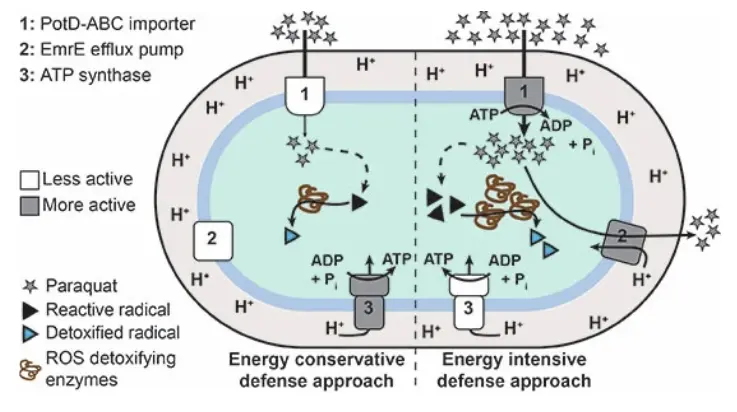
We found something similar in bacteria. When E. coli experienced lower levels of paraquat stress, it mainly adapted by reducing the amount of paraquat entering the cell. It did this by disrupting a polyamine transport system that can also allow paraquat to enter the cell.
At higher levels of stress, simply restricting entry was no longer sufficient. The bacteria adopted a more demanding strategy involving increased detoxification and active removal of paraquat from the cell. The EmrE efflux pump became particularly important in this response.
Our metabolic modelling showed that these strategies differ substantially in their energetic costs. The lower-cost strategy was advantageous under lower stress, whereas the more energetically expensive defense became important when the stress was high enough to require it.
So, in simple terms, our findings suggest that bacteria do not always choose the strongest defense available. They tend to use a defense that provides sufficient protection while conserving cellular resources, and they invest in more expensive defenses when the stress becomes more severe.
What are the potential implications of your findings for the field and society?
Our findings provide a broader way of thinking about bacterial evolution. Adaptation is often described as the accumulation of mutations that make an organism better suited to its environment. Our work suggests that this process is also strongly influenced by resource allocation; a mutation may be beneficial in one environment but not another because the physiological cost of the resulting adaptation changes with the level of stress.
This is particularly relevant because bacteria in nature rarely experience constant or uniform conditions. They encounter changing levels of oxidative stress, nutrient limitation, antibiotics and other environmental pressures. Understanding how the intensity of a stress shapes evolutionary trajectories may therefore help us better understand why particular adaptive strategies emerge in particular environments.
In the longer term, this principle could be relevant to understanding bacterial adaptation in clinically and environmentally important settings. For instance, it is well established that different tissues in a human host have different levels of reactive oxygen species (ROS). Also, the penetration of an antibiotic in different host tissues might also differ, thereby creating persistent yet heterogeneous stress. Along with understanding the adaptation, it may also help us identify physiological trade-offs that accompany adaptation in such complex environments.
At this stage, however, our work is primarily a fundamental study of bacterial evolution and resource allocation. Its main contribution is establishing a framework for understanding how the magnitude of stress and the metabolic cost of defense together shape evolutionary outcomes.
What was the exciting moment during your research?
One of the most exciting moments was when the different pieces of the project started coming together and we realized that the mutations we were observing were not simply a collection of independent changes.
We found that bacteria exposed to different levels of the same stress repeatedly arrived at distinct adaptive strategies. What made this particularly interesting was what happened when we changed the evolutionary conditions. When the low-paraquat-adapted strain was subsequently evolved at higher paraquat levels, it acquired mutations similar to those observed in populations evolved directly under high paraquat stress. However, when these high-stress-adapted populations were exposed to even greater stress, they evolved yet another, distinct adaptive strategy.
This pattern suggested that the evolutionary path was not random. Instead, the level of stress was repeatedly shaping which solutions were accessible and advantageous to the bacteria.
The genomic data showed distinct mutations, the physiological experiments revealed distinct mechanisms, and the metabolic modelling provided an explanation for why one strategy was favored under lower stress while another became important under higher stress.
That was particularly exciting because it changed the way I looked at the results. Instead of simply asking, “Which mutation helps the bacteria survive?”, we could ask, “Why is this particular evolutionary solution favored under these specific conditions?”
Seeing evolution, bacterial physiology and metabolism connect into one coherent story was one of the most rewarding parts of the project.
Paper reference: Patil, A.V., Zhao, J., Khairnar, S.V. et al. Selection favors cost-ordered adaptive mutational paths in a stress-magnitude-dependent manner. EMBO Reports (2026). https://doi.org/10.1038/s44319-026-00933-y