



Beyond the Drug Target: How Membranes Shape Drug Toxicity
Research Summary: My research explores how drugs interact with biological membranes and how these interactions can influence toxicity, providing molecular insights into drug safety beyond their intended targets.
Researcher Spotlight
Dr. Akash Kumar Jha works at the interface of molecular biophysics, drug–membrane interactions, and toxicology, with an interest in understanding the mechanisms of drug safety.
LinkedIn: www.linkedin.com/in/dr-akash-kumar-jha-b045b52a0
Lab PI name: Prof. Ashutosh Kumar, Department of Biosciences and Bioengineering, Indian Institute of Technology Bombay (IIT-Bombay)
Lab social media: https://www.bio.iitb.ac.in/~ashutoshk/
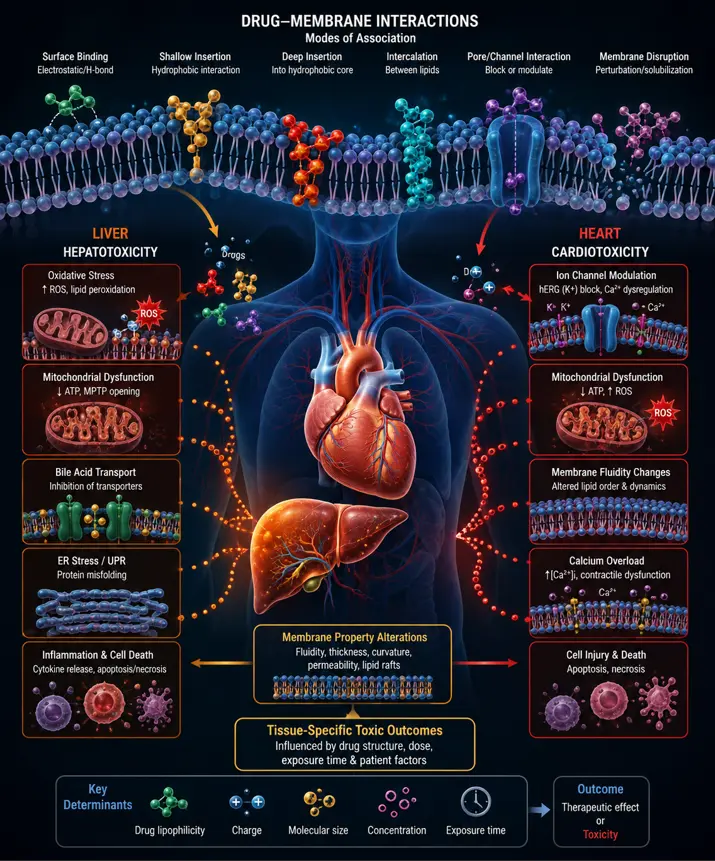
Drugs do not interact only with their intended targets. Their interactions with biological membranes can also influence how they behave in the body and may contribute to toxicity. Understanding these interactions can therefore provide an additional molecular perspective on drug safety.
What was the core problem you aimed to solve with this research?
Drugs are designed to act on specific biological targets, but their effects are not always limited to those targets. We wanted to understand whether interactions with cell membranes could contribute to drug toxicity and, if so, to identify the molecular basis of these effects.
In our recent work, we looked at two clinically important problems: the cardiotoxicity associated with commonly used NSAIDs and the hepatotoxicity associated with lipoglycopeptide antibiotics. Although these drugs have very different therapeutic functions, they raise a common question: what happens when these molecules encounter the lipid environment of our cells?
We therefore wanted to connect the molecular behavior of drugs at membranes with the biological responses observed at the tissue and organism levels. In the NSAID study, we investigated ketoprofen, indomethacin, and celecoxib, while in the antibiotic study, we compared teicoplanin and Oritavancin.
How did you go about solving this problem?
We used a combination of biological, biophysical, and computational approaches because no single technique can provide the complete picture of a drug–membrane interaction.
For the NSAID study, we evaluated ketoprofen, indomethacin, and celecoxib in rat and zebrafish models and also studied their interactions with cardiac-mimicking lipid membranes. We used techniques such as differential scanning calorimetry, NMR spectroscopy, and molecular dynamics simulations to understand how these drugs influence membrane properties at the molecular level. The results showed that the three NSAIDs had distinct profiles of membrane interactions and toxicity.
For the lipoglycopeptide study, we followed a similar integrated approach, combining biological assessment with hepatocyte-mimicking membranes. We combined lipid biophysics, ITC, DSC, NMR spectroscopy, and molecular dynamics simulations to understand not only whether the antibiotics interacted with membranes, but also where and how they interacted with the membrane.
For me, the important part of this approach was being able to move between different levels of understanding, from molecular interactions to membrane behavior and, finally, to biological outcomes.
“Our findings show that the membrane is not merely a barrier; it can be an active determinant of drug toxicity.” – Prof. Ashutosh Kumar
How would you explain your research outcomes (Key findings) to the non-scientific community?
We often think of a medicine as a key that fits a particular lock—the drug’s intended target. But our research shows that the story does not end there. Before reaching its target, a drug also encounters the membranes that surround our cells.
We found that different classes of drugs can interact with these membranes in different ways. These interactions can alter the membrane and may contribute to organ toxicity, including the heart and liver.
Most importantly, we found that it is not simply the strength of the interaction that matters. Where and how a drug interacts with the membrane can also influence its biological effects.
This gives us another way to think about drug safety: sometimes, understanding what happens around the target can be just as important as understanding the target itself, and could help us design a second generation of safer drugs.
What are the potential implications of your findings for the field and society?
I think the broader implication is that drug safety may need to be considered from a wider perspective than simply asking whether a drug reaches and affects its intended molecular target.
Our findings suggest that drug–membrane interactions can be an additional factor in understanding off-target effects and toxicity. If these interactions can be characterized early during drug development, membrane models and biophysical approaches may help identify compounds with undesirable membrane interactions before they progress further.
For society, the long-term goal is quite simple: to contribute to the development of medicines that are not only effective but also safer.
I do not see our work as providing a complete solution to drug toxicity. Rather, I see it as providing a mechanistic framework that can complement conventional pharmacology and toxicology. With further validation, these approaches could potentially become useful in early-stage drug evaluation and safety assessment.
What was the exciting moment during your research?
The most exciting part for me was when the individual results from different experiments began to come together, and we began to see a common story.
In our NSAID study, we observed that ketoprofen, indomethacin, and celecoxib behaved differently at the membrane level, and these differences were reflected in their cardiac effects. That was our first strong indication that membrane interactions could contribute to drug toxicity beyond the classical drug target.
When we extended this thinking to lipoglycopeptide antibiotics, we found another interesting layer. Teicoplanin and Oritavancin interacted with membranes differently, and the magnitude of membrane perturbation alone could not account for their distinct hepatic effects. This made us realize that the location, mode, and duration of a drug–membrane interaction may be just as important as the strength of the interaction.
For me, that was the real exciting moment, when two seemingly different toxicity problems began to point towards the same underlying principle: understanding how a drug interacts with the membrane can help us better understand what happens to the cell and, ultimately, to the tissue.
Paper reference
1. Jha, A. K., Subramaniyan, V., Gupta, S., Kumari, R., Tiwari, K. R., Gokulakrishnan, M., Nair, S., & Kumar, A. (2026). Membrane-mediated mechanisms of NSAID-induced cardiotoxicity independent of cyclooxygenase selectivity: Evidence from rat and zebrafish models. Toxicology and Applied Pharmacology, 514, 117923.
DOI: 10.1016/j.taap.2026.117923
2. Jha, A. K., Subramaniyan, V., Gupta, R., Saha, A., & Kumar, A. (2026). Mechanistic insight into the role of lipoglycopeptide drugs in hepatotoxicity. Biochimica et Biophysica Acta (BBA) – Biomembranes, 1868(2), 184497.