


EhNAP1: A Generalist Histone Chaperone in Entamoeba histolytica
Research Summary: We characterised Entamoeba histolytica NAP1 and found that it interacts with both the H2A/H2B dimer and the H3/H4 tetramer, and not just H2A/H2B, supporting nucleosome assembly despite substantial sequence divergence.
Researcher Spotlight
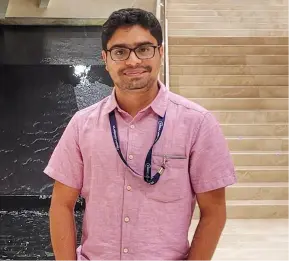
Surajit Gandhi is a PhD student at the BRIC-Institute of Life Sciences, Bhubaneswar. He employs structural and biochemical approaches to investigate the functional mechanisms of various proteins.
LinkedIn: linkedin.com/in/surajit-gandhi-32413212a
Twitter: x.com/Surajit157
Instagram: https://www.instagram.com/surajitgandhi/
Lab PI name: Dr. Dileep Vasudevan
University: BRIC-RGCB, Thiruvananthapuram (Previously with BRIC-ILS, Bhubaneswar)
Lab social media: x.com/lab_vasu
What was the core problem you aimed to solve with this research?
NAP1 is well studied in model organisms, but its function in early-diverging eukaryotes such as Entamoeba histolytica was unknown. We asked whether EhNAP1 retained the canonical chaperone role or had distinct histone preferences.
How did you go about solving this problem?
We combined sequence and phylogenetic analyses with recombinant protein purification, analytical SEC and sedimentation velocity AUC, circular dichroism, thermal stability assays, salt-dependent and competitive pull-down assays, ITC, plasmid supercoiling, nucleosome-assembly EMSA, and C-terminal truncation experiments.
“NAP1 is an H2A/H2B-specific chaperone, but Entamoeba histolytica NAP1 is a generalist chaperone, working on both H2A/H2B and H3/H4 histones.” – Dr. Dileep Vasudevan
How would you explain your research outcomes (Key findings) to the non-scientific community?
DNA is an extremely long, thread-like structure; if it is not kept neat, it can tangle, so cells package it around proteins called histones. However, free histones are difficult for a cell to handle because they can stick randomly to DNA or other proteins. Histone chaperones act like molecular escorts: they bind histones, keep them usable, and help place them onto DNA. NAP1 has been reported primarily as a chaperone for the H2A/H2B dimer. However, we found that Entamoeba NAP1 can interact with both major histone pairs, H2A/H2B and H3/H4, with similar overall binding strength. It also helps assemble nucleosomes in vitro. This shows that a protein can maintain the basic function of a histone chaperone while evolving distinct preferences for its histone partners.
What are the potential implications of your findings for the field and society?
The study expands our understanding of how chromatin assembly systems evolve outside well-studied model organisms. EhNAP1 retains the conserved NAP1 dimeric scaffold but recognises a broader range of histones, and its C-terminal region is especially important for stable H2A/H2B binding. These findings suggest that histone-substrate preference is an evolutionarily flexible feature of NAP1 proteins. For society, the main value is foundational: the work improves our molecular understanding of chromatin in a human parasite. Whether this finding can lead to the development of NAP1 as a therapeutic target would need further studies.
What was the exciting moment during your research?
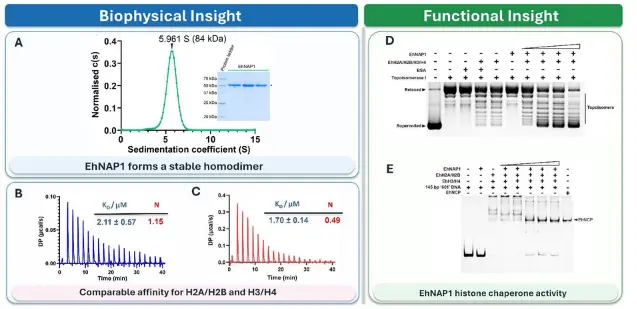
The most exciting moment was seeing different experiments converge on the same point. SEC and AUC showed that EhNAP1 forms a stable dimer and specific histone complexes, while ITC revealed comparable affinities for H2A/H2B and H3/H4. The purified NAP1 could perform chaperoning activity, depositing histones onto DNA and forming a nucleosome core particle (NCP). These outcomes strengthened the central result: the EhNAP1 protein is not merely a conventional NAP1 with minor sequence changes; it exhibited a broader histone-recognition profile and intact histone chaperoning activity.
Paper reference: Gandhi, S., & Vasudevan, D. (2026). Entamoeba histolytica NAP1 is a versatile histone chaperone for both H2A/H2B and H3/H4. International Journal of Biological Macromolecules, 383, 154554. https://doi.org/https://doi.org/10.1016/j.ijbiomac.2026.154554