


Developing Cost-Effective Indigenous Bioactive Recombinant Bovine FSH Production Platform.
Research Summary: We developed a mammalian cell-based platform to produce biologically active recombinant FSH from Bos indicus cattle, providing a potential alternative to pituitary-derived hormones used in assisted reproduction.
Researcher Spotlight
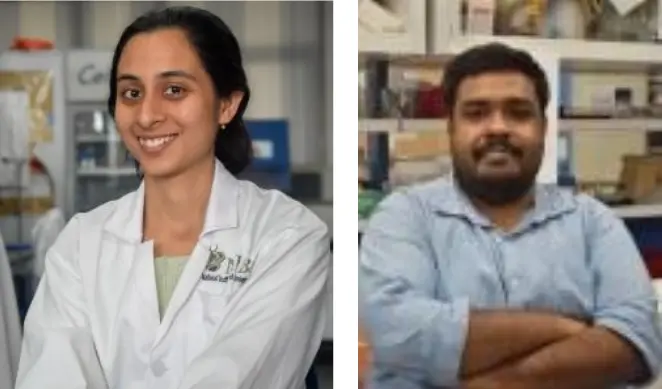
Abhishek Das and Srimoyee Koner are researchers from BRIC-National Institute of Animal Biotechnology whose work focuses on reproductive biotechnology, recombinant protein production, and Animal transgenesis.
Linkedin: www.linkedin.com/in/srimoyee-koner-07b9951b1
Twitter: https://x.com/Srimoyee397
Lab PI name: Dr. Nirmalya Ganguli
Institute: BRIC-National Institute of Animal Biotechnology
https://www.niab.res.in/peoplenirmalya/
https://www.linkedin.com/in/nirmalya-ganguli-0b1791204/
https://www.linkedin.com/in/gpe-lab/
What was the core problem you aimed to solve with this research?
Follicle-stimulating hormone (FSH) is widely used in livestock breeding programs, but commercially available products are largely derived from animal pituitary glands, which can have limitations related to purity, consistency, and large-scale production. We aimed to develop an indigenous recombinant FSH production system for Bos indicus cattle in a mammalian cell culture system.
How did you go about solving this problem?
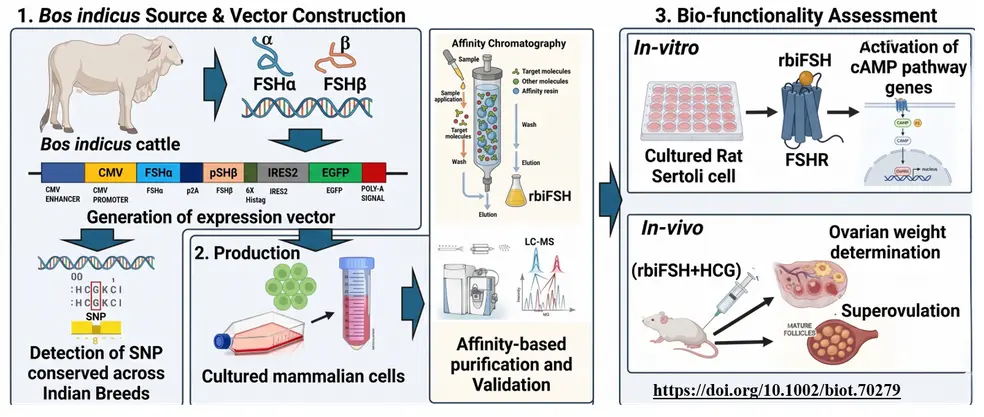
We cloned the FSH alpha and beta subunits from Bos indicus cattle and engineered a bicistronic mammalian expression system that enabled balanced expression of both subunits. The recombinant hormone was produced in mammalian cells and subsequently evaluated for its biological activity through both in vitro and in vivo studies.
“Our work utilizes the genetic blueprint of Indian cattle for biofunctional reproductive hormone production, opening new possibilities for indigenous assisted breeding technologies and helping marginal farmers.” – Dr. Nirmalya Ganguli
How would you explain your research outcomes (Key findings) to the non-scientific community?
We successfully produced an important reproductive hormone of Indian cattle in laboratory-grown cells instead of extracting it from animal tissues. More importantly, the hormone was biologically active and capable of stimulating reproductive responses, demonstrating its potential usefulness in livestock breeding programs.
What are the potential implications of your findings for the field and society?
This work provides a foundation for developing indigenous recombinant reproductive hormones for the livestock sector. In the future, it may help improve assisted breeding technologies, support genetic improvement programs, enhance reproductive efficiency, and contribute to sustainable livestock production.
What was the exciting moment during your research?
One of the most exciting moments was detecting the correctly assembled FSH heterodimer in the culture supernatant from cells expressing the FSHα and FSHβ. Equally rewarding was observing its biological activity in vivo, where the recombinant hormone (named as rbiFSH) successfully increased ovarian weight in mice, confirming that the hormone we produced was biofunctional.
Paper reference: Das A., Koner S., Ganesan V., Sharma D., Mansukhani M., Pal A., Dutta S., Kadivella M., Azam S., Sharma S.S., Majumdar S.S., Ganguli N. (2026). Engineering a Bicistronic Expression System for Mammalian Cell-Based Production of Biofunctional Recombinant Follicle Stimulating Hormone (FSH) of Bos indicus Origin. Biotechnology Journal, e70279. DOI: 10.1002/biot.70279.