



Taming the trojan horse: unwinding the complex relationship between HLA alleles and Apicomplexan infection in HbE/β-thalassaemic patients
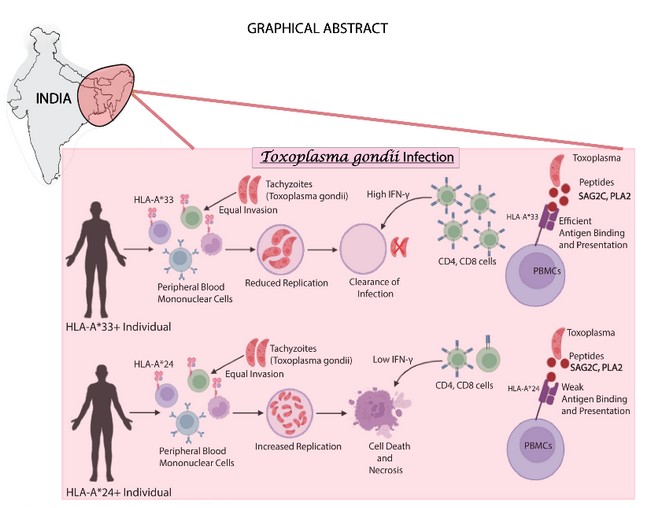
Research Summary: HbE/β-thalassemia patients carrying HLA-A*33 show protection against Toxoplasma* via enhanced CD8 IFN-γ responses and antigen binding, while HLA-C*07 associates with reduced Plasmodium* infection, highlighting pathogen-specific HLA selection in endemic regions.
Researcher Spotlight
Dr. Shatarupa Bhattacharya is a graduate student at Indian Institute of Technology, Kharagpur. She studies protozoan parasitic infection and host immunity in humans, in the context of a genetic disease, HbE/β-thalassemia. Other than working in the lab, she enjoys listening to good music and shakes a foot on it!
Lab: Dr. Nishant Chakravorty and Dr. Budhaditya Mukherjee, Indian Institute of Technology, Kharagpur
Twitter: @Budhadityamukh9 | @nishichakra
Website: https://www.idi-lab-smstiitkgp.com/
What was the core problem you aimed to solve with this research?
The core problem was to understand why a deleterious genotype like HbE/β-thalassemia persists at relatively high frequency in Eastern India, and whether this is driven by parasite specific immune advantages shaped by HLA polymorphisms. More specifically, the work set out to solve these linked questions:
- Do particular HLA class I alleles in an HbE/β-thalassemia cohort confer functional protection against key regional apicomplexan parasites (Toxoplasma gondii and Plasmodium falciparum), rather than just showing statistical association?
- Are these protective effects pathogen specific (for example, HLA-A*33 for Toxoplasma vs HLA-C*07 for Plasmodium), and can they be mechanistically explained through CD8 T-cell IFN-γ responses and peptide binding properties of the HLA molecules?
How did you go about solving this problem?
By combining HLA sequencing, ex vivo infection assays, and peptide-HLA binding studies, the overarching goal was to link host HLA diversity, antigen specificity, and infection outcome in a genetically vulnerable group, and thereby test the idea that pathogen driven selection helps maintain the HbE/β-thalassemia genotype in apicomplexan endemic populations.
“Nature has been conducting its own genetic experiment for thousands of years. Our findings suggest that certain HLA variants may have been favored because they help the immune system recognize and respond more effectively to parasite antigens. By studying these interactions in HbE/β-thalassemia patients, we gain new insight into how genetics, infection, and evolution are intertwined, and how this knowledge could eventually help identify individuals at greater risk of infectious diseases.” – Dr. Nishant Chakravorty and Dr. Budhaditya Mukherjee
How would you explain your research outcomes (Key findings) to the non-scientific community?
Our study shows that certain inherited blood and immune traits, although usually considered harmful, can help protect people from specific infections.
In a group of people from eastern India with a blood disorder called HbE/β-thalassemia, researchers found that those who carry a particular immune gene (called HLA-A*33) were better at controlling infection by a parasite called Toxoplasma gondii. Importantly, this protection was not due to medical treatment like blood transfusions, but to how their immune system naturally works.
When we looked more closely at immune cells from these individuals, they found that the parasite could still enter the cells, but it struggled to multiply inside them.
At a molecular level, the HLA-A*33 protein was better at “grabbing” and presenting a piece of the parasite to the immune system. This improved recognition helps the body respond more effectively.
Interestingly, this protective effect was very specific. The same HLA-A*33 gene did not help against another parasite, Plasmodium falciparum (which causes malaria), even though the two parasites are related. Instead, a different immune gene (HLA-C*07) seemed to be associated with protection against malaria, because it could better recognize malaria-specific proteins.
A simple way to think about it:
Our immune system has “locks” (HLA types), and different parasites carry different “keys” (antigens). Some locks are better matched to certain keys, allowing faster and stronger immune responses. In regions where particular infections are common, people with the best-matching locks are more likely to benefit, even if those same genetic traits come with other health costs.
What are the potential implications of your findings for the field and society?
Our findings suggest that HLA mediated pathogen specific immunity can help explain why harmful hemoglobinopathies persist in some endemic populations, adding a strong immunogenetic layer to the classic “heterozygote advantage” framework seen in malaria and other infectious diseases.
Implications for the field
- It provides a rationale for using HLA-peptide binding data to identify protective epitopes and design vaccines or immunotherapies tailored to local HLA distributions, an approach already explored for toxoplasmosis and malaria vaccine development.
Implications for population genetics
- Our work suggests that deleterious alleles such as HbE/β-thalassemia may persist partly because linked immune advantages improve survival in parasite-endemic regions, consistent with balancing selection and trade-offs between individual disease burden and population level fitness.
- It also implies that disease prevalence and severity in endemic settings may reflect an interaction between host genotype, local pathogen ecology, and immune presentation rules rather than hemoglobinopathy status alone.
- This kind of evidence can help refine evolutionary models of why certain high-burden genetic variants remain common despite clinical harm.
Clinical implications
- HLA typing could become useful for risk stratification in patients with HbE/β-thalassemia, especially in settings where toxoplasmosis or malaria are common and clinical outcomes are heterogeneous.
- If validated in larger cohorts, these markers might help identify patients at higher or lower risk of intracellular parasitic infection and guide monitoring, counseling, or prophylaxis decisions.
- The finding that protection was independent of transfusion frequency is important because it points to a host-genetic effect rather than a treatment artifact, which increases the translational value of our results.
Public health implications
- Our study supports integrating host genetics into regional infectious disease control programs, especially in South and Southeast Asia where hemoglobinopathies and apicomplexan infections overlap.
- It argues for precision public health approaches that consider both inherited blood disorders and local parasite burdens when designing screening, vaccination, and prevention strategies.
- At a societal level, our study highlights a difficult but important trade-off: a genotype that is harmful overall may still be maintained by evolutionary pressure because it confers protection against major infectious killers.
Broader significance
- More broadly, our work reinforces a central principle in human genetics: immune-related polymorphisms can have opposing effects across diseases, making “good” and “bad” alleles context dependent.
- It may also encourage more comparative work across apicomplexans, since our results suggest that even related parasites can be recognized through distinct HLA-peptide rules.
- The societal payoff is practical as well as conceptual: better understanding of these interactions can inform vaccine design, epidemiology, and equitable care in populations carrying common hemoglobin disorders.
What was the exciting moment during your research?
In research, there isn’t one moment of excitement, rather it’s a journey, filled with days of gloom and excitement both! I still remember the day I got my first successful clone after days of failure, moreover it came from one single clone, which was quite unbelievable for me! If at all I had to choose a moment of excitement during my research, I would definitely choose the day I was selected to represent India in the 72nd Lindau Nobel Laureate Meeting, where I got to discuss my PhD research work with so many Nobel Laureates and other distinguished scientists.
Paper reference: HLA polymorphisms shape divergent outcomes of Toxoplasma and Plasmodium infection in Eastern Indian HbE/β-thalassemia cohort. Bhattacharya, S., Rahaman, M., Suman, S. et al. HLA polymorphisms shape divergent outcomes of Toxoplasma and Plasmodium infection in Eastern Indian HbE/β-thalassemia cohort. Commun Biol 9, 690 (2026). https://www.nature.com/articles/s42003-026-10222-y