



Single-Molecule Imaging Reveals Context-Dependent Chromatin Binding of CHD Remodeler Hrp3
Research Summary: Using live-cell single-molecule tracking, we show that chromatin remodeler Hrp3 selectively and stably engages constitutive heterochromatin, its binding dynamics shaped by histone modifications, chromatin state, and domain architecture.
Researcher Spotlight
Akriti Kumari is a research scholar in the Department of Biotechnology, IIT Hyderabad, working with Dr. Gunjan Mehta. Her research investigates how chromatin-organizing proteins, including remodelers and cohesin, dynamically engage chromatin in living cells at single-molecule resolution.
Linkedin: https://www.linkedin.com/in/akritijaipuria14/
Instagram: https://www.instagram.com/akriti.jaipuria/
Lab PI name: Dr. Gunjan Mehta
University: Indian Institute of Technology Hyderabad (IIT Hyderabad)
Lab social media: https://www.mehtalab-iith.com/
What was the core problem you aimed to solve with this research?
CHD family chromatin remodelers are important for organizing DNA and regulating genome function, but much of what we know about their activity comes from in vitro studies using purified proteins and reconstituted nucleosomes, where the enzyme’s own biochemical properties dictate the outcome. A living cell nucleus is far more crowded and complex, with different chromatin states and structural constraints that a test tube cannot replicate. We aimed to understand how Hrp3, a CHD remodeler in fission yeast, actually behaves inside a real cell: which of its domains are genuinely required for chromatin binding in vivo, and whether its interaction with chromatin depends on the local epigenetic state.
How did you go about solving this problem?
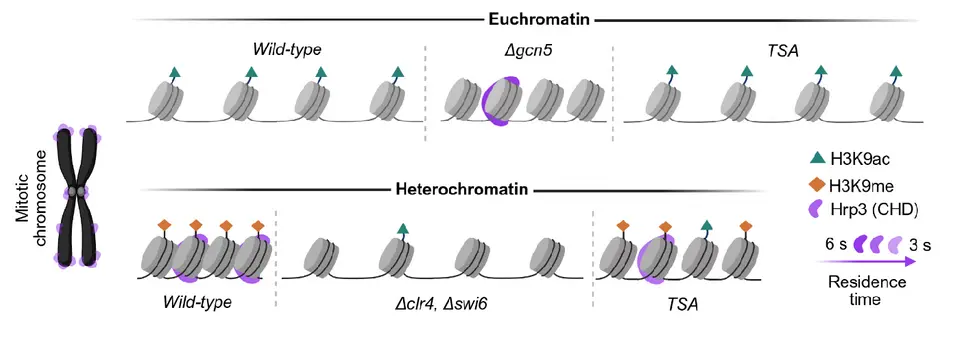
We used the fission yeast Schizosaccharomyces pombe as a model system and developed a live-cell single-molecule imaging approach to follow individual Hrp3 molecules inside the nucleus. We fused Hrp3 to HaloTag and labelled it with a fluorescent ligand, allowing us to track individual molecules and directly measure how long they stay bound to chromatin versus just passing through. To find out which parts of Hrp3 actually matter for this binding in vivo, we generated a panel of domain-deletion mutants spanning its chromodomains, ATPase motor, coupling region, DNA-binding domains, and DUF domain, and compared their behavior to that of wild-type. Using Swi6-GFP as a heterochromatin marker, we then directly compared Hrp3 binding at heterochromatin versus euchromatin, and further perturbed the system by disrupting heterochromatin machinery, altering histone acetylation, and arresting cells in mitosis, to see how each condition reshaped Hrp3’s residence time and binding fraction on chromatin.
“This study shows how chromatin context and epigenetic state shape the dynamic behavior of a chromatin remodeler in living cells.” – Dr. Gunjan Mehta
How would you explain your research outcomes (Key findings) to the non-scientific community?
Our genome is a very long thread of DNA that is packaged together with proteins to form chromatin. This packaging isn’t the same everywhere: some regions are loosely packed and active, while others are tightly compacted and silenced.
Hrp3 is a protein that helps reorganize this packaging. We found that it doesn’t work everywhere in the genome; it specifically and stably attaches to the tightly silenced regions of DNA, while largely ignoring the open, active regions. We also found that different parts of the Hrp3 protein contribute differently to this binding, and some of what we saw inside living cells was quite different from what earlier test-tube experiments had suggested, showing how important it is to study these proteins in their natural setting.
We discovered that the packaging itself acts like a switch. When we loosened the silenced regions slightly, Hrp3 started binding more often, but each interaction became much shorter and less stable. Certain chemical marks on the packaging proteins had a similar effect: removing some marks let Hrp3 start engaging regions it normally avoids, while adding other marks pushed it away from regions it normally prefers.
Finally, we found that Hrp3 stays attached to chromosomes even during cell division, when DNA is at its most compact. This suggests it may help cells remember which regions should stay silenced even after they divide, a possible clue into how cells preserve their identity over time.
What are the potential implications of your findings for the field and society?
Our work shows that a chromatin remodeler’s behavior cannot be predicted from its protein sequence alone; the chromatin environment inside a living cell plays an equally important role. This provides a framework for studying chromatin remodelers at single-molecule resolution in vivo. Because CHD-family remodelers are conserved and linked to developmental disorders and cancer, our finding that histone acetylation strongly reshapes Hrp3’s chromatin engagement suggests that epigenetic drugs such as HDAC inhibitors may act not just by opening chromatin but by directly altering remodeler behavior itself.
What was the exciting moment during your research?
One of the most exciting moments was when we compared Hrp3’s binding at heterochromatin versus euchromatin and saw a completely one-sided result: a clear, stable population of specifically bound molecules at heterochromatin, and essentially none at euchromatin. Up to that point, we had only looked at Hrp3’s behavior across the whole nucleus, so this was the first time we could see that its binding was truly chromatin-context-dependent rather than uniform. That clean separation became the anchor for the rest of the paper; it’s what let us make sense of why the subsequent acetylation and methylation experiments behaved as they did.
Paper reference: Kumari A, Varde O, Gopi V, Rajakumara E, Nambiar M, Mehta G. In Vivo Single-molecule Tracking of CHD Family Chromatin Remodeler Hrp3 Defines the Chromatin Context-dependent Binding Dynamics in S. pombe. Journal of Molecular Biology. 2026;438:169992. DOI: 10.1016/j.jmb.2026.169992 https://www.sciencedirect.com/science/article/abs/pii/S0022283626003657