



A relay of movement: How a local signal travels farther
Research Summary: A buried rigid bead triggers a contractility-dependent relay of directional migration across a soft gel; cell density shapes how efficiently this response reaches distant cells.
Researcher Spotlight
Dr. Akshada Jayant Khadpekar is a research professional with a PhD from IIT Bombay and over 3+ years of experience across academia, government research, and industry. Her interdisciplinary expertise spans mechanobiology, cell patterning, genome engineering, and cell and gene therapy. She completed her BSc and MSc in Biotechnology at Modern College, Pune, and qualified the CSIR-NET and ICMR-NET examinations. At IIT Bombay, under the supervision of Dr. Abhijit Majumder, her doctoral research focused on mechanics-mediated cell patterning, cell migration, and self-organization. Subsequently, at CSIR-NCL, Pune, under Dr. Mugdha Gadgil, she developed a CRISPR-Cas9-based knockout cell line. At Gennova Biopharmaceuticals, she contributed to establishing a lentivirus-based cell and gene therapy platform and gained experience in multidisciplinary R&D and project management. She is passionate about scientific problem-solving and translating research into practical applications.
LinkedIn: https://www.linkedin.com/in/akshada-khadpekar-phd-81744898/
Twitter: @Akshada2511
Lab PI name: Dr. Abhijit Majumder
University: Department of Chemical Engineering, Indian Institute of Technology Bombay (IIT Bombay)
LinkedIn: https://www.linkedin.com/in/m-lab-iit-bombay-4a5a9835b/
Website: https://iitbombaymlab.wixsite.com/mlab
What was the core problem you aimed to solve with this research?
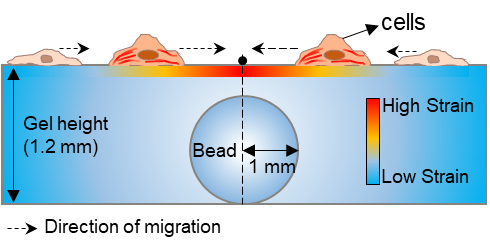
The core problem we wanted to solve was understanding how a local mechanical signal can influence cell movement over a much larger distance. Our research explores a fascinating possibility: cells may not need to sense a distant mechanical cue independently. Instead, they may pass on the directional response to neighbouring cells, much like passing a baton in a relay race. This raises a fundamental question in mechanobiology: can a local physical disturbance trigger a chain of cellular responses that propagates across a tissue-like environment? Our study investigates this collective, time-dependent process and how cell density and force generation govern the relay.
How did you go about solving this problem?
We designed experiments to understand how a local mechanical cue could influence cell movement over long distances. We cultured C2C12 myoblasts on soft polyacrylamide gels containing a rigid glass bead embedded deep beneath the surface and recorded cell movements every 30 minutes for 48 hours. By tracking individual cells and analysing their movement across regions at increasing distances from the bead, we investigated how the directional response developed over time. We also varied cell-seeding density to understand how interactions between neighbouring cells influenced the spread of this response, and used blebbistatin to inhibit myosin-II activity and examine the role of cellular force generation. By combining time-lapse imaging with mathematical and quantitative analysis, we went beyond observing the final pattern to investigate whether the directional response developed progressively across the surface, much like a baton being passed from one cell to the next.
“What excites me most about this study is the possibility that cells can pass mechanical information to one another, creating a relay that coordinates directional movement over long distances. This work is especially close to my heart, as it was published five years after my graduation. Revisiting the data with the same curiosity and determination I had during my PhD, and spending countless hours reanalysing it, revealed a much deeper story. It reinforced my belief that returning to a scientific question with fresh eyes can uncover discoveries we may not have initially imagined.” – Dr. Akshada Khadpekar
How would you explain your research outcomes (Key findings) to the non-scientific community?
Imagine a group of cells on a soft surface, with a tiny rigid bead hidden deep underneath. We found that cells close to the bead begin moving towards it first, and cells farther away gradually begin moving in the same direction. This suggests that cells can sense and respond to changes in the material around them, even when the source of the change is far away. We also found that how well this directional movement spreads depends on how many cells are present and how effectively they can generate force.
What are the potential implications of your findings for the field and society?
This work adds to our understanding of how cells interpret mechanical features in their surroundings. A local mechanical disturbance may influence cell movement well beyond the region where it can be sensed directly, through a contractility-dependent, substrate-mediated relay. This provides a possible framework for studying how cells organize during tissue remodeling and development, including processes such as angiogenesis. The study uses a simplified gel model, so further work is needed to establish how broadly the mechanism applies in real tissues.
What was the exciting moment during your research?
The most exciting moment for me was seeing the time-resolved analysis graph finally take shape. While watching the videos, I had an intuition about how the cells were gradually responding and moving in a particular direction, but I needed to figure out the mathematics behind what I was observing. Translating that intuition into an analysis and finally seeing it emerge as an observable graph was a real eureka moment for me. It helped me connect what I could see in the videos with measurable evidence of how the directional response developed over time.
Paper reference: Khadpekar A, Majumder A (2026). Density-dependent relay converts local pre-strain caused by sub-surface mechanical inhomogeneities into long-range cooperative directed cell migration. Frontiers in Biophysics, 4:1974627. https://doi.org/10.3389/frbis.2026.1974627