

FDA Approves Bezuclastinib: New Targeted Combination for Advanced Gastrointestinal Stromal Tumours
Today in Science | TIS 003 | 25 November 2026
For patients with advanced gastrointestinal stromal tumours (GIST) whose disease progresses despite initial treatment, finding an effective next therapeutic option can be challenging. On 24 November 2026, the US Food and Drug Administration (FDA) approved bezuclastinib (Ekitna), in combination with sunitinib, for adults with advanced GIST who have previously received imatinib. The approval introduces a new treatment option for a cancer in which resistance to targeted therapies remains a major clinical challenge. More importantly, it highlights how understanding the molecular mechanisms that drive tumour growth—and the ways cancer cells adapt to treatment—can inform the development of new therapeutic combinations.
GIST is a relatively uncommon cancer arising from specialised cells in the gastrointestinal tract, most frequently in the stomach and small intestine. These tumours originate from or resemble the interstitial cells of Cajal, which help regulate movement through the digestive tract. Unlike many gastrointestinal cancers that arise from epithelial cells, GIST belongs to a group of mesenchymal tumours. Its development is closely linked to abnormal signalling through receptor tyrosine kinases, particularly KIT and platelet-derived growth factor receptor alpha (PDGFRA).
When cancer-driving signals become treatment targets
In approximately 80–85% of GIST cases, activating mutations occur in the KIT gene. Another 5–10% are associated with mutations in PDGFRA. These genes encode receptor tyrosine kinases—proteins that sit on the cell surface and transmit signals controlling cell growth, survival and proliferation.
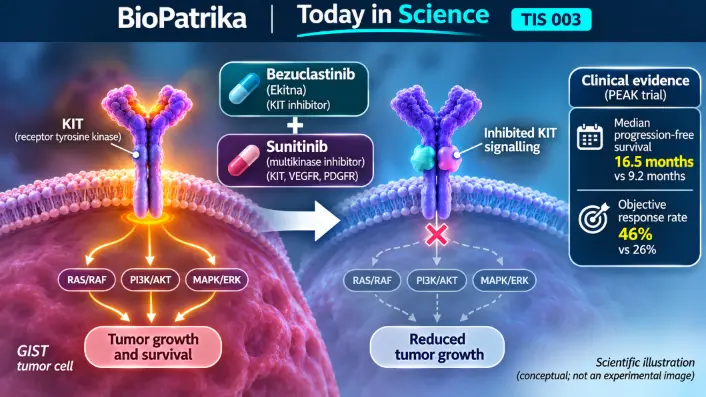
Under normal conditions, these receptors are activated in response to specific molecular signals. In GIST, however, certain mutations can keep the signalling pathway switched on even without the normal activating stimulus. The result is persistent activation of downstream pathways that encourage tumour cells to grow and survive.
This molecular understanding transformed GIST treatment. Imatinib, a tyrosine kinase inhibitor, was among the first targeted therapies to demonstrate that blocking a cancer-driving molecular pathway could produce substantial clinical benefit. By inhibiting KIT and PDGFRA signalling in susceptible tumours, imatinib can control disease progression and has become a standard first-line treatment for many patients with advanced GIST.
However, the initial response does not always last. Cancer cells can acquire additional mutations in the KIT gene, particularly in regions encoding the kinase domain. These secondary mutations can alter the structure of the protein and reduce the effectiveness of drugs that previously inhibited it. Tumours may consequently resume growing despite continued treatment.
This phenomenon, known as acquired resistance, is one of the central challenges in targeted cancer therapy. It also explains why the development of drugs capable of inhibiting KIT through different molecular interactions has become an important research direction.
Bezuclastinib is a potent, selective inhibitor of KIT, designed to block abnormal signalling from this receptor. Sunitinib, another kinase inhibitor, acts on several molecular targets, including KIT, VEGFR and PDGFR. Combining the two drugs is intended to provide more comprehensive inhibition of tumour-promoting signalling than sunitinib alone. The strategy is particularly relevant in advanced GIST, where tumour cells may carry different KIT mutations and where resistance can involve multiple molecular mechanisms.
What did the Phase 3 trial demonstrate?
The approval was supported by the PEAK study, an international, randomised Phase 3 clinical trial involving 413 adults with locally advanced, unresectable or metastatic GIST whose disease had progressed during imatinib treatment or who could not tolerate it.
Participants received either bezuclastinib in combination with sunitinib or sunitinib alone. The primary efficacy endpoint was progression-free survival (PFS), which measures the time a patient lives without the cancer progressing or dying from any cause.
The results showed a median PFS of 16.5 months in the combination group, compared with 9.2 months in the sunitinib-alone group. This represented a 50% reduction in the risk of disease progression or death, with a hazard ratio of 0.50. The objective response rate—the proportion of patients whose tumours showed a predefined reduction in size—was also higher with the combination: 46%, compared with 26% for sunitinib alone.
These findings are clinically important because they demonstrate an improvement over an active treatment comparator, rather than simply comparing the new therapy with a placebo. Nevertheless, progression-free survival and tumour response do not automatically establish an overall-survival benefit. Overall-survival data were not mature at the time of the FDA’s assessment.
The combination also requires careful safety monitoring. The FDA prescribing information carries a boxed warning for hepatotoxicity, meaning potentially serious liver injury. Increased liver enzymes were reported, and liver-function monitoring is required before and during treatment. Other commonly reported adverse reactions include diarrhoea, hypertension, nausea, fatigue and changes in taste. The treatment is also associated with embryo-fetal toxicity warnings.
What comes next?
The approval expands the treatment options available to adults with advanced GIST following imatinib. It also reinforces an important principle in precision oncology: cancer treatment increasingly depends on understanding not only the original molecular driver of a tumour but also how that driver changes under therapeutic pressure.
For GIST, the challenge is particularly relevant because different patients—and even different tumour regions within the same patient—may harbour distinct KIT mutations. Future research will need to clarify how molecular profiling can help identify patients most likely to benefit from particular inhibitor combinations and how resistance might be overcome as the disease evolves.
The PEAK results provide strong evidence for improved progression-free survival and tumour response with bezuclastinib plus sunitinib. Longer follow-up will be important to understand the durability of this benefit and its effect on overall survival.
For the broader oncology field, the development is another example of how targeted drug combinations can address the adaptive behaviour of cancer cells. Rather than treating resistance as an endpoint, researchers are increasingly studying the molecular changes that produce it—and designing therapies to counter those changes.
Source FDA – Bezuclastinib plus sunitinib for advanced GIST