



m⁶A RNA Methylation Regulates Black Pepper Immunity Against Foot Rot Disease
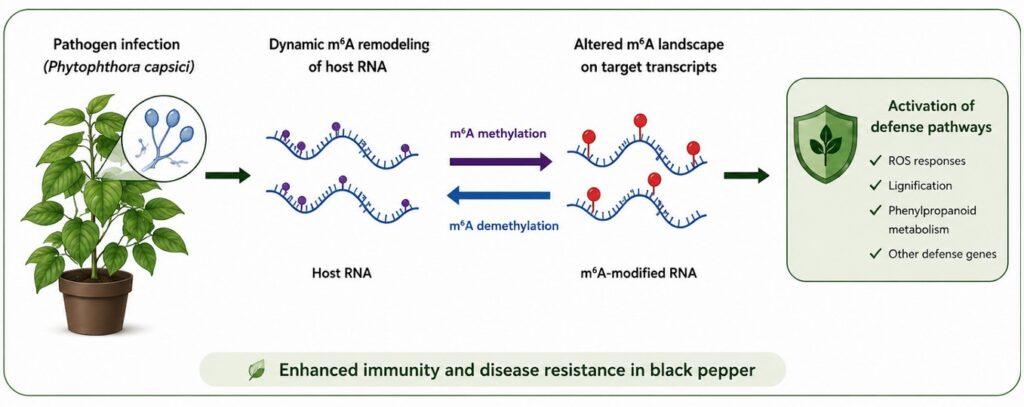
Research Summary: We demonstrate that pathogen-triggered m⁶A epitranscriptomic reprogramming regulates defense responses in black pepper against Phytophthora capsici, an oomycete responsible for the devastating foot rot (quick wilt) disease.
Researcher Spotlight
Sora S. conducted this work at the Transdisciplinary Biology Laboratory, iBRIC-RGCB, where she investigated RNA-mediated regulatory mechanisms and epitranscriptomic responses associated with black pepper disease resistance.
Linkedin: https://www.linkedin.com/in/sora-s-680119235/
Lab: Dr. E. V. Soniya, FNASc, BRIC-RGCB
What was the core problem you aimed to solve with this research?
Our laboratory has been extensively investigating RNA-mediated regulatory mechanisms underlying black pepper responses to foot rot disease caused by P. capsici. While m⁶A is the most abundant internal RNA modification in eukaryotes and is known to regulate diverse biological processes in plants, its role in black pepper–pathogen interactions remained unexplored. We aimed to determine whether pathogen infection triggers m⁶A-mediated epitranscriptomic reprogramming and whether these RNA modifications contribute to disease resistance or facilitate pathogen establishment during infection.
How did you go about solving this problem?
We approached the problem step by step. First, we sought to establish whether m⁶A RNA modification is present in black pepper transcripts. We then investigated how m⁶A levels change in response to infection by P. capsici. To identify the specific transcripts undergoing m⁶A modification during infection, we performed transcriptome-wide m⁶A profiling using MeRIP-seq. In addition, we disrupted m⁶A-associated regulatory processes using pharmacological inhibitors to examine how perturbation of m⁶A writer/reader functions influences disease progression and pathogen colonization. By integrating molecular, biochemical, and transcriptomic analyses, we were able to link m⁶A-associated transcripts to key defense-related pathways. As one of the first studies exploring epitranscriptomic regulation in the black pepper–P. capsici pathosystem, this work provides a foundation for future investigations aimed at unraveling the precise mechanisms by which m⁶A influences plant immunity.
“This study provides the first evidence linking m⁶A-mediated epitranscriptomic regulation with defense responses in the black pepper–P. capsici interaction.” — Dr. E. V. Soniya, FNASc
How would you explain your research outcomes (Key findings) to the non-scientific community?
Black pepper is often affected by a devastating disease called foot rot (quick wilt), caused by the pathogen P. capsici, leading to substantial crop losses. Developing sustainable disease management strategies requires a deeper understanding of how plants naturally defend themselves against pathogens. Unlike animals, plants cannot move away from threats and therefore rely on sophisticated regulatory mechanisms to adapt and respond to environmental challenges.
Our study discovered that black pepper uses a chemical modification on RNA, known as m⁶A, during pathogen infection. This modification acts like a molecular switch that helps regulate which defense-related messages are strengthened, stored, or degraded within the plant. We found that m⁶A-associated changes are linked to important defense processes, including strengthening cell walls, producing protective compounds, and managing stress responses. When these regulatory processes were disrupted, the plants became more vulnerable to disease. These findings suggest that m⁶A is an important player in the plant’s defense arsenal and represents a previously unexplored layer of disease resistance in black pepper.
What are the potential implications of your findings for the field and society?
Our study provides one of the first insights into how epitranscriptomic regulation, particularly m⁶A RNA methylation, contributes to disease responses in black pepper. By identifying m⁶A-associated changes linked to key defense pathways, we highlight a previously unexplored layer of plant immunity that operates beyond the genetic code itself.
In the long term, understanding how m⁶A regulates the stability and fate of defense-related RNA molecules could help researchers identify novel targets for developing disease-resistant black pepper varieties and more sustainable disease management strategies. Such approaches could reduce reliance on chemical fungicides, benefiting both farmers and the environment.
More broadly, our findings contribute to the growing field of plant epitranscriptomics by demonstrating that RNA modifications play an important role in plant-pathogen interactions. As climate change and emerging diseases continue to threaten crop productivity, uncovering these regulatory mechanisms may help scientists develop innovative strategies to enhance crop resilience and ensure agricultural sustainability.
What was the exciting moment during your research?
This project was filled with both challenges and exciting discoveries. One of the biggest hurdles was obtaining high-quality RNA from black pepper tissues, which are rich in phenolic compounds that can interfere with molecular analyses. Since m⁶A studies require large amounts of intact RNA, optimizing every step—from RNA isolation and dot blot assays to MeRIP-seq experiments and data analysis—was a long and demanding process.
The most exciting moment came when we finally observed a clear increase in m⁶A methylation following pathogen infection. Seeing the experimental results align with our hypothesis was incredibly rewarding. It became even more exciting when the transcriptome-wide analysis revealed that many m⁶A-modified transcripts were associated with well-known defense pathways. At that point, we realized that we were uncovering a previously unexplored layer of black pepper immunity, making all the optimization efforts worthwhile.
Paper reference: Salim, S., Revikumar Sunitha, L. & Eppurath Vasudevan, S. Pathogen-triggered m⁶A epitranscriptomic reprogramming is linked to host defense responses in the Piper nigrum–Phytophthora capsici pathosystem. Plant Cell Rep 45, 184 (2026). https://doi.org/10.1007/s00299-026-03854-1
Latest biotech Jobs, Internships, & Research Opportunities (June 8, 2026) | Biopatrika Jobs