



From Biology to Chip: Recreating the Human Placenta
Research Summary: We developed a placenta-on-chip that recreates key functions of the human placental barrier. This will provide a more human relevant model for studying nutrient, drug, and metabolite transport during pregnancy and reduce the dependence on human tissues.
Researcher Spotlight
First authors: Anshul Bhide and Sourav Mukherjee
Anshul is a PhD scholar and a CSIR-SRF at ICMR- National Institute for Research on Women’s Health (Formerly Known as ICMR-NIRRCH). His research domain mainly revolves around reproductive biology and organ-on-chip technologies, with a focus on developing physiologically relevant models to improve maternal and fetal health research.
LinkedIn | Twitter | Instagram
Sourav is a final-year PhD scholar at IIT Bombay in Prof. Abhijit Majumder’s laboratory, where he developed and optimized a placenta-on-chip platform for modelling the human placental barrier.
LinkedIn | Twitter | Instagram
Lab: Prof. Deepak Modi, ICMR- National Institute for Research on Women’s Health (Formerly known as ICMR-NIRRCH)
LinkedIn | Twitter | Instagram
Lab: Prof. Abhijit Majumder, Indian Institute of Technology Bombay
What was the core problem you aimed to solve with this research?
Studying the human placenta is extremely challenging because it is available for research only after delivery, while animal models do not accurately reproduce its unique structure and function. As a result, we still have a limited understanding of how nutrients, medicines and harmful substances cross from the mother to the developing baby.
Over the past decade, several placenta-on-chip models have been developed to address this challenge. However, as we explored these systems, we realised that most were designed around continuous fluid flow through microchannels. While this is an elegant engineering solution, we began to wonder whether it truly reflected how the human placenta works.
Unlike most organs, the human placenta is not constantly exposed to directional blood flow. Instead, maternal blood gently bathes the placental tissue, allowing nutrients, oxygen and waste products to move across the placental barrier primarily by diffusion. This made us rethink the problem. Rather than asking how to build a more sophisticated chip, we asked whether we could build a more physiologically faithful placenta.
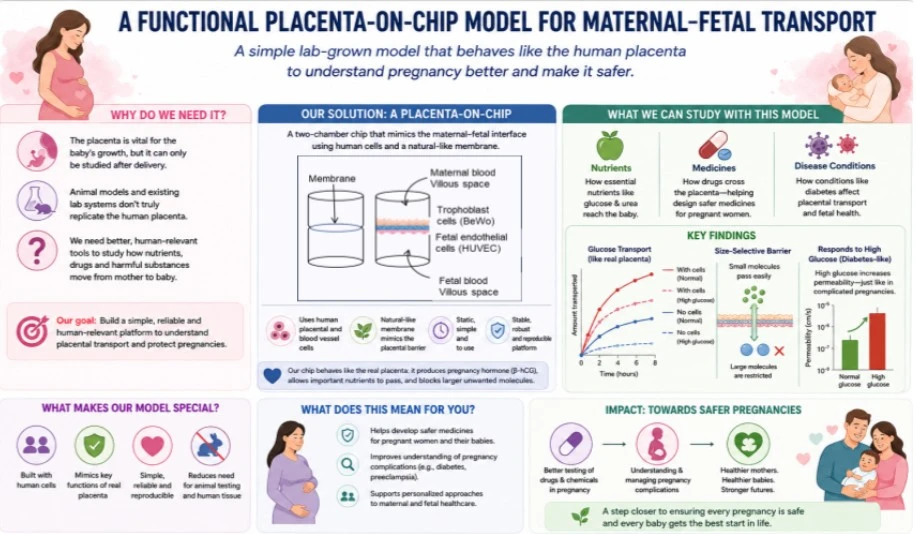
This shift in thinking became the foundation of our work. We developed a simple placenta-on-chip that recreates the diffusion-driven transport of the human placental barrier while remaining easy to use with standard laboratory infrastructure. Our hope is that this approach will make physiologically relevant placenta-on-chip technology accessible to a much wider scientific community.
How did you go about solving this problem?
To solve this challenge, team reproductive biology (at ICMR-NIRWoH) and team engineering (at IIT Bombay) collaborated. The engineering team first designed a simple two-chamber device separated by a porous membrane, representing the maternal and fetal sides of the placenta. Unlike many existing models that rely on complex microfluidic channels and pumps, our design was intentionally simple, allowing the placental cells to exchange nutrients and other molecules in a way that more closely resembles the human placenta. We also spent considerable time optimizing the chamber design so that cells remained healthy while the device was easy to handle using standard laboratory techniques.
The next question was: Does it really behave like a placenta? To answer this, we grew human trophoblast cells on one side of the membrane and fetal endothelial cells on the other. Interestingly, the trophoblast cells fused together to form a syncytium, the same specialized layer found in the human placenta and began producing the pregnancy hormone hCG, confirming that the cells had developed into a functional placental tissue.
We then tested whether the model behaved like the placental barrier. Just like in a real pregnancy, small molecules could cross the barrier while larger molecules were blocked. Finally came what we considered the real test: could the chip reproduce the two-way exchange that sustains a developing baby? We observed glucose moving from the maternal side to the fetal side and urea moving in the opposite direction, closely resembling nutrient delivery and waste removal across the human placenta.
To determine whether the model could also mimic disease, we recreated hyperglycaemic conditions similar to gestational diabetes. The chip responded by altering glucose transport while maintaining its barrier function, demonstrating that it could reproduce not only normal placental physiology but also disease-associated changes.
Seeing all these features come together in a single platform convinced us that we had built much more than a cell culture device; we had created a physiologically relevant model of the human placental barrier.
“This placenta-on-chip bridges engineering and reproductive biology, creating a powerful platform to improve pregnancy research and develop safer therapies for mothers and babies.”
– Prof. Deepak Modi and Prof. Abhijit Majumder
How would you explain your research outcomes (Key findings) to the non-scientific community?
Before a baby is born, the placenta is its lifeline. It delivers oxygen and nutrients, removes waste, produces hormones that sustain pregnancy, and acts as a protective barrier between the mother and the baby. Yet, despite its vital role, it is one of the least understood human organs because it cannot be studied while pregnancy is ongoing.
In this study, we recreated some of the key functions of the human placenta in the laboratory using a tiny device called a placenta-on-chip. It is not an electronic chip like those found in computers or mobile phones, but a miniature laboratory model that behaves like the human placental barrier.
Our placenta-on-chip can transport nutrients, remove waste, produce pregnancy hormones, and even mimic disease conditions such as gestational diabetes. This allows scientists to observe, in real time, how substances move from the mother to the baby, something that is extremely difficult to study during pregnancy itself.
In the future, this technology could help researchers better understand pregnancy complications and evaluate whether medicines are likely to cross the placenta and reach the developing baby. Ultimately, it could contribute to developing safer therapies and improving the health of both mothers and babies.
What are the potential implications of your findings for the field and society?
We hope this technology will transform how pregnancy is studied. By recreating key functions of the human placenta in the laboratory, researchers can investigate how nutrients, medicines, infections and environmental pollutants interact with the placental barrier and influence the developing baby. In the long term, this platform could become an important tool for evaluating how medicines cross the placenta, to identify drugs that are more likely to be safe during pregnancy and development of new therapies for pregnancy-related disorders. It can also complement animal studies and, in selected applications, reduce the need for animal experimentation.
Ultimately, our goal is to provide better scientific tools that lead to healthier pregnancies, safer medicines, and improved outcomes for both mothers and babies.
What was the exciting moment during your research?
There were many exciting moments, but the one I will never forget was watching a tiny fluorescent molecule move from the maternal chamber to the fetal chamber across our engineered placental barrier. What made it even more exciting was that we could watch this process happen in real time, rather than simply measuring the amount of a substance that had crossed the barrier. It felt like opening a window into a process that normally takes place hidden inside the womb.
That moment also made us think about the future. If we can watch an inert molecule crossing the placenta today, perhaps tomorrow we will be able to observe how medicines, viruses or other pathogens interact with the placental barrier and understand why some cross to the baby while others do not. That was the real eureka moment as it made us realise that this platform could help answer many important questions that were previously impossible to study.
Paper reference: Bhide A, Mukherjee S, Ghosh K, Majumder A, Modi D. A functional placenta-on-chip model for maternal-fetal transport. Biofabrication. 2026. https://iopscience.iop.org/article/10.1088/1758-5090/ae7bc8