


Periplasmic Chaperones Oppositely Regulate Protein Folding Under Mechanical Stress.
Research Summary: Single-molecule experiments reveal that distinct periplasmic chaperones oppositely reshape protein folding energy landscapes under force, tuning folding probability, kinetics, and mechanical work generation.
Researcher Spotlight
Deep Chaudhuri is a fifth-year Ph.D. student in the Department of Chemistry at Ashoka University, working collaboratively at the S. N. Bose National Centre for Basic Sciences (SN Bose N.C.B.S.), Kolkata. His research uses single-molecule techniques to understand how mechanical forces and molecular interactions regulate protein folding and function.
LinkedIn: www.linkedin.com/in/deep-chaudhuri-a763a01a9
Instagram: https://www.instagram.com/chaudhurideep99/
Lab: Dr. Shubhasis Haldar, S.N. Bose National Centre for Basics Sciences, Kolkata, West Bengal and Ashoka University, Haryana, India
Lab website:
https://www.shubhasis-haldar-cmt.com/
What was the core problem you aimed to solve with this research?
Proteins passing through the SecYEG translocon experience mechanical forces as they move into the bacterial periplasm, where they begin to fold and interact with chaperones. Although periplasmic chaperones are known to assist protein biogenesis, it was unclear how they influence protein folding under mechanical stress. In our research, we aimed to understand how SecYEG-associated and periplasmic chaperones regulate force-dependent protein folding. In particular, we explored whether different classes of chaperones promote folding or instead stabilize the unfolded state, and what physical principles determine these distinct responses to mechanical force.
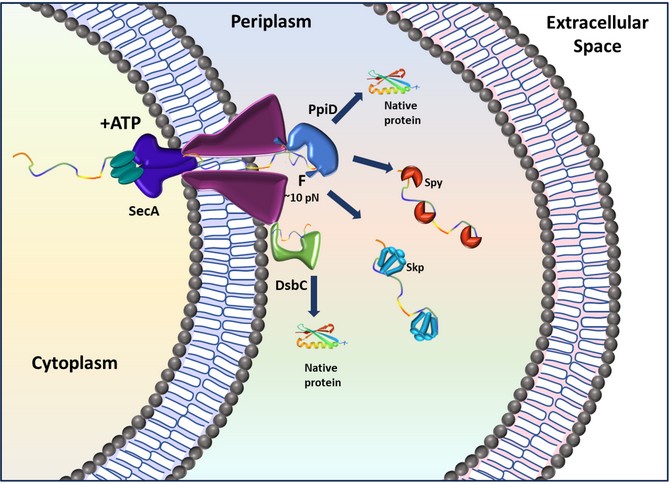
The unfolded polypeptide passes through the SecYEG translocon. Chaperones such as PpiD and DsbC interact with the nascent chain, helping it fold correctly and improving refolding during mechanical stress. Alternatively, Skp and Spy act as mechanical holdases, keeping the unfolded chain soluble and preventing misfolding as it moves through the periplasm toward the extracellular space.
How did you go about solving this problem?
We used custom-built single-molecule magnetic tweezers to directly observe the folding and unfolding of individual protein molecules under precisely controlled forces. This approach allowed us to mimic the mechanical environment experienced by proteins in the bacterial periplasm and measure how different chaperones- PpiD, DsbC, Spy, and Skp- alter folding probability, kinetics, energy landscapes, and mechanical work generation.
“Our study shows that periplasmic chaperones help proteins fold properly, prevent them from backsliding, and maintain their stability under mechanical stress.” – Dr. Shubhasis Haldar
How would you explain your research outcomes (Key findings) to the non-scientific community?
Inside every cell, proteins are constantly being made, folded, stretched, and moved around. Like tiny molecular machines, they must fold into the right shape to work properly. When folding goes wrong, proteins can misfold and clump together, a process associated with several neurodegenerative diseases, including Alzheimer’s and Parkinson’s disease.
Cells have their own quality-control team: chaperones. These helper proteins protect newly made proteins and guide them toward their functional states. But what happens when a protein is not just folding, but is also being pulled and stretched by mechanical forces?
This is the question we explored. Using single-molecule experiments, we found that different chaperones can have surprisingly different effects. Some act like molecular guides, helping proteins fold and become more stable, while others act like protective hands, keeping proteins flexible and preventing them from misfolding under force. Our findings reveal that chaperones are more than simple folding assistants, they can sense and regulate how proteins respond to mechanical stress, adding a fascinating physical dimension to the way cells control protein folding.
What are the potential implications of your findings for the field and society?
Our work uncovers a previously unrecognized mechanical role of periplasmic chaperones. Beyond preventing aggregation, chaperones can actively reshape the energy landscape of proteins under force. This provides new insights into protein translocation, membrane protein biogenesis, and the interplay between mechanics and protein folding. More broadly, these principles may apply to many biological systems where proteins operate under mechanical stress.
What was the exciting moment during your research?
The most exciting moment was seeing how different periplasmic chaperones can completely change the fate of the same protein under mechanical force. At the single-molecule level, we observed that foldase chaperones such as PpiD and DsbC can promote productive folding, while holdases such as Skp and Spy help keep the unfolded protein stable and prevent misfolding. Coming from a Chemistry background, I found it fascinating to see these molecular interactions directly through single-molecule experiments. It was exciting to realize that these chaperones do not simply “help proteins fold”-they can act as molecular decision-makers, determining whether a protein folds, remains protected in an unfolded state, or continues its journey through the periplasm under mechanical stress.
Paper reference: Chaudhuri, D., Bhatt, M and Haldar, S. (2026). Opposing Effects of Periplasmic Chaperones on Protein Folding. Journal of Molecular Biology. https://doi.org/10.1016/j.jmb.2026.169966