



Role of Phlorizin in chronic kidney disease induced bone loss
Research Summary: Chronic kidney disease causes mineral imbalance which results in bone loss in the body. Our study found that phlorizin, a flavonoid and known sodium-glucose cotransporter (SGLT) inhibitor, may protect bones, improve kidney function, restore metabolic balance by targeting sclerostin.
Researcher Spotlight
Rajat Rathur demonstrates exceptional research potential through intellectual curiosity, analytical thinking, scientific rigor, creativity, and a strong commitment to impactful, innovative research.
Linkedin: Rajat Rathur | LinkedIn
Twitter: Rathore Rajat (@rathorerajat11) / X
Instagram: Instagram
Lab PI name: Dr. Divya Singh
University: CSIR- Central Drug Research Institute, Lucknow
Lab social media: Divya singh_ lab (@DivyaSingh_lab) / X
What was the core problem you aimed to solve with this research?
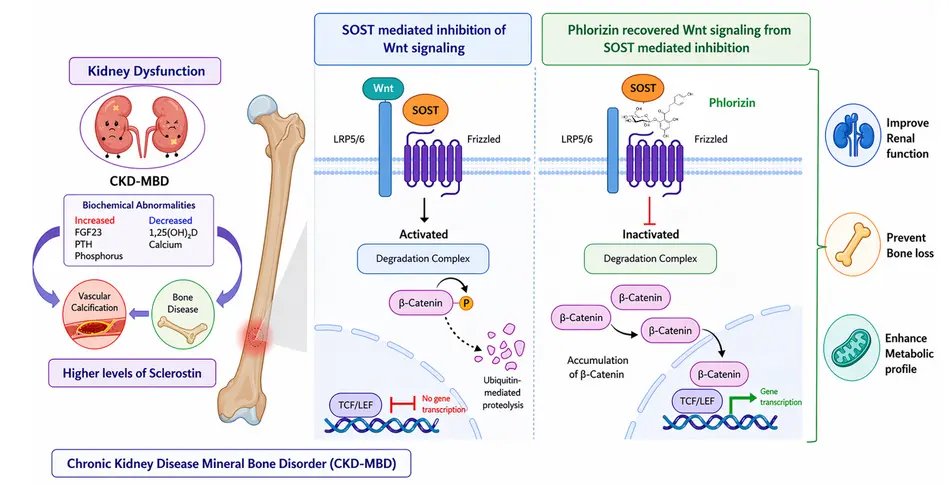
CKD-MBD is a complex disorder involving disturbances in calcium, phosphate, PTH, vitamin D, and FGF23, leading to bone abnormalities, vascular calcification. Elevated sclerostin in CKD inhibits Wnt/β-catenin signaling, suppressing bone formation and contributing to bone loss. Romosozumab which is the only FDA approved drug, targets sclerostin and used in CKD-MBD remains limited by concerns regarding hypocalcemia and cardiovascular events such as myocardial infarction and stroke. In this study, phlorizin used to explore its therapeutic potential in CKD-MBD. Romosozumab is a monoclonal antibody, making it a relatively expensive therapeutic option, and its use is also associated with potential cardiovascular risks. Therefore, small-molecule therapies may offer a more cost-effective and potentially safer alternative for the management of CKD-MBD, with the possibility of fewer adverse effects.
How did you go about solving this problem?
In this study, we explored the therapeutic potential of Phlorizin in CKD-MBD. Its anti-diabetic and nephroprotective role is already reported. So first we performed cell culture-based assays to evaluate the bone forming effects of phlorizin and further its capacity to inhibit Sclerostin which suppresses bone formation and their anti-sclerostin capacity through bioinformatics and cell-based assays. After getting encouraging results, we moved on to the animal model studies. The model used was the 5/6th nephrectomy model of CKD-MBD. Rats were treated with phlorizin, and its effects on bone formation, renal function, mineral balance, body composition, bone microarchitecture and bone metabolism was assessed using biochemical assays, ELISA, micro-CT, and GC-MS-based metabolomics.
“It is a very important study as currently no natural/small molecule inhibitors for Sclerostin is available in the market worldwide.” – Dr. Divya Singh
How would you explain your research outcomes (Key findings) to the non-scientific community?
This study demonstrates that phlorizin protects against CKD-MBD–induced bone loss by improving both bone and kidney function. Phlorizin enhanced the activity of bone forming cells and was devoid of any cytotoxicity. Mechanistically, it interacted with sclerostin and disrupted its binding to LRP6 receptor, thereby restoring Wnt/β-catenin signaling which is critical for bone development. In diseased rats, phlorizin improved renal function, body weight and lean mass, normalized FGF23 and PTH, reduced sclerostin levels, and improved trabecular and cortical bone parameters. Metabolomic analysis further showed that phlorizin restored amino acid metabolism, energy production, antioxidant pathways, and renal metabolic functions. Overall, these findings suggest that phlorizin has dual bone- and kidney-protective effects and may represent a promising therapeutic approach for CKD-MBD.
What are the potential implications of your findings for the field and society?
By targeting the sclerostin–LRP6/Wnt/β-catenin pathway and also improving renal function and metabolic balance, phlorizin may offer a broader approach than therapies that primarily address mineral imbalance. These findings could contribute to the development of small-molecule based cost-effective treatments for CKD-MBD and reduce the burden of bone loss and related complications. From a societal perspective, improved management of CKD-MBD could enhance patients’ quality of life and reduce healthcare costs associated with fractures and disease progression. However, further pharmacological, long-term safety, and clinical studies are required before translation to human use.
What was the exciting moment during your research?
While working on phlorizin, one of the most exciting moments was discovering how it interacts with the sclerostin–LRP6 system which was not reported. Bioinformatic analyses revealed that phlorizin binds to sclerostin and disrupts its interaction with LRP6, thereby enhancing the Wnt/β-catenin signaling pathway which is vital for skeletal development. I found it particularly fascinating to visualize the molecular interactions of phlorizin with sclerostin in a virtual environment and observe their dynamic behavior through molecular dynamics simulations. It is a very important study as currently no natural/small molecule inhibitors for Sclerostin is available in the market worldwide.
Paper reference
Rathur, Rajat, et al. “Phlorizin attenuates chronic kidney disease induced bone loss by mitigating sclerostin mediated inhibition of Wnt/β-catenin signaling and ameliorating metabolic alterations.” Biomedicine & Pharmacotherapy 203 (2026): 119810. https://doi.org/10.1016/j.biopha.2026.119810