



Polymer microstructure moderates CRISPR-Ribonucleoproteins (RNPs) delivery performance
Research Summary: RNPs are powerful genome editing proteins widely used for correcting genetically inherited disorders. Our research demonstrates the significance of polymer microstructure in the binding, stabilization, and delivery of RNPs.
Researcher Spotlight
Ram Prasad Sekar is currently working as an Assistant Professor at Mahindra University.
Linkedin: www.linkedin.com/in/ram-prasad-sekar-61b04824
ResearchGate: https://www.researchgate.net/profile/Ram-Prasad-Sekar
Twitter: @RamPrasadSekar1
Lab PI name: Prof. Ramya Kumar
University: Colorado School of Mines, Colorado, USA
Lab social media: https://kumarbiomaterials.org/
What was the core problem you aimed to solve with this research?
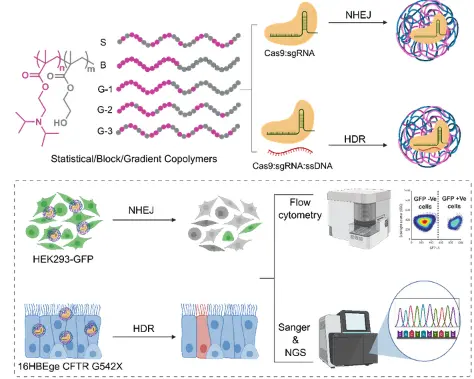
Lipid nanoparticles excel in nucleic acid delivery but struggle to condense CRISPR-Ribonucleoprotein (genome editor) proteins. Synthetic polymers can load proteins in aqueous conditions and mimic protein-protein interactions to mediate intracellular delivery. We hypothesized that polymer microstructural differences will postulate polymer−RNP binding affinities and gene editing outcomes. To check our hypothesis, we selected the reporter cell line (GFP HEK) and the clinically relevant disease model (G542X-cystic fibrosis bronchial cells) and performed numerous characterizations and cellular assays to uncover the polymer microstructure potential. (Figure 1)
How did you go about solving this problem?
We synthesized copolymers with the same composition and length but distinct microstructural features (statistical, block and gradients), complexed them with editor proteins to form polyplexes, and evaluated editing performance in reporter cells and cystic fibrosis G542X cells. Statistical (S) copolymers have high delivery efficiency but low cell viability. Block (B) copolymers have low delivery efficiency but high cell viability. We found that gradient (G) copolymers balance these trade-offs for RNP delivery. More interestingly, regardless of microstructure, all copolymers stabilize editor proteins more effectively than commercial reagents such as Lipofectamine CRISPRMAX and jet PEI.
“In the era of lipid nanocarriers facilitated biotherapeutics delivery, polymeric vectors retain unmatched scalability and fine‑tuning flexibility for nucleic acids and protein delivery.” – Prof. Ramya Kumar
How would you explain your research outcomes (Key findings) to the non-scientific community?
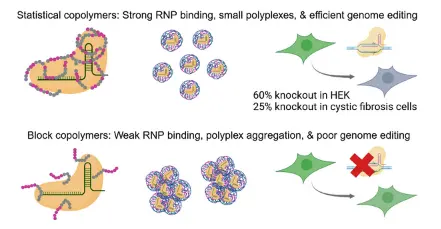
It is well known that lipid-based carriers are widely used for mRNA (for example, COVID vaccines) or RNP delivery. Here, we explored microstructural behaviors in RNP complexation and the possibilities of polymers as alternative carriers. We successfully designed and developed length- and compositionally equivalent different polymer microstructures S, B & G. We encapsulated the RNPs with all microstructures and head-to-head compared their delivery performance. We observed strong binding affinity for S (Kd < 10 μM) and weak binding for B (Kd ~ 200 μM). Though in a lower N/P ratio (1), RNP complexed tightly with S, and polyplexes were stable, resulting in nano-dimensions. Polyplexes were effectively taken up by GFP-HEK293 cells and showed higher knockout efficacy (~90%). In G542X mutations in cystic fibrosis bronchial epithelial cells, 25% NHEJ editing and 2% HDR editing were observed. (Figure 2)
What are the potential implications of your findings for the field and society?
Our work demonstrates that microstructural differences will specify polymer−RNP binding affinities and editing outcomes.
We address three outstanding questions in polymer-mediated RNP delivery:
- How do polymer−RNP binding affinity (Kd) and polyplex size compare across statistical, block, and gradient copolymers?
- How do we engineer polymer microstructure to augment editing efficiency while minimizing toxicity?
- How does the cellular internalization of RNPs vary with microstructure?
Our work is the first to demonstrate that polymer microstructure is a powerful design handle to navigate trade-offs between RNP binding affinity, delivery efficiency, and toxicity. This approach could accelerate more efficient RNP delivery for genetic disorders such as cystic fibrosis. Provides a method to develop scalable polymer carriers for next-generation genome editors.
The concept of polymeric vectors (S/B/G) will be a signpost for the researchers who are working in nucleic acids and genome delivery.
What was the exciting moment during your research?
Understanding the polymer microstructure behaviors in RNP complexation and delivery performance. We were more excited to examine the cystic fibrosis G542X point mutation correction via lab-designed guide RNA and HDR templates.
Paper reference: Ram Prasad Sekar, Jessica L. Lawson, Alyson N. Camacho, Andrew Werneth, Kyra Jordan, Anoosha Paruchuri, Ramya Kumar, “Statistical, block, and gradient copolymers reveal microstructure-dependent binding and intracellular delivery of genome editor proteins” ACS Polymers Au 2026. https://doi.org/10.1021/acspolymersau.6c00169