



Turning Peptides into Tiny Power Generators for Sustainable Bioelectronics
Research Summary: We discovered how subtle control of peptide self-assembly activates strong piezoelectricity, providing a sustainable strategy to engineer biocompatible materials for self-powered bioelectronics and energy harvesting.
Researcher Spotlight
Aparna Ramesh is a doctoral researcher at the Centre for Nano and Soft Matter Sciences (CeNS), Bengaluru, investigating peptide self-assembly, supramolecular chirality, and functional biomaterials for bioelectronics and sustainable energy applications.
Linkedin: https://www.linkedin.com/in/aparna-ramesh-527ab1375/
Twitter: https://x.com/AparnaRamesh20
Lab: Dr Goutam Ghosh, Centre for Nano and Soft Matter Sciences (CeNS), Bengaluru
Lab social media: https://suprapolychemlab.wixsite.com/gglab
What was the core problem you aimed to solve with this research?
Piezoelectric materials, which generate electricity in response to mechanical force, are indispensable for sensors, wearable electronics, medical implants, and energy-harvesting devices. However, most commercially used piezoelectric materials rely on inorganic ceramics such as lead zirconate titanate (PZT), which are rigid, non-biodegradable, and often contain toxic elements. Although peptides have emerged as attractive alternatives because of their excellent biocompatibility, biodegradability, and remarkable ability to self-assemble into highly ordered nanostructures, the fundamental design principles governing their piezoelectric behaviour remain poorly understood.
Our research sought to answer a fundamental question: How can we rationally design peptide-based materials that exhibit efficient piezoelectricity? Specifically, we wanted to determine whether the emergence of supramolecular chirality, the ordered helical arrangement of molecules during self-assembly, could serve as the key factor controlling piezoelectric performance. Establishing this relationship would provide a new blueprint for developing next-generation sustainable piezoelectric biomaterials.
How did you go about solving this problem?
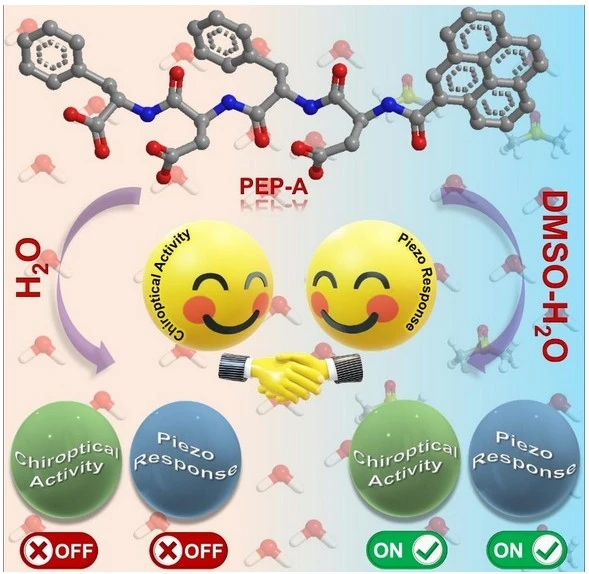
Instead of changing the molecular structure of the peptide, we explored whether its internal organization could be controlled during self-assembly. We designed a pyrene-conjugated peptide capable of forming one-dimensional nanofibers through hydrogen bonding and aromatic π–π interactions. By introducing only trace amounts of a suitable cosolvent, we precisely tuned the molecular packing within these assemblies.
To understand this transformation, we combined advanced spectroscopy, microscopy, piezoresponse force microscopy, and atomistic molecular dynamics simulations. This multidisciplinary approach enabled us to visualize how a subtle change in the molecular environment reorganizes peptide molecules into ordered chiral architectures, aligns molecular dipoles, and dramatically enhances their electromechanical behaviour. Rather than simply observing piezoelectricity, we uncovered the molecular mechanism responsible for its emergence.
“This study reveals supramolecular chirality as a powerful design principle for creating sustainable peptide-based piezoelectric materials for future bioelectronic technologies.” – Dr Goutam Ghosh
How would you explain your research outcomes (Key findings) to the non-scientific community?
Imagine thousands of tiny compass needles scattered randomly on a table. Even though each needle has a direction, together they produce no meaningful effect. Now imagine carefully aligning every one of those needles to point in nearly the same direction. Suddenly, they begin to work together.
Our peptide molecules behave in a very similar way. In water, they naturally assemble into fibres, but their internal arrangement is too disordered to generate electricity. By adding just 1% of a suitable solvent, we encourage the molecules to reorganize into beautifully ordered, helical structures where their tiny electrical dipoles point cooperatively in the same direction.
As a result, these peptide nanomaterials begin to produce electricity when gently pressed or mechanically deformed. In other words, we discovered that the secret to creating efficient piezoelectric biomaterials lies not in changing the molecules themselves, but in teaching them how to organize together.
What are the potential implications of your findings for the field and society?
This work establishes an important design principle for peptide-based piezoelectric materials by demonstrating that supramolecular chirality can directly regulate electromechanical functionality. Rather than relying on toxic inorganic materials, our strategy exploits naturally derived, biodegradable building blocks whose properties can be programmed through molecular self-assembly.
In the future, such materials could enable a new generation of flexible, lightweight and environmentally friendly devices that harvest energy directly from natural body movements such as walking, breathing, or heartbeat. These peptide-based piezoelectric materials also hold promise for self-powered biosensors, implantable medical devices, artificial tissues, soft robotics, wearable healthcare technologies, and sustainable bioelectronics. More broadly, our findings highlight how understanding molecular self-assembly can inspire smarter materials that bridge biology, chemistry, and engineering.
What was the exciting moment during your research?
The most exciting moment came when we realized that a seemingly insignificant experimental change had produced an extraordinary functional transformation. After adding only 1% DMSO/DMF, we observed a clear piezoelectric response in the peptide assemblies through piezoresponse force microscopy. Until then, the same peptide assembled in pure water remained completely inactive despite forming similar nanofibers.
Watching an electrically silent biomaterial suddenly become piezoelectrically active simply because its molecules had reorganized into a chiral arrangement was an unforgettable experience. It was the moment when all our spectroscopic observations, microscopic images, simulations, and electromechanical measurements converged into one coherent scientific story. That realization made us appreciate how profoundly molecular organization can dictate material function.
Paper reference/citation (with link): A. Ramesh, S. Layek, T. N. Das, N. Sengupta, and and G. Ghosh, Angewandte Chemie International Edition. (2026): e3135255. https://doi.org/10.1002/anie.3135255