



Engineering the Smallest Aggregation Tags for Affordable Therapeutic Peptide Production
Research Summary: We developed the smallest multifunctional aggregation tag for recombinant production of therapeutic peptides and validated its utility by successfully producing a liraglutide precursor peptide with enhanced yield attributed to reduced non‑target fusion mass.
Researcher Spotlight
Pavan Reddy Regatti is a PhD research scholar, biotechnology professional, and expert in microbial strain engineering and recombinant expression platform development.
Linkedin: https://in.linkedin.com/in/rpreddy
Lab PI name: Prof. Kirtimaan Syal
University: BITS Pilani, Hyderabad Campus
Lab social media: https://www.bits-pilani.ac.in/hyderabad/kirtimaan-syal/
What was the core problem you aimed to solve with this research?
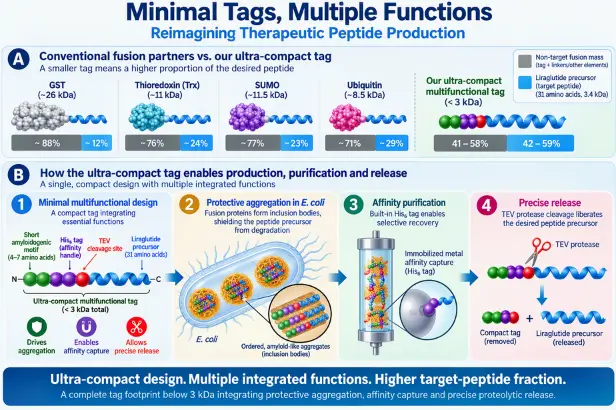
Small therapeutic peptides are often unstable and susceptible to degradation during recombinant production. Although conventional fusion partners can improve their expression and recovery, their large size reduces the proportion of the desired peptide, reducing the overall yield. Our goal was to create an ultra-compact tag that could protect the peptide, facilitate purification and enable precise release with minimal non-target fusion mass, resulting in high yield. The idea is to reduce the tag size, increase peptide yield, and reduce production costs. Our aim is to reduce the cost of therapeutic peptides, including liraglutide, and make it accessible to everyone.
How did you go about solving this problem?
We selected very short amyloid-forming peptide sequences and evaluated whether they could guide the liraglutide precursor into protective inclusion bodies inside E. coli. We combined these sequences with elements for affinity purification and precise enzymatic release, creating a compact multifunctional tag. After screening different designs, we purified the promising fusion proteins, removed the tags and confirmed the identity of the released precursor. We also studied the aggregates and verified the molecular basis of tag function.
How would you explain your research outcomes (Key findings) to the non-scientific community? Imagine producing something delicate inside a busy factory. It needs protective packaging, a handle to retrieve it and a way to remove the packaging without damaging the product. Our ultra-compact tag performed all three functions for a liraglutide precursor inside bacterial cells. It directed the precursor into protective deposits, enabled its purification, and allowed its precise release while reducing the tag’s mass fraction. We then confirmed that the released precursor had the expected molecular identity. The key finding was that these multiple functions could be built into a remarkably small tag, reducing the amount of unnecessary fusion material attached to the desired peptide, which would reduce the cost of the therapeutic peptides. We have engineered the world’s smallest aggregation tags.
What are the potential implications of your findings for the field and society? For the field, we have successfully engineered the smallest possible aggregation tags, where several essential functions are integrated into a very small molecular footprint. This could help researchers develop more efficient production strategies for other small therapeutic peptides while reducing the amount of non-target material produced alongside them. From a societal perspective, our aggregation tags will reduce the cost of peptide-based medicines including liraglutide. This study is a proof of concept, and further work will be carried out to verify its applicability to other peptides, biological activity, process scalability and industrial feasibility.
What was the exciting moment during your research? Every stage brought its own exciting moment: assembling the genes in-house from synthetic oligonucleotides, seeing the ultra-compact tags support expression, observing the proteins form protective inclusion bodies and successfully purifying the fusion proteins. The journey became especially rewarding when we removed the tags and confirmed the identity and purity of the released liraglutide precursor by mass spectrometry. As a researcher, what could be more exciting than watching a scientific vision move from a molecular design to clear experimental results and, ultimately, producing a correctly released peptide precursor. Our approach could potentially make peptide-based therapeutics much more affordable.
Paper reference: Regatti, P.R., Bhatt, J., Worah, R. et al. Ultra-compact amyloidogenic fusion tags mediated efficient production of liraglutide precursors and molecular insights. Microbial Cell Factories (2026). https://doi.org/10.1186/s12934-026-03138-z