



Urinary exosomal microRNAs as non-invasive diagnostic markers for IgA nephropathy
Research Summary: This case-control study profiled urinary exosomal miRNAs in an Indian cohort and identified a nine-miRNA panel, and a minimal two-miRNA combination, that distinguishes IgA nephropathy from healthy and diseased controls.
Researcher Spotlight
Dr Mythri Shankar is an Associate Professor in the Department of Nephrology at the Institute of Nephro-urology, Bengaluru, India, whose research focuses on genetic and glomerular kidney diseases.
Linkedin – https://www.linkedin.com/in/mythri-shankar/
Twitter – @nephromythri
Instagram – @mythrishankar.1
Lab PI name: Dr Mythri Shankar (first and corresponding author)
University: Institute of Nephro-urology, Victoria Hospital Campus, Bengaluru, Karnataka, India
What was the core problem you aimed to solve with this research?
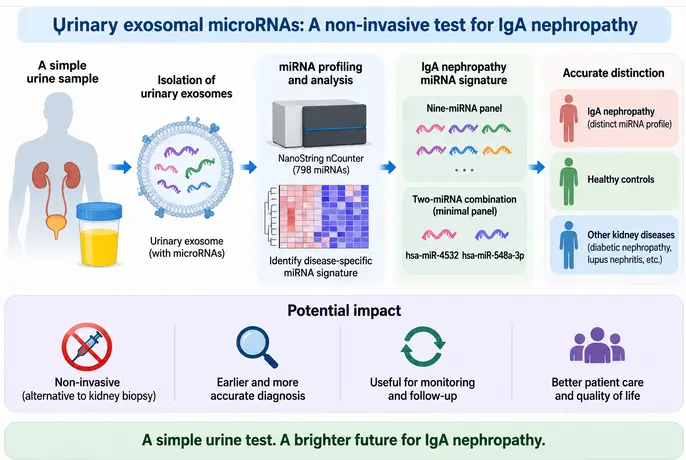
IgA nephropathy is the most common primary glomerulonephritis worldwide and can progress to kidney failure, yet its definitive diagnosis still depends on kidney biopsy — an invasive procedure with complication rates up to 6.4% that samples only a small piece of tissue and cannot be repeated easily. We wanted to find a reliable, non-invasive alternative. Urinary exosomes carry stable, well-protected miRNAs that reflect the whole urinary system, but their profile in IgA nephropathy had never been characterised in the Indian population, and existing data varied across ethnic groups. Our goal was to determine whether a urinary exosomal miRNA signature could accurately identify IgA nephropathy, distinguishing it not only from healthy people but also from other kidney diseases.
How did you go about solving this problem?
Over four years (2020–2024) we recruited 150 participants at the Institute of Nephro-urology, Bengaluru: 50 biopsy-confirmed IgA nephropathy patients, 50 healthy controls, and disease controls with other glomerular diseases (diabetic nephropathy, lupus nephritis, membranous nephropathy, focal segmental glomerulosclerosis, hypertensive nephrosclerosis, and minimal change disease). We isolated exosomes from urine, extracted their miRNA, and profiled 798 unique miRNA barcodes using the NanoString nCounter Human v3 miRNA Expression Assay — a digital technique that needs no amplification or hybridisation, making results robust and precise. We then applied LASSO regression to select the most informative miRNAs, evaluated them with logistic regression and leave-one-out cross-validation, and used the CombiROC algorithm to build multi-marker panels. Candidate markers were further checked against external public datasets (GSE141344 and GSE64306).
“A simple urine test reading exosomal microRNAs could one day spare IgA nephropathy patients the invasive kidney biopsy.” — Dr Mythri Shankar, Corresponding author
How would you explain your research outcomes (Key findings) to the non-scientific community?
Kidneys leak tiny biological messengers called microRNAs into the urine, packaged inside protective bubbles called exosomes. We found that people with IgA nephropathy have a distinctly different pattern of these urinary messengers compared to both healthy people and people with other kidney diseases. By reading this pattern, we could tell IgA nephropathy apart with good accuracy — a panel of nine microRNAs, and even a simpler combination of just two (hsa-miR-4532 and hsa-miR-548a-3p), reliably flagged the disease. In principle, this means a simple urine test could one day help detect IgA nephropathy without the need for a painful kidney biopsy.
What are the potential implications of your findings for the field and society?
A validated non-invasive test would reduce reliance on kidney biopsy, sparing patients an invasive procedure and its risks while enabling earlier and more repeatable diagnosis and monitoring. Because urine is easy to collect, such a test could make screening and follow-up more accessible. This is also the first such signature characterised specifically in an Indian population and the first to use NanoString technology for IgA nephropathy, and the enriched pathways behind the panel — involving mucosal and B-cell immunity, NF-κB and JAK/STAT signalling, complement and coagulation, and TGF-β-related fibrosis — fit known IgA nephropathy biology, supporting the markers’ plausibility and pointing toward future mechanistic and clinical studies.
What was the exciting moment during your research?
A striking moment was seeing that a combination of just two microRNAs — hsa-miR-4532 and hsa-miR-548a-3p — could distinguish IgA nephropathy with an area under the curve above 0.9, and that hsa-miR-4532 behaved in a disease-specific way, being downregulated in IgA nephropathy while upregulated in disease controls.
Paper reference: Shankar M, Moorthy M, Shetty A, Gurusiddaiah SC. Potential diagnostic role of urinary exosomal microRNAs in immunoglobulin A nephropathy: A case-control study. World J Nephrol 2026; 15(3): 119882. DOI: https://dx.doi.org/10.5527/wjn.119882