

Once a Week Instead of Every Day: Novo Nordisk Launches World’s First Weekly Basal Insulin in India
Could insulin icodec help overcome one of the biggest barriers in diabetes care?
For more than a century, insulin therapy has been synonymous with daily injections. While insulin formulations have steadily improved, most people requiring basal insulin still inject themselves every day—a treatment burden that often delays insulin initiation and reduces long-term adherence.
That may now be changing.
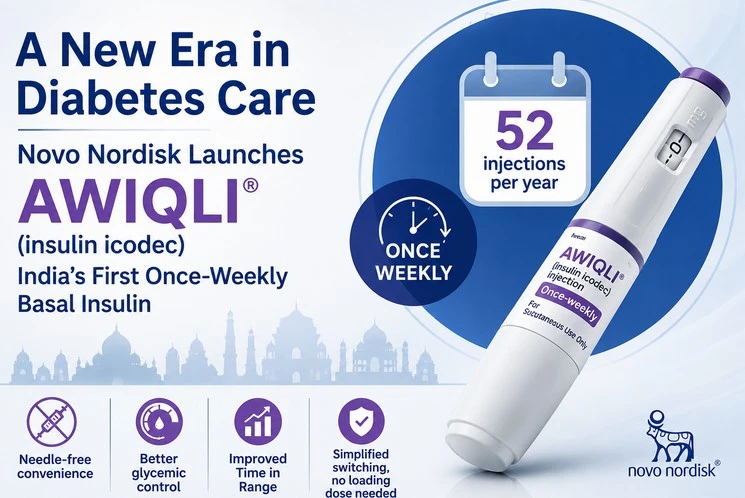
Novo Nordisk has launched Awiqli® (insulin icodec) in India, making the country one of the first in the world to offer the first once-weekly basal insulin for adults with diabetes. The launch represents a major shift in diabetes management, reducing the number of annual basal insulin injections from 365 to just 52.
Why Does This Matter?
India is often referred to as the diabetes capital of the world, with more than 100 million people living with diabetes. Yet insulin therapy is frequently delayed—even when clinically indicated.
Studies suggest that many patients start insulin 7–9 years later than recommended, largely because of concerns about daily injections, treatment complexity, and psychological resistance, a phenomenon known as therapeutic inertia.
By reducing injection frequency to once a week, insulin icodec has the potential to simplify treatment and improve adherence for many patients who require basal insulin.
What Is Insulin Icodec?
Insulin icodec is an ultra-long-acting basal insulin analogue developed by Novo Nordisk.
Unlike rapid-acting insulin used around meals, basal insulin provides a continuous background level of insulin throughout the day and night to maintain stable blood glucose levels.
The innovation behind insulin icodec lies in its molecular engineering.
Researchers modified the insulin molecule by introducing three amino acid substitutions and attaching a fatty diacid side chain that binds strongly—but reversibly—to albumin, the most abundant protein in blood. This creates a circulating reservoir of insulin that is released slowly over the course of a week.
As a result, insulin icodec has a half-life of more than eight days, making once-weekly dosing possible.
How Effective Is It?
The approval of Awiqli is supported by Novo Nordisk’s global ONWARDS clinical trial programme, which evaluated insulin icodec across diverse populations with type 2 diabetes.
Across multiple Phase 3 studies, once-weekly insulin icodec demonstrated:
- Glycemic control that was non-inferior or superior to once-daily basal insulins in several patient groups.
- Significant reductions in HbA1c, the standard marker of long-term blood glucose control.
- Improved Time in Range (TIR)—the percentage of time blood glucose remains within the target range. In some studies, patients gained approximately four additional hours per day within the recommended glucose range compared with insulin glargine U100.
- Simplified switching from daily basal insulin without requiring a loading dose in the recently reported ONWARDS 10 study.
A Different Way to Think About Insulin
The significance of Awiqli extends beyond convenience.
Poor adherence to basal insulin remains a major challenge worldwide. Daily injections can create treatment fatigue, leading patients to skip doses or delay initiation altogether.
By requiring only one injection every week, insulin icodec may reduce the psychological burden associated with insulin therapy while maintaining effective glucose control.
Experts believe this simplified regimen could particularly benefit adults with type 2 diabetes who struggle to remain consistent with daily injections.
Who Is It For?
Awiqli is approved as a once-weekly basal insulin for adults with diabetes requiring basal insulin therapy. In the United States, the current FDA-approved indication is for adults with type 2 diabetes, where it is used alongside diet and exercise to improve glycemic control.
Like other basal insulins, it provides background insulin coverage and does not replace rapid-acting mealtime insulin in patients who require prandial insulin.
Treatment decisions should always be individualized based on clinical assessment and physician guidance.
India Among the Earliest Launch Markets
Novo Nordisk’s decision to introduce Awiqli in India soon after its global approvals reflects the country’s growing importance in diabetes care and innovation.
According to the company, Awiqli will be available in prefilled FlexTouch® pens. India is among the earliest countries to commercialize the product following approvals in the United States, Europe, and several other markets.
Reports indicate that Novo Nordisk has priced the therapy competitively with existing daily basal insulin options, aiming to improve accessibility for Indian patients.
Not a Cure—But a Significant Step Forward
Although insulin icodec does not eliminate the need for insulin therapy, it represents one of the most important innovations in basal insulin since the introduction of long-acting insulin analogues.
For millions of people living with diabetes, the possibility of replacing daily injections with a once-weekly regimen could improve convenience, adherence, and overall treatment experience.
Whether this ultimately translates into better long-term outcomes in routine clinical practice remains to be seen. However, insulin icodec has already changed the conversation around what insulin therapy can look like.
For many patients, the biggest breakthrough may not simply be a new insulin molecule—but a simpler way to live with diabetes.
Key Facts
- Brand name: Awiqli®
- Generic name: Insulin icodec
- Developer: Novo Nordisk
- Type: Ultra-long-acting basal insulin analogue
- Dosing: Once weekly
- Injection frequency: 52 injections/year instead of 365
- Current U.S. indication: Adults with type 2 diabetes
- India: One of the first countries to launch Awiqli commercially
References
- Novo Nordisk. Awiqli® official information.
- ONWARDS Phase 3 clinical programme.
- FDA approval information for insulin icodec.
- Reports on the launch of Awiqli in India.