


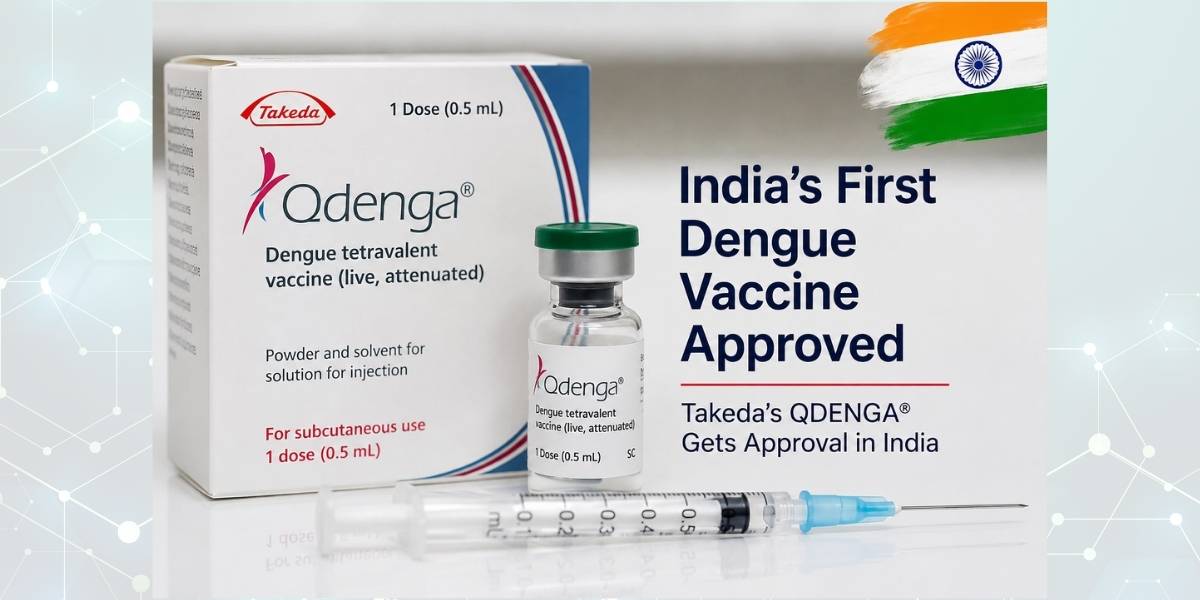
Takeda’s QDENGA Becomes the First Dengue Vaccine Approved in India
Landmark approval brings India’s first licensed dengue vaccine capable of protecting against all four dengue virus serotypes
India has approved its first dengue vaccine, marking a significant milestone in the country’s fight against one of its fastest-growing mosquito-borne diseases.
The Central Drugs Standard Control Organisation (CDSCO) has approved QDENGA® (TAK-003), developed by Japanese pharmaceutical company Takeda, for the prevention of dengue in individuals aged 4 to 60 years. The approval makes India the 44th country to authorize the vaccine and represents the first dengue vaccine available for use in the country.
The approval comes as dengue cases continue to rise worldwide, with the World Health Organization (WHO) reporting a record 14.4 million dengue infections and more than 11,000 deaths globally in 2024. India alone recorded over 232,000 reported cases and 233 deaths, although experts believe the true burden is substantially higher due to underreporting.
A Vaccine Against All Four Dengue Viruses
One of the biggest challenges in developing dengue vaccines is that the disease is caused by four distinct virus serotypes (DENV-1 to DENV-4).
Infection with one serotype provides long-term protection only against that specific type. A subsequent infection with a different serotype can increase the risk of severe dengue due to a phenomenon known as antibody-dependent enhancement (ADE).
This biological complexity has made dengue vaccine development particularly challenging.
QDENGA is a live attenuated tetravalent vaccine designed to generate immunity against all four dengue virus serotypes, helping reduce the risk of symptomatic disease and severe outcomes.
Clinical Trial Results
The approval is supported by Takeda’s global Phase III TIDES clinical trial, one of the largest dengue vaccine studies conducted to date.
The vaccine demonstrated:
- 80.2% efficacy against laboratory-confirmed dengue one year after the second dose.
- 90.4% efficacy in preventing dengue-related hospitalization 18 months after vaccination.
Protection against severe disease and hospitalization is considered one of the most important public health goals because severe dengue can rapidly become life-threatening.
No Need for Prior Dengue Infection
Perhaps the most important advantage of QDENGA is that it can be administered regardless of whether a person has previously been infected with dengue.
This distinguishes it from Sanofi’s Dengvaxia, the first licensed dengue vaccine globally.
Dengvaxia is recommended only for individuals with confirmed previous dengue infection because vaccination of dengue-naïve individuals was associated with an increased risk of severe dengue during subsequent natural infections.
As a result, Dengvaxia requires pre-vaccination testing, limiting its widespread use.
QDENGA eliminates this requirement, making vaccination programs considerably simpler.
Dosing Schedule
QDENGA is administered as:
- Two doses
- 0.5 mL per dose
- Three months apart
The vaccine is approved for individuals 4–60 years of age.
Manufacturing in India
Takeda has partnered with Biological E. Limited in 2024 to support manufacturing and supply in India.
The collaboration is expected to strengthen local production capacity and improve vaccine availability as demand increases.
Will It Prevent Dengue Outbreaks?
While the approval represents a major advance, experts caution that vaccination alone will not eliminate dengue.
The disease is transmitted by Aedes mosquitoes, whose populations continue to expand because of urbanization, climate change, and changing rainfall patterns.
“QDENGA can help reduce disease severity and hospitalizations, but it is unlikely to prevent outbreaks as long as the mosquito vector continues to circulate,” infectious disease specialist Dr. Divya K.S. of Apollo Hospitals told Reuters.
Vector control—including eliminating mosquito breeding sites—will remain essential alongside vaccination.
Why Dengue Vaccines Have Been Difficult to Develop
Dengue vaccine development has taken decades because of several unique scientific challenges.
Unlike many viral diseases, dengue immunity is highly complex.
Researchers must ensure that vaccines generate balanced immune responses against all four serotypes while avoiding immune responses that could increase disease severity after later infections.
Large efficacy studies also require years of follow-up across multiple countries because dengue transmission varies seasonally and geographically.
These challenges continue to affect other vaccine developers, including several Indian companies currently advancing dengue vaccine candidates through clinical trials.
What This Means for India
India has witnessed an 11-fold increase in reported dengue cases over the past two decades, making effective preventive strategies increasingly important.
The approval of QDENGA provides clinicians with the country’s first licensed vaccine option against dengue and represents a major addition to existing public health measures focused on mosquito control and early diagnosis.
Although real-world effectiveness will continue to be monitored following rollout, the availability of a vaccine capable of protecting against all four dengue serotypes—and usable without prior infection testing—marks an important step forward in dengue prevention.
As dengue continues to expand globally, QDENGA may become an important component of integrated disease control strategies alongside surveillance, vector management, and community awareness.
Key Highlights
- First dengue vaccine approved in India
- Vaccine: QDENGA® (TAK-003)
- Developer: Takeda Pharmaceutical
- Age group: 4–60 years
- Protection: All four dengue virus serotypes
- Schedule: Two doses, three months apart
- Prior dengue infection required? No
- Reported efficacy: 80.2% against symptomatic dengue; 90.4% against dengue-related hospitalization