

FDA Approves First Treatment for Limb-Girdle Muscular Dystrophy, Opening a New Chapter in Rare-Disease Care
Today in Science | TIS 002 | BIOPATRIKA | 24 November 2026
The US Food and Drug Administration (FDA) has approved Welgemda (ribitol), an oral medicine developed by BridgeBio Pharma, for adults and children weighing at least 30 kg with limb-girdle muscular dystrophy type 2I/R9 (LGMD2I/R9). The approval, announced on 23 November 2026, marks a significant milestone: Welgemda is the first approved treatment for LGMD2I/R9 and the first therapy approved for any form of limb-girdle muscular dystrophy (LGMD). For patients and families who have largely depended on supportive care, the decision introduces a treatment designed to address an underlying molecular defect associated with the disease.
LGMD refers to a group of inherited neuromuscular disorders characterised by progressive weakness and wasting of muscles around the hips and shoulders. The disease can gradually affect mobility, making everyday activities such as climbing stairs, walking, lifting the arms and getting up from a seated position increasingly difficult. Depending on the genetic subtype, respiratory muscles and the heart may also become affected. LGMD2I/R9 is associated with mutations in the FKRP gene, which encodes the fukutin-related protein.
Understanding the molecular defect
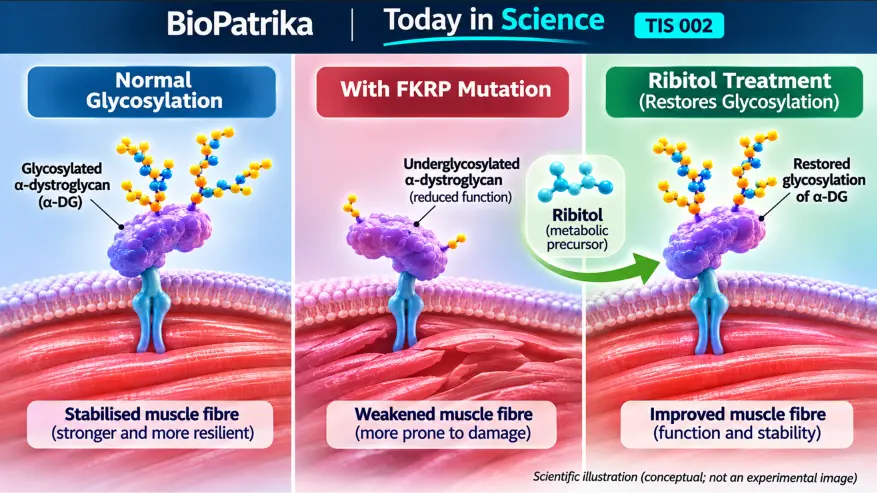
To understand how Welgemda works, it is important to look at a protein called alpha-dystroglycan (α-DG). This protein is present on the surface of muscle cells and plays an important role in connecting the internal structural framework of a muscle cell to the surrounding extracellular matrix. This connection helps muscle fibres withstand the mechanical stress generated during repeated contraction and relaxation.
Alpha-dystroglycan requires the addition of specific sugar structures, a process known as glycosylation, to perform this function effectively. The FKRP enzyme participates in this process by helping generate and transfer essential components of the sugar structure. When mutations reduce FKRP activity, alpha-dystroglycan becomes inadequately glycosylated. Its ability to interact with surrounding structural proteins is compromised, leaving muscle fibres more vulnerable to damage.
Over time, repeated muscle injury contributes to progressive weakness and loss of function. This is the central biological problem that Welgemda is designed to address.
Welgemda contains ribitol, a naturally occurring sugar alcohol that serves as a metabolic precursor in the pathway required for alpha-dystroglycan glycosylation. By supplying additional ribitol, the treatment aims to increase the availability of substrates needed by the residual activity of the altered FKRP enzyme. The objective is to improve alpha-dystroglycan glycosylation and strengthen its function in muscle cells.
This approach is particularly interesting because it does not attempt to replace the mutated gene directly. Instead, it seeks to compensate for the biochemical consequences of reduced enzyme activity. It represents an example of how understanding the molecular pathway underlying an inherited disorder can reveal therapeutic opportunities beyond conventional symptom management.
What did the clinical trials show?
The FDA approval was supported by results from FORTIFY, a Phase 3 clinical trial evaluating BBP-418, the development name for ribitol, in people living with LGMD2I/R9.
The trial assessed both biological markers and measures of physical function. One important endpoint was the level of glycosylated alpha-dystroglycan. At three months, treatment increased this marker approximately 1.8-fold compared with placebo. The improvement was sustained through 12 months, providing evidence that the drug was influencing the intended biological pathway.
Importantly, the findings extended beyond a molecular marker. At 12 months, participants receiving Welgemda demonstrated a treatment difference of approximately 0.27 metres per second in walking speed, measured using the 100-metre timed test, compared with placebo. The treatment group also showed an approximately 4.9-percentage-point advantage in predicted forced vital capacity, a measure of pulmonary function. Serum creatine kinase, an indicator of muscle damage, also improved. These findings suggest potential benefits across mobility and respiratory function.
The results are encouraging because they connect changes at the molecular level with outcomes that matter in patients’ daily lives. Nevertheless, the distinction between an improvement in clinical trial measurements and long-term preservation of independence remains important. The ongoing FORTIFY follow-up will help establish whether these benefits are sustained over a longer period.
What comes next?
The approval is an important step forward, but it does not mean that LGMD2I/R9 has been cured. The treatment is currently approved in the United States for eligible adults and paediatric patients weighing at least 30 kg. Its availability in other countries will depend on separate regulatory reviews.
BridgeBio plans to pursue European regulatory approval in 2028, supported by longer-term data from FORTIFY. The company has also indicated plans to investigate the treatment in younger children and explore its potential in other genetically distinct forms of muscular dystrophy. These possibilities will require additional clinical evidence and regulatory assessment.
For the broader rare-disease field, the approval illustrates the value of targeting the molecular consequences of genetic mutations. It also highlights the importance of clinical trials that measure not only whether a drug changes a biological marker, but whether that change translates into meaningful functional improvements.
For people living with LGMD2I/R9, the significance is immediate: a disease-specific treatment option is now available where none existed before. The next challenge will be to establish its long-term benefits, expand access and determine whether similar metabolic strategies can help address other inherited muscle disorders.